


Key Takeaways
- The Toptracer vs. TrackMan decision is not about accuracy; it’s about which system’s technology, data depth, and cost structure best fits your facility’s business model.
- Toptracer uses cameras mounted above the hitting bays to track ball flight, making it ideal for entertainment and engagement. TrackMan uses dual-radar behind the bay to measure club and ball data, making it the standard for instruction and fitting.
- The two systems are usually deployed differently. Toptracer Range typically runs on a recurring licensing model across every bay, while most facilities buy portable TrackMan units as capital equipment for a few dedicated teaching bays. TrackMan also offers a range-wide system that competes with Toptracer head to head.
- The data gap is significant. TrackMan provides 20+ club and ball metrics essential for teaching pros (like club path and face angle), while Toptracer provides around 8 ball-flight metrics.
- Neither system addresses the physical tee-line experience. The highest-performing facilities pair digital tracking with automated teeing to reduce friction and increase ball throughput.
Most comparisons of Toptracer vs. TrackMan start and end with accuracy. For a facility operator, that’s the wrong place to begin. Both systems track a golf ball with more than enough precision for recreational practice, and even for serious game improvement. The debate over which is a yard more accurate on a well-struck 6-iron misses the point entirely for the person signing the check.
The real differences the ones that impact your P&L, your staffing model, and your customer retention are in the underlying technology, the deployment model, the ongoing cost structure, and the depth of data available to your instructors. The strongest approach treats ball tracking and the physical hitting experience as two halves of the same system, because a screen full of data means little to a golfer whose rhythm is broken by a worn mat or manual re-teeing between every shot.
This comparison is written for the owner, operator, or director of golf evaluating a six-figure tee-line investment. It bypasses the golfer-facing hype to focus on what you actually need to know to make a sound capital decision.
How Toptracer and TrackMan Actually Track the Ball
The core difference between these two systems isn’t software; it’s physics. Toptracer and TrackMan collect fundamentally different information because they observe the shot from different positions using different methods. This distinction shapes everything from the data your instructors can access to the infrastructure you’ll need to install.
Imagine a golfer hitting a 7-iron. Toptracer’s cameras, mounted above the bays and looking out over the range, follow the ball’s flight path to its landing. TrackMan’s radar, positioned behind the golfer, directly measures the club and ball at the moment of impact before the ball even reaches its apex. One watches the result; the other measures the cause.
Toptracer: Camera-Based Tracking from Above the Bays
Toptracer uses a series of high-speed cameras, typically mounted on the roof or structure above the hitting bays, to optically track every ball hit from every bay. The system triangulates the ball’s position in real-time throughout its flight, calculating key ball flight parameters like carry distance, total distance, ball speed, launch angle, and apex. This is the same core technology that powers the ubiquitous shot-tracing graphics on PGA Tour broadcasts, which serves as a constant validation of its flight-path reliability.
However, because Toptracer’s camera-based system tracks the ball in flight only, it must infer certain data points. Spin rate, for example, is calculated based on the observed shape of the trajectory, not measured directly. For most golfers and entertainment applications, this inferred data is perfectly sufficient. But for high-level instruction or fitting, it’s a critical distinction.
TrackMan: Dual-Radar Measurement from Behind the Golfer
TrackMan technology, specifically the TrackMan 4 unit common at commercial facilities, uses a patented dual-radar system. It sits on the ground behind the hitting bay and performs two jobs simultaneously. One radar system tracks the clubhead as it approaches the ball, measuring metrics like club head speed, club path, face angle at impact, and attack angle. The second radar tracks the ball from the moment it leaves the clubface, directly measuring ball speed, launch angle, spin rate, and spin axis using the Doppler effect.
This architecture means TrackMan captures both cause (club delivery) and effect (ball flight). It doesn’t infer or estimate club data; it measures it. This comprehensive data capture is why TrackMan has become the gold standard for PGA Tour players, elite instructors, and professional club fitters. That depth, however, may be more than a casual entertainment-focused range bay requires.
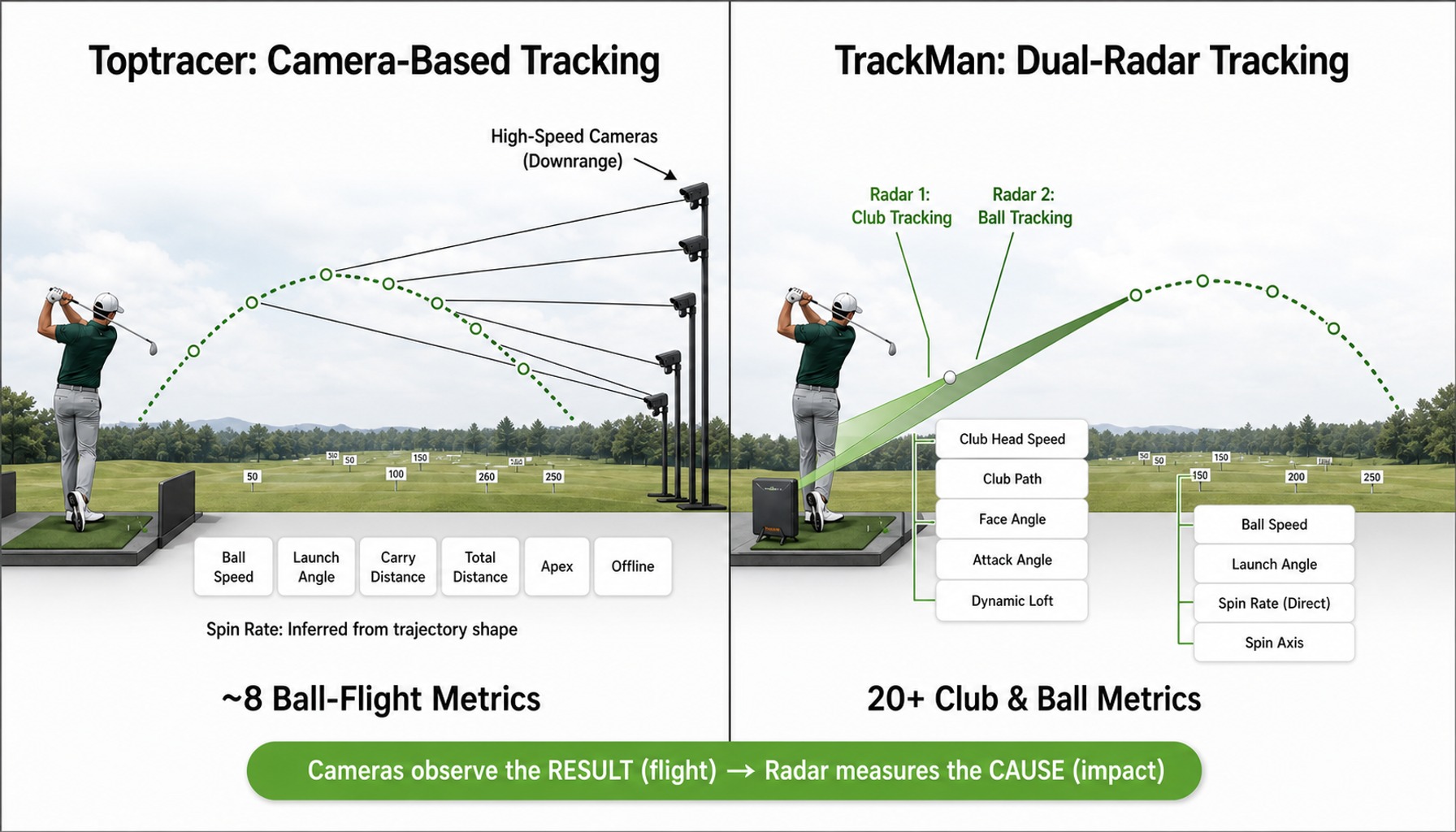
Toptracer vs TrackMan comes down to cameras watching flight versus radar measuring impact.
What Data Each System Gives Your Golfers and Instructors
The data-point gap is where the operational difference between these systems becomes clearest. It’s not about whether one system’s carry distance is off by a yard; it’s about whether your teaching professionals can diagnose a swing flaw or if a fitter can validate a new driver.
Toptracer provides a solid set of around 8 essential ball-flight metrics: ball speed, launch angle, apex, carry distance, total distance, offline dispersion, and hang time. This is more than enough to show a golfer how far they hit the ball and in which direction, fueling competition and practice.
TrackMan, by contrast, provides over 20 metrics spanning both club delivery and ball flight. In addition to all the ball-flight data, it adds the club data that instructors depend on: club head speed, smash factor, attack angle, dynamic loft, and most critically, club path and face angle.
Picture a lesson program at a public facility where the instructor uses a portable TrackMan, while the range’s bay-mounted screens give students instant visual feedback from Toptracer but lack the club-delivery metrics needed to diagnose the swing fault. The instructor can see the slice on the screen, but only the radar can reveal the out-to-in path and open clubface that caused it. Neither system, on its own, fully solves the teaching workflow.
For an operator, the takeaway is simple: if your facility’s revenue model relies heavily on instruction, player development programs, or hosting paid fitting events, the club-delivery data from a system like TrackMan is a non-negotiable tool. If your model is built around recreational practice, social leagues, and family entertainment, Toptracer’s ball-flight data and engaging game modes are often the more strategic fit.
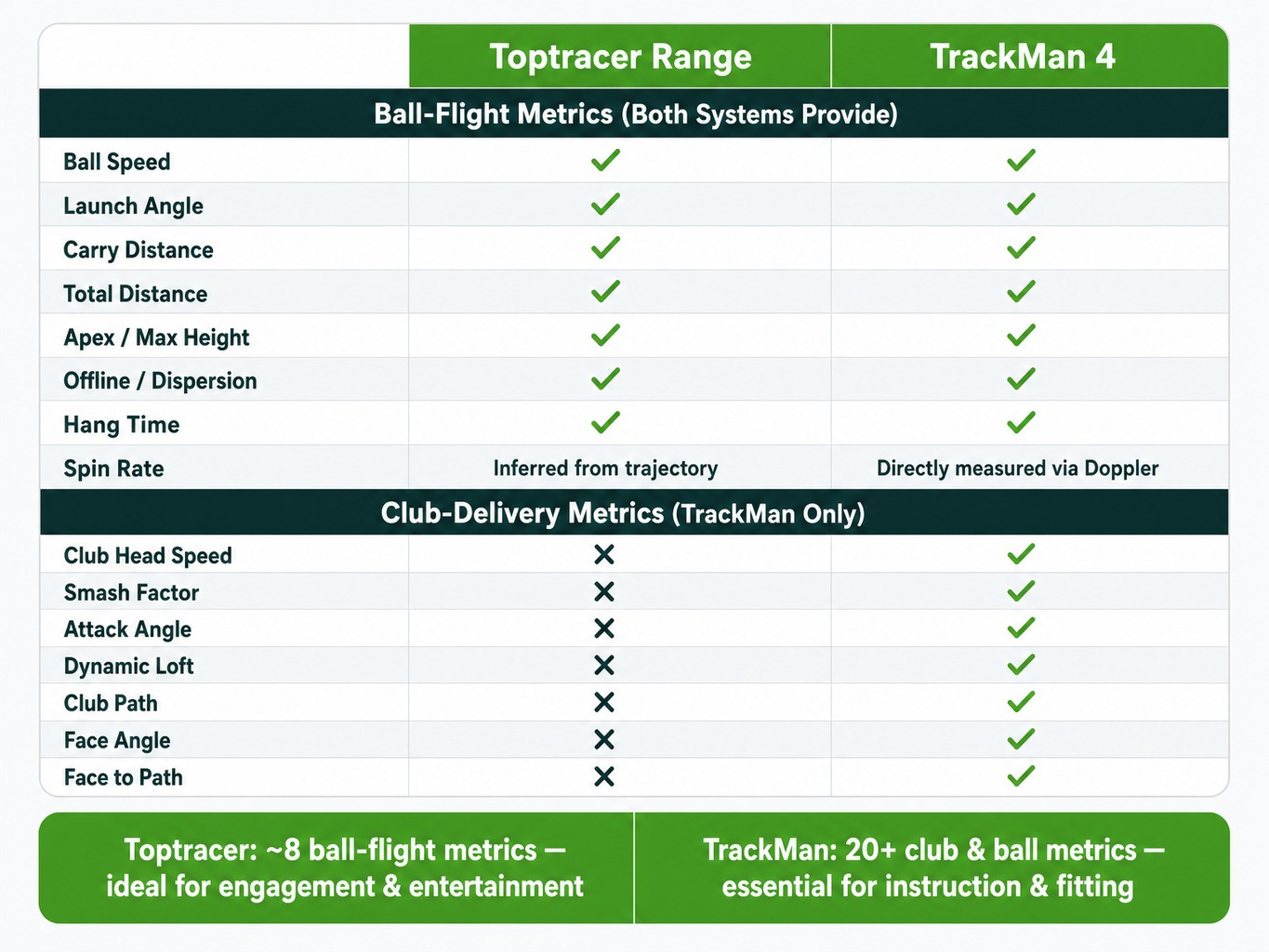
The data gap between Toptracer and TrackMan lives entirely in club-delivery metrics.
The Infrastructure and Cost Gap Operators Underestimate
The price a golfer pays for a bucket of balls tells you almost nothing about the true cost of deploying either technology. The sticker price of the hardware is only the beginning. Toptracer and TrackMan operate on fundamentally different business models, and understanding this is critical to any financial projection. A Toptracer installation is fundamentally a per-bay fixed infrastructure project with ongoing licensing, while a portable TrackMan unit is a capital asset that can move between bays.
Toptracer Range is typically deployed as a subscription or licensing service. A facility commits to an ongoing fee, and Toptracer provides the camera hardware, software, and network infrastructure for a set number of bays. This model turns the technology into a predictable operating expense. The infrastructure requirements include stable mounting points for cameras, power and data cabling to every bay, and bay-mounted screens.
TrackMan units, on the other hand, are generally purchased as capital equipment. A TrackMan 4 unit is widely understood to be a capital asset costing in the range of $25,000 or more. Because of this cost, most facilities buy one or two units and offer them as a premium, supervised service for lessons or fittings, rather than outfitting every bay. The ongoing costs are less about subscription fees and more about warranty, periodic calibration, and the labor cost of the trained professional required to operate a session.
Consider a 20-bay range. A Toptracer deployment would likely involve outfitting all 20 bays with screens and cameras under a multi-year licensing agreement. The same facility considering TrackMan would probably buy one or two units, dedicate specific bays for their use, and build a pricing structure around by-the-hour supervised sessions. These are not interchangeable options; they are completely different business strategies.
Where Each System Fits in a Facility’s Practice Model
The right choice isn’t about which technology is “better.” It’s about which system aligns with your facility’s primary goals for its practice area. In fact, many of the most successful facilities have stopped asking “which one?” and instead deploy both for different purposes.
Scenario 1: The Engagement & Entertainment-Led Facility
If your primary goal is to increase bay utilization, attract casual golfers and families, and drive food and beverage sales through longer stays, Toptracer Range is almost always the stronger fit. Its ecosystem of games (like virtual golf courses and closest-to-the-pin contests), global leaderboards, and user-friendly app are designed to drive engagement and repeat visits across all skill levels. It turns a solitary practice session into a social, shareable experience.
Scenario 2: The Instruction & Performance-Focused Facility
If your facility is known for its strong teaching program, hosts regular club fittings, or serves a clientele of competitive golfers, TrackMan is the standard. The depth of its club delivery data gives instructors the diagnostic tools they need to create real improvement. For this segment, the ability to see face-to-path relationships and attack angle is far more valuable than any game mode.
Scenario 3: The Hybrid Model (Complementary Deployment)
Many high-volume facilities are finding the most profitable model is a hybrid one. They install Toptracer across most or all of their public-facing bays to capture the entertainment and engagement revenue. At the same time, they purchase one or two TrackMan units for dedicated teaching bays, offering supervised sessions at a premium price point. This isn’t redundancy; it’s market segmentation, allowing the facility to serve both the social golfer and the serious player effectively.
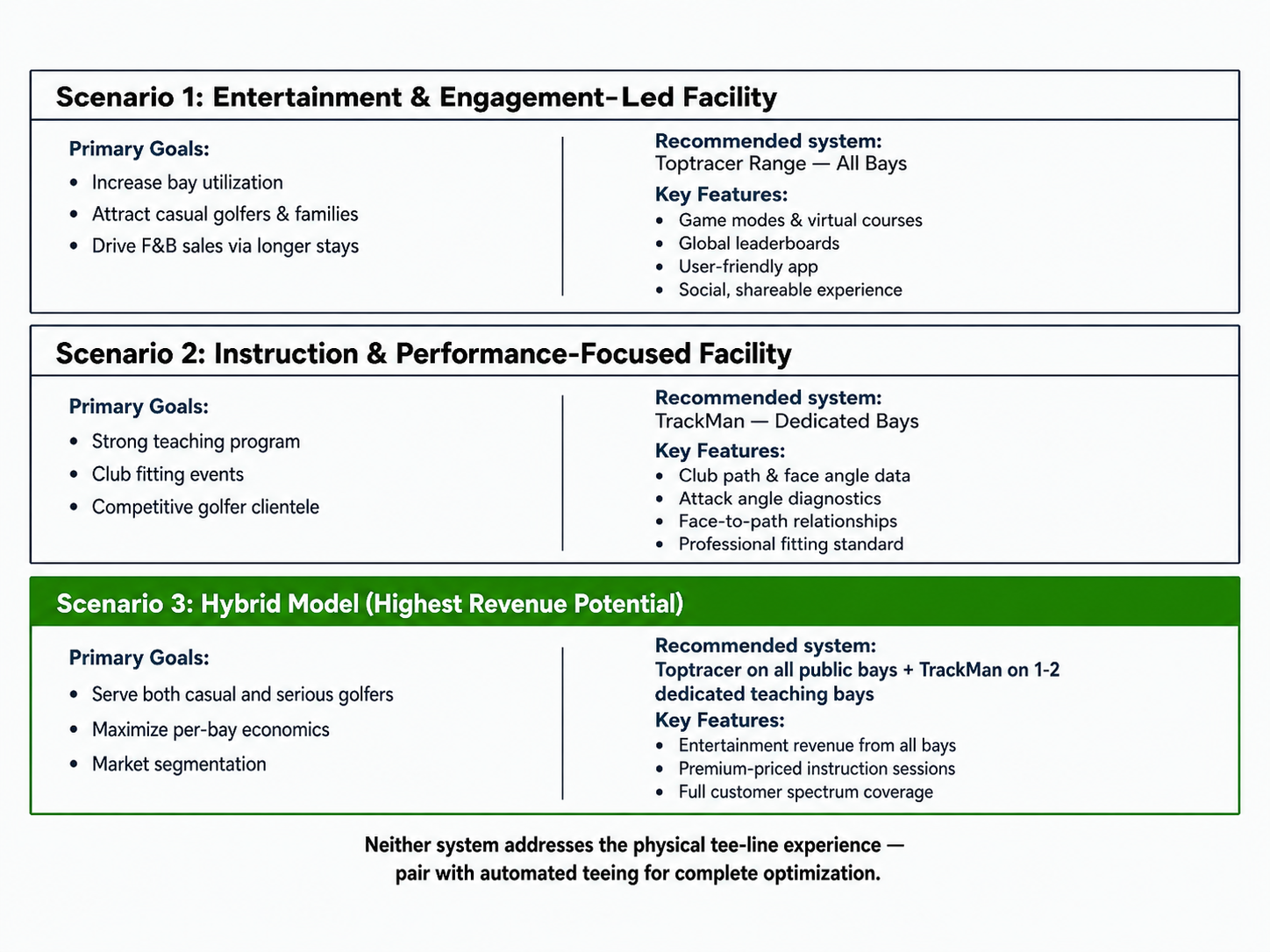
Choosing Toptracer vs TrackMan depends on your facility’s revenue model, not accuracy.
The Layer Neither Tracking System Addresses: The Physical Tee-Line Experience
Whether you choose Toptracer, TrackMan, or both, you are making a significant investment to upgrade the digital layer of your practice experience. But this often creates a jarring disconnect for the golfer. Toptracer provides excellent feedback, yet golfers often spend extra time looking at the screen after each shot, which can naturally slow their hitting pace and reduce the number of balls hit per hour. When that pause is combined with manual re-teeing on worn, inconsistent range tees, the rhythm of the session breaks down even further.
This is the gap Power Tee was built to fill. As a specialist in the complete tee-line experience, Power Tee resolves the friction neither tracking system can. Our patented automatic teeing system, paired with commercial-grade hitting and standing mats, ensures the physical practice environment matches the quality of the digital one. The system tees up a new ball at a consistent, adjustable height the moment the last one is hit, which helps speed the golfer between shots and keeps the session moving.
This allows golfers to maintain their practice rhythm and hit more quality shots per session, even while enjoying all the feedback and entertainment Toptracer provides. Power Tee complements ball-tracking technology like Toptracer, TrackMan, and InRange by automating the teeing process, so golfers at tracking-equipped facilities can move efficiently from one shot to the next and act on the data they see on the screen faster and more effectively. For operators, that means a more premium tee-line experience that helps protect ball volume per session while preserving the value of the digital investment. Power Tee customers often report revenue increases between 30% to 50% after installation, along with stronger food and beverage sales, because the seamless experience encourages longer stays and more frequent return visits.
A tracking system tells a golfer what happened. An automated teeing system helps them respond to that feedback without losing momentum.
Request a facility consultation to see how automatic teeing fits your range.
It’s About Fit, Not Just Flight
Ultimately, the Toptracer vs. TrackMan decision is not about which system is more accurate. It’s a strategic choice about which deployment model, data depth, and cost structure best fits your facility’s business goals. Camera-based entertainment engines and radar-based diagnostic tools serve different and often complementary purposes.
The comparison most operators miss, however, isn’t digital. It’s the physical reality of the tee line. An investment in a state-of-the-art tracking system can be undermined by a 1990s practice experience. The facilities that will win in the coming years are those that understand the tee line is a complete operating system, where digital tracking, physical surfaces, and automated teeing must work together to create a truly premium, frictionless experience.
Frequently Asked Questions
How accurate is Toptracer compared to TrackMan for measuring spin rate?
Toptracer infers spin rate from the ball’s observed trajectory using cameras, while TrackMan measures it directly at launch with Doppler radar. For drivers and long irons, where trajectory differences are clear, Toptracer’s estimate is quite reliable. For wedges and short irons, where small spin changes are critical and trajectories are similar, TrackMan’s direct measurement is significantly more precise and trusted by professionals for dialing in short-game performance.
Can Toptracer data be used for a professional club fitting?
Most professional fitters require launch monitors that directly measure club delivery data like face angle, club path, and attack angle to understand why a ball is flying a certain way. Since Toptracer does not capture these club metrics, it is not considered a primary tool for professional fittings. The industry standards for fitting, like TrackMan and Foresight GCQuad, are built around capturing this essential cause-and-effect data at impact.
Is Toptracer Range free to use at driving ranges?
For the golfer, yes, the use of Toptracer Range is typically included in the price of a bucket of balls or a timed bay rental. The facility itself pays Toptracer a recurring subscription or licensing fee to have the system installed and maintained. Some venues may offer premium pricing for Toptracer-equipped bays, but there is no separate fee paid by the golfer directly to Toptracer.
Does Toptracer work well in windy or rainy conditions?
Because Toptracer’s cameras track the ball’s actual flight path, the system can accurately show how wind affects the shot. However, its performance can be degraded by heavy rain, fog, or poor visibility, as the cameras need to optically “see” the ball to track it. TrackMan’s radar is generally unaffected by visibility, and outdoors it tracks the ball’s full flight, so wind effects show up in its data as well.
Can a facility run both Toptracer and TrackMan on the same range?
Yes, and this is an increasingly common and effective strategy. A typical hybrid model involves installing Toptracer across all general-use bays to drive engagement and throughput, while reserving one or two dedicated bays for TrackMan units. These are then used for premium-priced instruction, professional fittings, and player-development programs. The two systems serve different customer segments and are fully complementary.
How do Toptracer and TrackMan compare to Foresight GCQuad for accuracy?
Foresight GCQuad uses a high-speed, quadrascopic camera system positioned in front of the golfer to directly photograph the club and ball at impact. This photometric method is extremely accurate for both club and ball data, making it a gold standard, especially for indoor use. TrackMan’s dual-radar is comparably accurate outdoors. Toptracer is designed for mass-scale range deployment and entertainment, so a direct accuracy comparison with a single-bay diagnostic tool like GCQuad isn’t an apples-to-apples evaluation.


