


Key Takeaways
- Deferred maintenance is the biggest hidden cost of ownership. Aging irrigation, drainage, and turf equipment can require seven-figure capital investment, so plan reserves before the bill arrives.
- Courses relying on greens fees for more than 65% of revenue are financially fragile. Profitability comes from ancillary streams: food and beverage, events, and especially the practice facility.
- Owner income varies dramatically, from under $60,000 for struggling daily-fee operators to over $500,000 for owners of well-run, diversified clubs. Your debt load and ancillary revenue mix are the biggest factors.
- Hidden operating costs like water, labor, seasonal cash flow, and compliance erode margins faster than most budgets assume. Build reserves for them before they hit.
- The practice facility is often the most underleveraged asset. Upgrading it with automation to increase throughput and session frequency is one of the most direct paths to improving a course’s financial model.
Most golf course owners know their green fees and round counts to the decimal. Far fewer know how their revenue mix, cost structure, and owner income compare with well-run facilities, or where the next dollar of profit is most likely to come from.
The numbers bear this out. While golf participation remains strong, hundreds of courses have closed or changed hands in the past decade, not because the game is failing, but because owners misjudged the financial model. They bought a listing price, not an operating business.
The truth about owning a golf course is that it’s a capital-intensive, operationally demanding venture closer to running a small resort than managing a stock portfolio. Success requires a deep understanding of what a course truly costs, where its revenue actually comes from, and which hidden expenses can quietly erode every dollar of profit.
This guide is written for owners and operators who already run a course. We’ll cover the real cost of keeping a facility competitive, which revenue streams drive profit, the hidden expenses that erode margins, and how owner income compares across facility types.
What It Really Costs to Keep a Golf Course Competitive
The biggest costs of ownership rarely show up in a single year’s P&L. They build up quietly as deferred capital expenditures, and they decide whether a facility can stay competitive over the next decade.
The Deferred Maintenance Trap
Deferred maintenance is the silent deal-breaker in golf course acquisitions. It’s not uncommon during due diligence on a listed 18-hole course to find that the broker’s financials show healthy revenue but conveniently omit that the irrigation system’s pump station is original to 1987. Sellers often delay critical capital expenditures to inflate short-term cash flow, leaving the new owner with a massive bill.
A course listed at $2.5M with a 25-year-old irrigation system is really a $3.5M acquisition once you account for the capital you will spend in the first three years. Broker-listed EBITDA figures almost always use “add-backs” that assume a new owner will eliminate the seller’s discretionary expenses, but they rarely adjust downward for the deferred capital expenditures the seller avoided.
Key items to scrutinize with an independent capital reserve study include:
- Irrigation System: A full replacement can cost $500,000 to over $2 million and is the single largest hidden liability. The age of the pump station and mainline matters more than the cosmetic condition of the greens.
- Drainage Infrastructure: Poor drainage limits playable days and directly impacts revenue.
- Cart Paths: Resurfacing costs can run into the hundreds of thousands.
- Bunker Renovation: Including liner replacement, this is a major expense many clubs defer.
- Turf Equipment Fleet: A well-maintained fleet requires a consistent replacement cycle, and a neglected one can cost $200,000+ to catch up.
Lenders understand this, which is why they focus on the debt service coverage ratio (DSCR) a measure of whether the property’s cash flow can cover its debt payments after accounting for necessary capital expenditures. A smart owner plans the same way.
Where Golf Course Revenue Actually Comes From
Many owners focus on greens fees as the primary revenue driver. In reality, courses that depend solely on tee times are the most financially vulnerable. The most profitable facilities are those that have mastered ancillary revenue. At many well-run courses, greens fees represent only 40-55% of total revenue.
This is because the distinction between a course’s gross revenue per round and its contribution margin per round is where most ownership projections fall apart. A facility can increase rounds played by discounting tee times while simultaneously destroying profitability if the incremental rounds cannibalize full-rate demand and don’t contribute to higher-margin ancillary sales.
Why Greens-Fee Dependency Is the Biggest Financial Risk
Relying on greens fees for more than 65% of your revenue makes your business model structurally fragile. Tee time inventory is finite, constrained by daylight, weather, and pace of play. Even with perfect yield management using dynamic pricing tools from providers like Lightspeed Golf or foreUP to adjust rates based on demand you will eventually hit a capacity ceiling.
A rainy spring or an unusually hot summer can wipe out a huge percentage of your projected annual revenue, but your fixed costs for course maintenance and debt service remain. This is why a diversified revenue model isn’t a “nice-to-have”; it’s a prerequisite for long-term survival.
The Ancillary Revenue Streams That Actually Drive Profit
The courses that thrive financially are those that maximize every revenue opportunity beyond the first tee. An owner who models profitability around greens fees alone will almost certainly undervalue the practice facility, which at well-run courses can generate higher per-square-foot margin than any other amenity on the property, particularly when automated teeing systems like Power Tee increase bay throughput and session frequency during peak hours.
Here are the four ancillary streams that separate profitable courses from the rest:
- Food & Beverage (F&B): This can contribute 20-35% of total revenue. The key metric is F&B capture rate the percentage of golfers who spend money in the clubhouse. A simple snack bar might capture 15%, while a clubhouse with an inviting bar and patio can capture over 50%.
- Practice Facility & Driving Range: Often the most underleveraged asset, a well-run range can generate 5-15% of revenue through ball sales, lessons, and clinics. It functions as a high-margin profit center that doesn’t depend on a four-hour tee time.
- Events & Outings: Corporate outings, weddings, and tournaments can contribute 10-25% of revenue. They provide guaranteed income blocks and introduce new customers to the facility.
- Pro Shop & Merchandise: While a smaller piece of the pie (typically 5-10% of revenue), a well-managed pro shop with appealing merchandise and proper inventory control contributes directly to the bottom line and enhances the club’s brand.
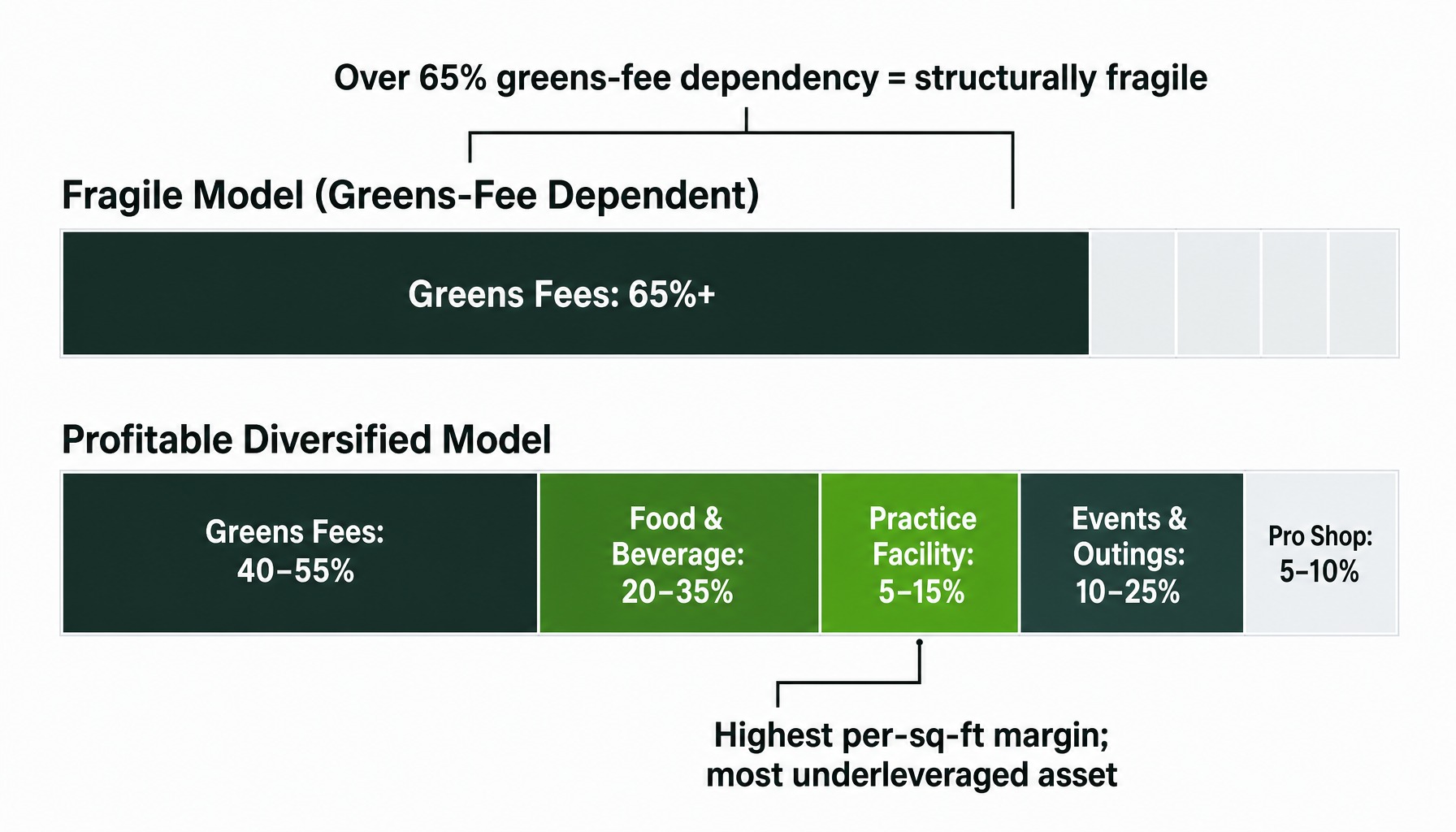
How much golf course owners make depends on diversifying beyond greens fees.
Turning the Practice Facility into a Revenue Engine
The recurring theme for profitable golf courses is the strength of their ancillary revenue, and the practice facility often holds the most untapped potential. Many owners treat the range as a cost center or a simple amenity for warming up. This is a strategic error.
A practice facility that hits over 800,000 balls per year with range tees is leaving measurable revenue on the table. Manual re-teeing interrupts rhythm, slows down the pace of practice, and reduces the number of balls a golfer can hit in a session. This limits bay turnover and, by extension, revenue per bay.
This is where commercial-grade automatic teeing systems transform the financial model of a driving range. By teeing up each ball automatically at a consistent, adjustable height, systems like Power Tee help golfers find their rhythm and hit more balls in less time. This increases ball throughput and bay utilization, turning a passive amenity into an active revenue driver.
Facility-specific results from Power Tee customers point to the same pattern. Some have reported revenue increases of 30% to 50% on their practice facilities after installation. This is often accompanied by a corresponding lift in food and beverage sales, s golfers enjoy the experience more, stay longer, and come back more often.
Power Tee is a complete operating solution a commercial-grade system delivered with premium mats, professional installation, warranty, and ongoing support. It’s an investment in the core infrastructure of your facility’s revenue engine.
The Hidden Costs That Quietly Destroy Golf Course Margins
Most business plans underestimate annual operating expenses because they are built on averages, not the real-world pressures that actually determine survival. Four specific margin killers consistently catch new owners by surprise.
First, water. In many regions, irrigation is the largest variable cost after labor, running from $100,000 to over $500,000 annually. In drought-prone states like California, Arizona, and Texas, water rights and mandatory usage restrictions can make a course financially unviable overnight, regardless of demand. Budgeting for a 10% rate increase is prudent; a 30% increase is a real possibility.
Second, labor. The turf management workforce crisis is real. According to the GCSAA, superintendent compensation continues to rise and finding qualified groundskeeping staff is a constant struggle. A typical 18-hole course needs a maintenance crew of 15-25 people during peak season, representing a significant payroll expense.
Third, seasonal cash flow. It’s not uncommon for courses in northern climates to generate 80% of their annual revenue in just six months. This creates a severe cash-flow trough in the off-season, where fixed costs for debt service, insurance, and a skeleton crew continue to burn cash. A facility that hasn’t built a sufficient working capital reserve can find itself in default by February.
Fourth, environmental compliance. Stormwater management, pesticide application regulations, and habitat preservation requirements add layers of cost and complexity that vary significantly by state and municipality. These are rarely line items in a broker’s pro forma but are a real cost of doing business.
How Much Golf Course Owners Actually Make
Owner income is the clearest benchmark of whether a facility’s financial model is working. The honest answer is: it depends enormously on the facility type, debt load, and operational competence. The fantasy of a seven-figure salary is just that for most.
Here are realistic ranges for annual owner compensation (salary and distributions) after debt service:
- Single Daily-Fee Course Owner: $60,000 to $150,000. Many owners in this category, especially those with heavy debt or significant deferred maintenance, earn less than they would in a salaried general manager role.
- Well-Positioned Private Club or Multi-Course Operator: $200,000 to $500,000+. These owners benefit from stable membership dues, strong ancillary revenue, and economies of scale.
Industry benchmarks suggest a well-run golf facility can achieve a profit margin of 10-15% of gross revenue. However, data from firms like Club Benchmarking shows a massive variance between top-quartile performers and the rest of the industry, many of whom operate at break-even or a slight loss.
Three variables determine where an owner falls on this spectrum:
- Debt Structure: A heavily leveraged acquisition compresses cash flow for years, regardless of how well the course is run.
- Ancillary Revenue Mix: As discussed, courses with strong F&B, event, and practice-facility revenue have higher, more stable margins.
- Operational Efficiency: This includes everything from labor scheduling and turf management practices to the adoption of technology for tee sheet management and marketing.
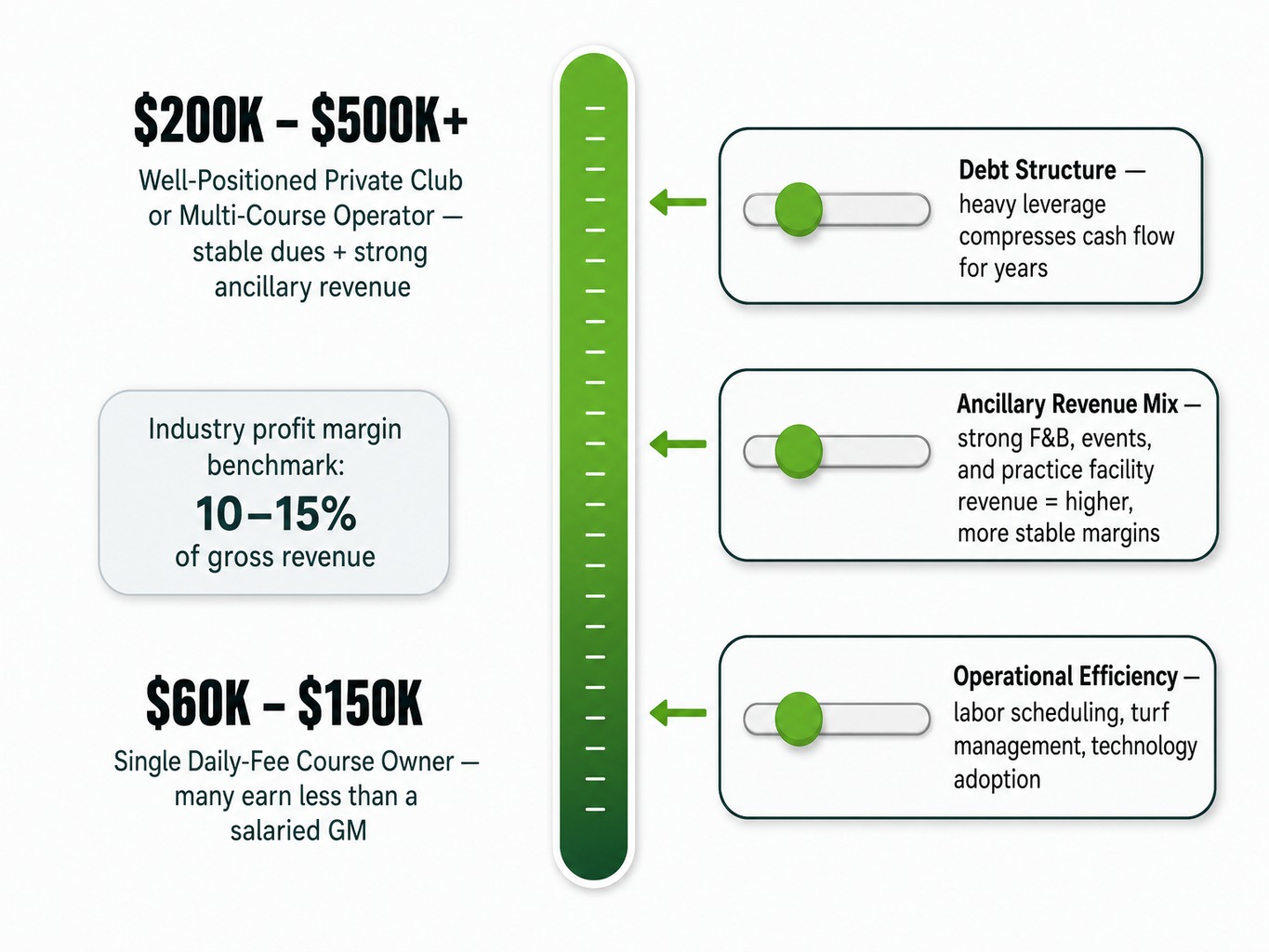
How much do golf course owners make? Three variables decide the answer.
Buying an Existing Golf Course vs. Building from Scratch
For the vast majority of prospective owners, buying an existing course is the superior financial decision. Building a new 18-hole course from raw land is a monumental undertaking, with costs ranging from $10 million to over $30 million and a “grow-in” period of 12-24 months before a single round can be sold. The capital at risk is enormous, and the timeline to cash flow is dangerously long.
Buying an existing facility, even one requiring significant renovation, offers a much faster path to revenue. You acquire an established footprint, a known market, and some level of existing customer base.
The one major exception is when a golf course is the central amenity for a larger residential or resort real estate development. In this model, the course itself can be a “loss leader,” with its construction and operating costs subsidized by high-margin lot sales or premium hotel room rates. Unless you are a real estate developer with a clear plan for the surrounding land, you should be focused on acquiring and improving existing courses.
Can You Own a Golf Course as a Passive Investment?
The short answer is no. Passive golf course ownership is theoretically possible but practically a myth. Most owners who attempt it either become active operators within two years or sell at a loss.
Golf courses are intensely operational businesses. Daily decisions about turf conditions, staff scheduling, weather response, tournament logistics, and customer service do not manage themselves. An absentee owner who isn’t deeply engaged in these details will quickly see standards slip and margins erode.
The management company model exists, but these firms typically charge 3-7% of gross revenue plus incentive fees, which can consume a significant portion of a course’s already-thin profit margin.
The only scenario where semi-passive ownership can work is when an owner hires an exceptional, empowered General Manager or Director of Golf and trusts them to run the entire operation. In this model, the owner acts more like a board chairman, focusing on strategy and capital allocation while leaving the day-to-day to a trusted professional. But even this requires significant oversight and is far from a hands-off investment.
Conclusion
The path to successful golf course ownership is paved with financial discipline, not just passion for the game. It is a capital-intensive operating business where the owners who succeed are those who see the entire facility as a system of interconnected profit centers.
Deferred capital costs never stay deferred. Greens fees alone cannot sustain the business. Hidden operating expenses will erode margins faster than any business plan predicts. And the most successful owners are those who identify and invest in the ancillary revenue streams their competitors neglect especially the practice facility.
Start by benchmarking your facility against the ranges in this article. Stress-test your model against a bad weather year, and decide which ancillary revenue streams you’ll invest in first, starting with the one most owners overlook: the practice facility.
Frequently Asked Questions
How can a golf course increase driving range revenue without adding bays?
What insurance coverage does a golf course owner need?
A comprehensive insurance package includes general liability, property, workers’ compensation, liquor liability, and environmental liability. Many owners also carry business interruption insurance. Premiums for an 18-hole facility typically run from $50,000 to $150,000 annually, depending on location, services offered, and claims history.
How many rounds per year does a golf course need to break even?
This varies widely, but as a benchmark, a daily-fee course with $2M-$3M in annual operating costs often needs 25,000-35,000 rounds to break even. This assumes an average all-in revenue of $70-$100 per round, which includes not just the green fee but also cart rental, merchandise, and F&B spend.
What are the tax advantages of owning a golf course property?
Owners can depreciate improvements like buildings, irrigation systems, and equipment, which can create significant tax shields. Operating expenses are deductible. Conservation easements on undeveloped land can also provide tax benefits. However, land itself is not depreciable. Always consult a CPA with experience in hospitality real estate.
How has the post-pandemic golf boom affected course valuations?
The 2020-2022 surge in play drove valuations up significantly. As of 2026, round counts have normalized from those peaks but remain above pre-pandemic levels. Consequently, valuations have softened slightly but are still strong. Buyers should underwrite deals based on current, sustainable round counts, not the pandemic-era highs.


