


Key Takeaways
- Apply hotel-style yield management to your tee sheet, adjusting green fees based on real-time demand signals like booking velocity and weather, not just static day-of-week tiers.
- Increase food and beverage per-cap spend by focusing on capture rate and dwell time; a better practice experience keeps golfers on-site longer, directly boosting F&B sales.
- Replace high-attrition annual memberships with subscription-style hybrid models that offer monthly billing and bundled perks, improving retention and creating predictable, recurring revenue.
- Use pace-of-play technology to identify and fix on-course bottlenecks, which can add 8-12 additional high-margin rounds to your tee sheet daily without any course expansion.
- Treat the practice range as a standalone revenue center by investing in the physical tee-line experience to increase balls hit per session, justify premium pricing, and drive repeat visits.
Last quarter’s numbers come in. Rounds are up 6%, but net revenue is stubbornly flat. After accounting for the third-party tee time commissions, the discounted blocks, and the stagnant ancillary spend, the gains from a busier course simply vanished. This is the reality for too many golf course owners and general managers. Too many facilities measure success by rounds played, but the operators who actually grow profit focus on yield per customer, across every touchpoint, not just the first tee.
Picture a facility where range revenue per available bay-hour is less than a third of what the same property earns per available tee time on the course. The tee sheet is managed with surgical precision, but the range its most flexible asset is treated like a vending machine. This gap isn’t an anomaly; it’s a strategic blind spot.
The question isn’t just how to increase golf course revenue, but where to find leverage beyond simply filling the tee sheet. The answer lies in five areas many facilities under-optimize: tee-sheet yield management, food and beverage capture, hybrid membership models, pace-of-play throughput, and most importantly the monetization of your practice range.
Treat Your Tee Sheet Like a Hotel Revenue Manager Treats Inventory
The most actionable way to increase revenue is to stop selling tee times and start managing perishable inventory. Static green-fee pricing with simple tiers for weekday, weekend, and twilight leaves significant money on the table. The golf industry is a decade behind hospitality in applying dynamic yield management, and the gap shows on the bottom line.
Most golf facilities can name their revenue per available tee time (RevPATT) on the course but cannot state their revenue per available bay-hour on the range. This means capital decisions about the tee line are often made on intuition, while the tee sheet gets all the analytical attention. It’s time to apply the same rigor everywhere. Rounds played have seen a strong resurgence, but revenue per round hasn’t always kept pace, often because of discounting. Dynamic pricing is the mechanism to close that gap.
How Dynamic Pricing Actually Works on a Tee Sheet
Dynamic pricing is not about guesswork; it’s about adjusting green fees in real time based on concrete demand signals: day of the week, time of day, booking velocity, local weather forecasts, and your days-out fill rate. The logic is identical to how a hotel prices its rooms. A hotel doesn’t sell a Friday night room for the same price as a Tuesday night room, especially when Friday is already 90% full. Why should a golf course?
Consider a typical Saturday morning. By Wednesday, 80% of your tee times are booked. Those remaining 20% are now your most valuable inventory. Leaving them at the standard rack rate is a mistake. Pricing them 15-20% higher is a rational response to demand. Conversely, if a Tuesday afternoon has low booking velocity, a targeted price reduction can stimulate demand and fill slots that would otherwise go empty.
This isn’t a manual process. Technology platforms like Sagacity Golf, foreUP, Lightspeed Golf, and TeeSnap are built to automate this logic. They analyze your historical fill rates, monitor current booking pace against that baseline, and factor in competitive positioning to recommend or automatically adjust prices, ensuring you capture maximum value for every slot.
Reclaiming Revenue Lost to No-Shows and OTA Trade Times
The two biggest silent revenue leaks on most tee sheets are no-shows and trade times given to third-party online travel agencies (OTAs). A no-show on a Saturday morning isn’t just a missed $65 green fee; it’s a missed $65 plus the $18 cart fee and the potential $22 in food and beverage spend that will never be recovered.
The solution is simple and effective: require a credit card to hold all bookings and implement a clear, automated 24-hour cancellation policy. Facilities that do this report that no-show rates plummet.
Similarly, while marketplaces like GolfNow or Supreme Golf can fill empty slots, their trade-time allocations and commission fees directly siphon off your highest-margin revenue. Reducing your trade-time allocation by even 20% can shift thousands of dollars per quarter back to direct, full-price bookings. To understand the real cost, use this simple calculation for your own facility: (average weekend no-shows per month × blended RevPATT). The resulting number is the direct monthly cost of not requiring a card at booking.
Food and Beverage Is Not a Side Business It Is Your Highest-Margin Revenue Stream
Most golf facilities treat their food and beverage operation as a necessary amenity rather than a core profit center. The result is predictable: average performance. The difference between a top-performing F&B operation and an average one is rarely the menu. It’s the capture rate and the per-capita spend.
Capture rate is the percentage of golfers who make at least one F&B purchase during their visit. Well-run facilities often aim for capture rates of 60% or more, while average facilities can sit closer to 35-45%, and per-cap spend tends to follow the same gap. The operational lever that connects these is dwell time. Golfers who feel rushed or have a mediocre experience on the course or range don’t stick around to eat and drink.
A golfer who finishes a 90-minute range session and immediately leaves is worth $0 in F&B revenue. But a golfer who has a great practice experience, stays for an extra 20 minutes, and grabs lunch with a friend might spend $25-35 beyond the price of the bucket. Imagine a 20-bay range with 800 visitors a month. If you can increase the average F&B spend from $7 to $14 per person simply by creating an environment they want to stay in longer, that’s an additional $5,600 in high-margin revenue every month. F&B performance is not a menu problem; it’s an experience and dwell-time problem.
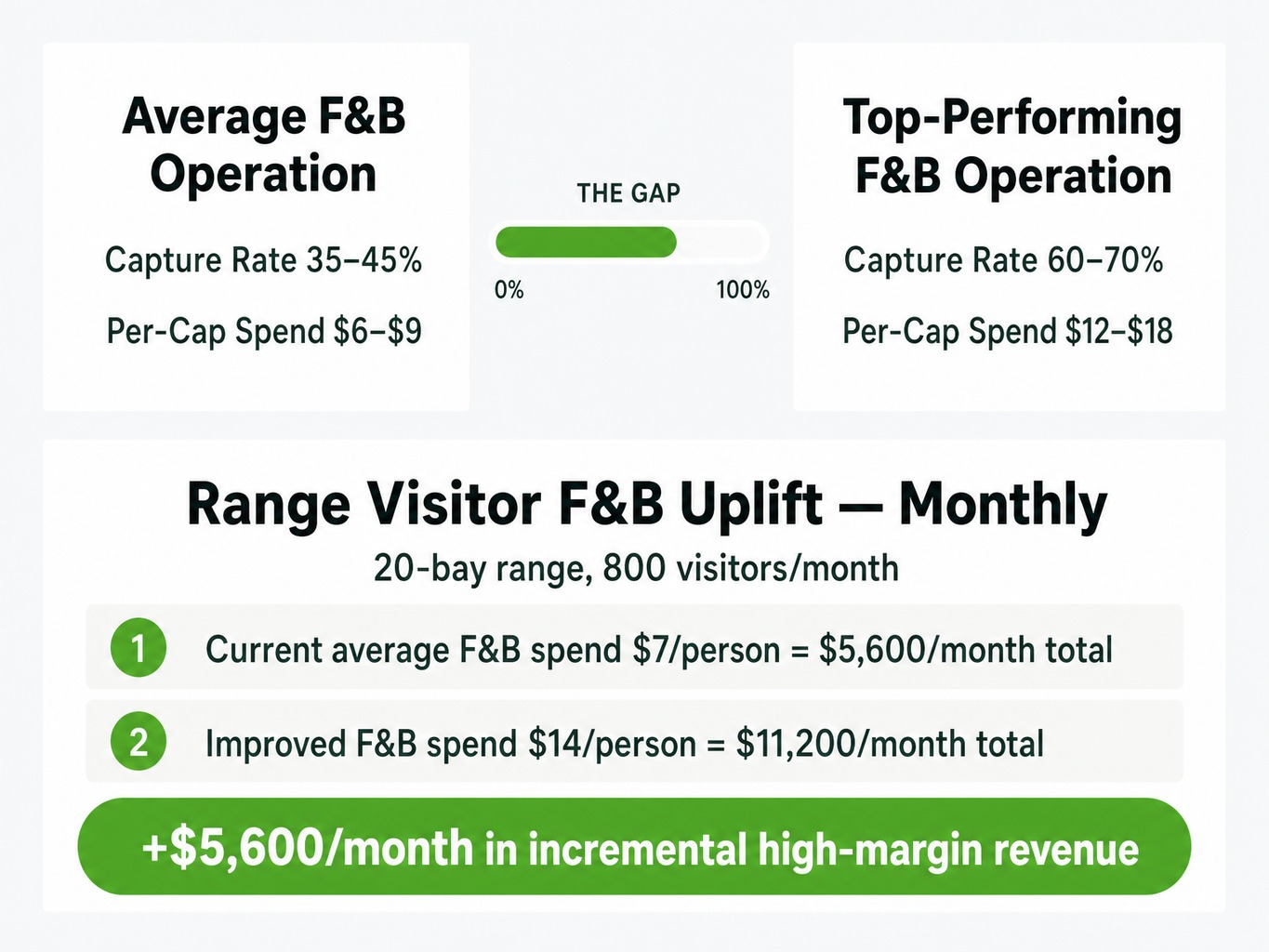
Dwell time, not menu changes, drives golf course revenue from food and beverage.
Hybrid Memberships Are Replacing Traditional Dues at Public and Daily-Fee Courses
For daily-fee and municipal courses, traditional annual memberships often suffer from high attrition. A golfer pays $2,000-$4,000 upfront and then feels pressure to play 30-50 rounds just to break even a target many fail to hit, leading them to churn after one season.
The facilities with the strongest membership revenue growth are borrowing from the subscription economy. They offer monthly billing, tiered access levels, and bundled perks like range balls, cart credits, or F&B discounts. This makes the value tangible every single month, not amortized over a year.
Consider the economics. Suppose a traditional $3,200 annual membership sees 40% first-year attrition, while a $149/month subscription retains members better, with churn closer to 15% annually. Over three years, the subscription model produces more predictable revenue and a significantly higher customer lifetime value, even with a lower headline price. These members also visit more frequently to extract their monthly value, which drives ancillary spend across the pro shop, lessons, and F&B. As research has shown, acquiring a new customer can cost 5 to 25 times more than retaining an existing one, making membership retention a critical financial lever.
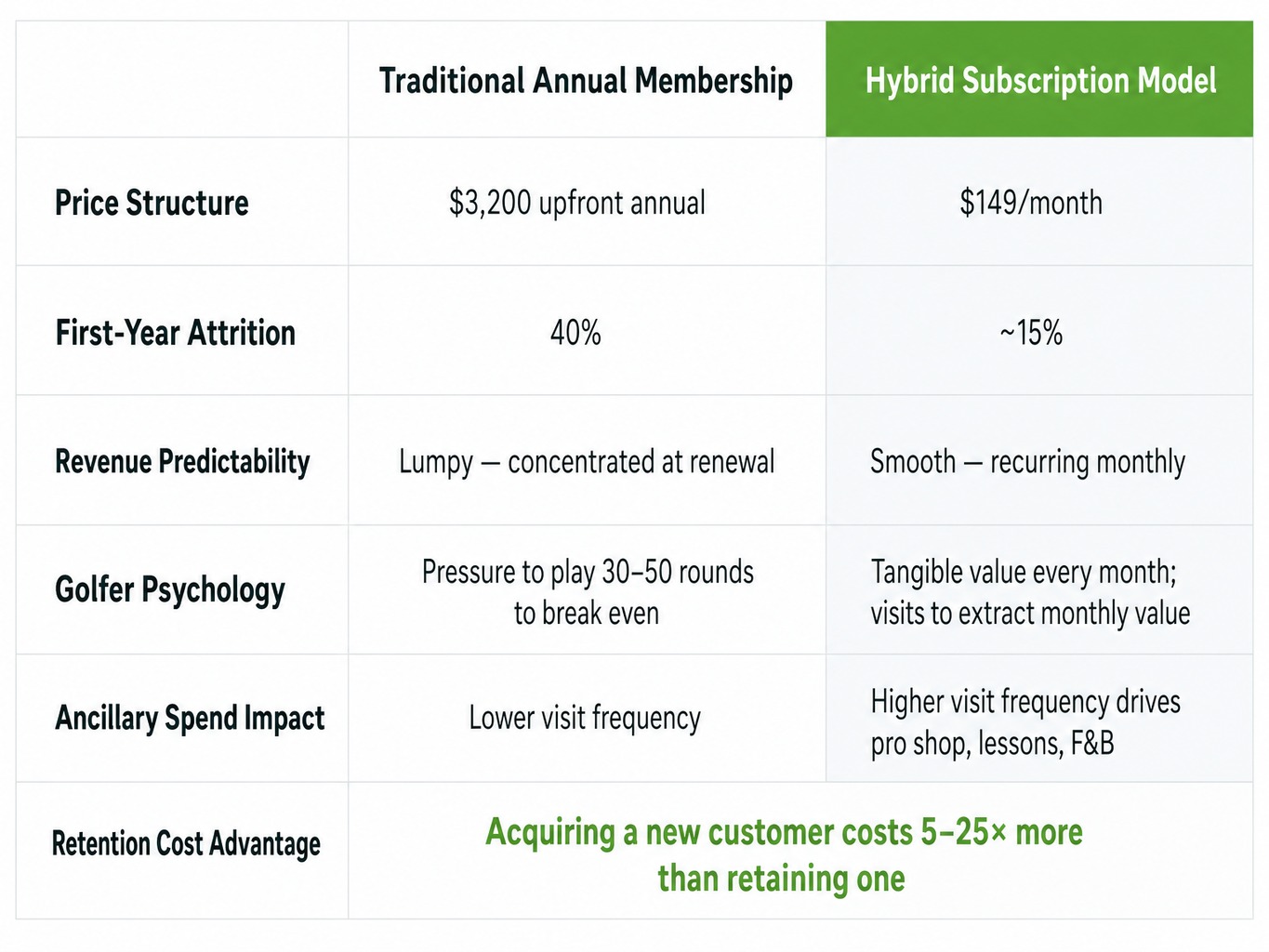
Subscription-style memberships create predictable golf course revenue streams with lower churn.
Pace-of-Play Management Can Add 8-12 Rounds Per Day Without Expanding the Course
Most facilities trying to grow revenue focus on demand generation getting more golfers to book. But for many, the binding constraint is course capacity. A course running 8-minute tee time intervals with an average pace of play of 4 hours and 30 minutes is leaving 8-12 potential rounds on the table every day compared to a course running the same intervals at a 4-hour pace.
This isn’t about rushing golfers; it’s about removing operational friction. Pace-of-play management technology from providers like Tagmarshal and FairwayIQ uses real-time tracking to identify exactly where bottlenecks occur, allowing you to deploy rangers based on data, not intuition. Often, the problem is a single poorly-signed crossover or a slow-playing par-3.
Fixing these issues adds inventory directly to your tee sheet. Imagine freeing up capacity for just two additional rounds per day. At a blended rate of $55 per round, over a 200-day season, that’s $22,000 in incremental green-fee revenue. Ten additional rounds per day at that same rate generates $110,000 before even accounting for cart fees and F&B. Pace of play is a capacity problem with a measurable revenue cost, and the technology to solve it is now widely available.
Faster pace of play is one of the most direct ways to increase rounds and revenue at public golf courses.
Why the Practice Range Deserves Its Own Revenue Strategy
Operators apply sophisticated revenue thinking to the tee sheet, the restaurant, and the pro shop, but often treat the driving range as a commodity. Golfers pay a flat rate for a bucket of balls and leave. This is a strategic error. The range is your only revenue center that doesn’t require a four-hour commitment, serves every skill level, and can generate revenue per bay, per hour, all day long.
Yield management on a tee sheet and on a range operate on different inventory clocks; a tee time is a fixed-duration, sequential slot, while a range bay is an open-duration, parallel-use asset. This flexibility is its strength. The range is also your facility’s most powerful customer acquisition tool. A golfer who has a great experience on the range is far more likely to book a round, take a lesson, and become a repeat customer.
The Throughput Economics Most Operators Miss
Range revenue is a function of three variables: balls hit per session, sessions per bay per hour, and price per bucket. Most operators only focus on price, but the real leverage lies in the first two. A golfer who hits 80 balls in 25 minutes is worth less than one who hits 120 balls in 40 minutes, because the second golfer is more engaged, more likely to return, and has a higher probability of ancillary spend. Most operators also conflate ‘range revenue’ with ‘bucket sales,’ which hides the real economics by ignoring lesson-fee attribution, loyalty program lift, and F&B attachment from range-only visitors.
Anything that increases the number of balls hit per session improves bay utilization and revenue per hour. Consider a 15-bay facility that hits over 800,000 balls a year. If you can increase the average balls hit per session from 70 to 105 a 50% jump and price accordingly, the annual revenue impact is substantial. Range optimization is a throughput problem, not just a pricing problem.
How Experience Quality Drives Range Revenue and Repeat Visits
Throughput gains are only sustainable if the practice experience justifies the golfer’s time and money. Worn mats, inconsistent range tees, and a manual process that breaks a golfer’s rhythm every 10 seconds cannot support premium pricing or inspire repeat visits.
This is especially true for facilities that have invested in a digital layer like Toptracer or TrackMan. Layering advanced tracking technology onto a worn or inconsistent tee line creates a dissonance that golfers feel immediately; the screen promises premium data, but the physical experience undermines its validity. The quality of the physical practice environment is not a cosmetic detail; it is the operational foundation that makes higher throughput, premium pricing, and stronger retention possible. Facilities that pair a consistent physical experience with technology report stronger customer engagement and higher return rates.
What Automatic Teeing Changes in the Range Revenue Equation
The core challenge of range monetization is clear: to grow revenue, you must increase ball throughput and improve the physical experience enough to justify a higher price and encourage longer stays. This is precisely the operational problem Power Tee was designed to solve.
Power Tee is the infrastructure that makes a modern range revenue strategy executable. Our customers report that golfers hit 50% more balls because the system eliminates the dead time between shots. This directly increases revenue per bay, per hour. The system automatically tees up a new ball at an adjustable height after every swing, creating a seamless rhythm that keeps golfers engaged. Power Tee is fully compatible with ball-tracking technology like Toptracer, TrackMan, and InRange, and paired with our commercial-grade mat surfaces, the physical experience matches the quality of the digital layer.
As a result, many Power Tee facilities report revenue increases of 30% to 50%, along with a significant lift in food and beverage sales because golfers enjoy the experience and stay longer. We deliver this as a complete operating solution hardware, mats, installation, and ongoing support because the distinction between a capital purchase and a long-term lease with bundled support matters. Commercial reliability over years of all-day use is what separates a strategic investment from a gadget.
Conclusion
The most significant opportunities for revenue growth at most golf facilities are not about getting more golfers through the gate. They are about extracting more value from every golfer who is already there. The five levers covered here yield management, F&B capture, hybrid memberships, pace of play, and range monetization all share this principle. They focus on increasing revenue per customer, not just chasing volume. The facilities that will outperform their competition over the next five years will be the ones that apply the same analytical rigor to their range, restaurant, and membership model that they currently reserve only for the tee sheet.
Frequently Asked Questions
What is a good RevPATT benchmark for a public golf course?
RevPATT (revenue per available tee time) varies by region and facility type, but well-managed daily-fee courses often target $45-$70 when blending green fees, cart revenue, and ancillary spend. The metric is most useful for tracking your own performance over time, as local demand, weather, and your competitive set create wide variance that makes national averages less relevant.
How do third-party tee time marketplaces affect a golf course’s direct revenue?
Platforms like GolfNow can fill empty tee times, but their trade-time allocations and commission structures directly erode your margin on rounds that might have booked direct. The strategic risk is training golfers to shop on discount marketplaces instead of your own site. Most operators benefit from capping marketplace allocation and investing the savings into direct-booking incentives and loyalty programs.
How can municipal golf courses compete with private clubs on experience without a major capital budget?
Municipal facilities can compete on convenience, value, and practice-facility quality. Upgrading the range experience, adding modern online booking with dynamic pricing, and improving F&B capture are three levers that require modest capital relative to course renovations. The goal is not to replicate a private club but to make the public facility feel intentional, professional, and well-run.
How do you reduce no-show rates for online tee time bookings?
The most effective method is requiring a credit card at booking with a clearly communicated cancellation policy. Facilities that implement card-on-file requirements typically see a sharp drop in no-show rates. Automated reminder emails or texts 24 hours before the tee time, a standard feature in platforms like foreUP or Lightspeed Golf, also helps significantly.
What technology platforms help golf courses optimize pricing and booking?
Sagacity Golf specializes in AI-driven dynamic pricing. foreUP, Lightspeed Golf, TeeSnap, and Club Prophet Systems offer integrated tee-sheet management with online booking. For pace-of-play optimization, Tagmarshal and FairwayIQ provide real-time GPS tracking. Noteefy helps fill last-minute cancellations by managing automated waitlists. The right stack depends on your facility’s specific goals and budget.


