


Key Takeaways
- Toptracer Range is a camera-based system that visually tracks ball flight to provide shot data; it is different from radar-based systems like TrackMan Range.
- The system uses an array of high-speed cameras and computer-vision software to reconstruct a ball’s trajectory and calculate metrics like carry distance, ball speed, and curve.
- While Toptracer increases golfer engagement, it also slows down the pace of play as golfers watch the screen, which can reduce ball consumption and bay turnover at bucket-based facilities.
- The operational impact of this slowdown is most felt at the physical tee line, where manual re-teeing further reduces shot throughput.
- An automated teeing platform removes the manual re-teeing delay between shots, which helps offset the slower shot pace at Toptracer-equipped bays.
Most golfers have seen a tracer line follow a ball’s flight during a televised PGA Tour broadcast. That technology is Toptracer. But the version installed at commercial driving ranges Toptracer Range works differently than many assume. It does not use radar. It does not require sensors on the club or ball.
So, how does Toptracer work?
It is a camera-based ball-flight tracking system that captures shot data and displays it on a screen at each bay. Understanding this technology is critical for facility operators because it reveals both what Toptracer adds (engagement, data, games) and what it does not address. When a facility invests in ball-tracking screens but leaves the physical tee line unchanged, the gap between digital engagement and shot pace can reduce bucket revenue per bay hour. This article explains the camera technology, the data it delivers, how it affects bay utilization, and what operators should consider when modernizing their range technology stack.
What Is Toptracer and How Is It Different from the Broadcast Version?
Toptracer is a camera-based ball-tracking technology originally developed for golf broadcasts and now owned by Topgolf, which is part of the Callaway Brands portfolio. The broadcast version that audiences see on television is designed to overlay a real-time tracer line on a single player’s shot, enhancing the viewing experience.
Toptracer Range, however, is the commercial product engineered specifically for driving ranges. It uses the same core camera-tracking principle but is scaled for high-volume, multi-bay environments. In a Toptracer Range facility, every golfer in every equipped bay gets their own real-time shot data and tracer displayed on a dedicated screen.
Installed at hundreds of U.S. facilities, Toptracer Range is one of the most widely deployed ball-tracking systems for commercial ranges. It operates in a competitive landscape alongside other camera-based systems like InRange and radar-based alternatives like TrackMan Range. For an operator, the key distinction is that Toptracer Range is a camera-driven system designed for mass-market engagement.
How Toptracer Uses Cameras to Track Ball Flight at a Driving Range
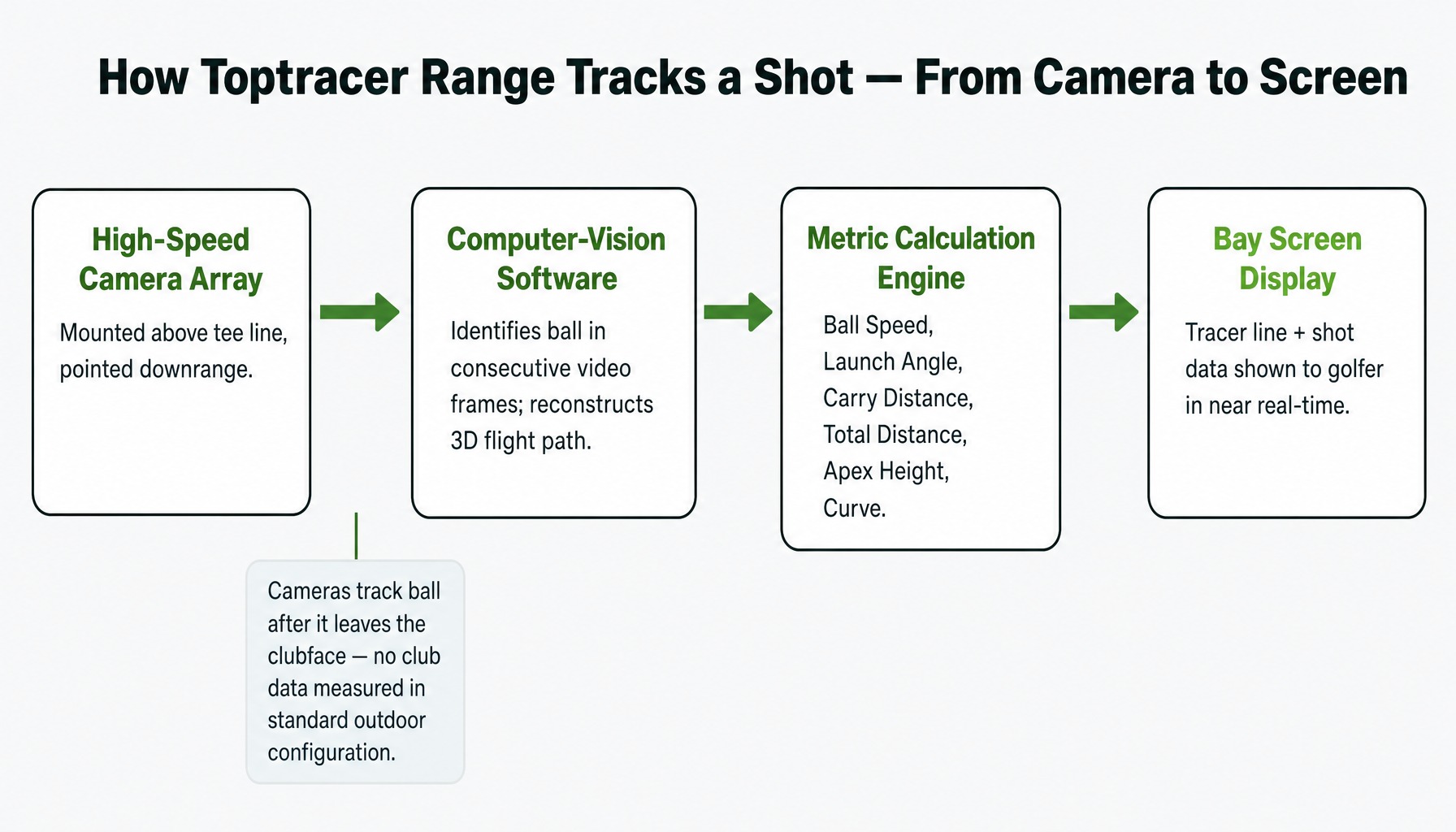
At its core, Toptracer Range uses an array of high-speed cameras mounted above the hitting bays, pointed downrange, to visually track the golf ball from the moment it leaves the clubface until it lands. This method is fundamentally different from radar-based systems that measure ball flight using Doppler radar signals. Toptracer relies on computer vision sophisticated software algorithms that identify the ball in each video frame and reconstruct its three-dimensional flight path.
A golfer at a Toptracer-equipped facility will see the physical evidence of this: cameras mounted on poles or structures behind the tee line, a screen at their bay, and the tracer line appearing on that screen within seconds of their shot.
The Camera Array and Bay-Level Hardware
A Toptracer Range installation involves multiple high-speed cameras positioned on elevated structures like poles, rooftops, or purpose-built mounts that overlook the entire range. This setup ensures that every shot from every bay is within the cameras’ field of view. The number and placement of these cameras are specific to each facility’s layout and dimensions. For operators, this is a practical consideration; the camera array requires specific mounting heights and sight-line clearances that may interact with a facility’s existing canopy, lighting, or net structures and require site modifications.
At the bay level, each hitting station is equipped with a screen typically a weather-resistant monitor that displays the golfer’s shot data. A local server runs the tracking software, processing the camera feeds and delivering the results to each bay’s screen in near real-time. The installation connects this hardware, runs the necessary cabling, and calibrates the cameras to the specific geometry of the range.
How the Software Calculates Ball Speed, Carry, and Trajectory
Once the cameras capture the ball in flight, Toptracer’s computer-vision software gets to work. It identifies the ball in consecutive video frames, calculates its position in 3D space at each point, and reconstructs the full trajectory.
From this reconstructed flight path, the system derives a host of metrics, including ball speed, launch angle, carry distance, total distance, apex height, and curve. Because Toptracer’s cameras track the ball only after it has left the clubface, the system infers launch conditions from the initial moments of ball flight rather than measuring them directly at impact. This is a key difference from radar systems or optical launch monitors that measure the club and ball interaction at the moment of impact. As a result, the standard outdoor Toptracer Range configuration does not natively measure club data like club speed, face angle, or attack angle.
What Shot Data Does Toptracer Provide and How Accurate Is It?
Toptracer Range displays a range of metrics designed to make practice more informative and engaging. The most common data points can be grouped into three categories:
- Distance Metrics: Carry distance (how far the ball flew in the air), total distance (carry plus estimated roll), and distance to target.
- Ball-Flight Metrics: Ball speed (the speed of the ball just after impact), launch angle, apex height (peak shot height), and hang time.
- Shape Metrics: Curve (draw/fade), offline distance from the target line, and landing angle.
So, how accurate is it? For most practice and entertainment purposes, the data is reliable and directionally correct. However, it’s important for operators to understand that Toptracer Range is a ball-flight tracker, not a clinical launch monitor. Camera-based systems can be sensitive to environmental factors; significant changes in lighting at dawn and dusk or adverse weather can affect data quality. While Toptracer provides support for calibration, operators should expect that the system’s accuracy is contingent on a properly maintained and calibrated setup. For serious club fitting, many PGA professionals still rely on dedicated radar or optical launch monitors that capture a more comprehensive set of club-delivery data.
How Toptracer Affects Shot Pace, Dwell Time, and Bay Utilization
Most evaluations of Toptracer focus on what the technology adds engagement, games, and data. But experienced operators know to also examine what it changes about how golfers physically use the bay.
The primary change is the “screen-fixation effect.” When golfers have a screen displaying tracer lines and data after every swing, they naturally pause to study the results. This is not a flaw; it is the engagement working as designed. However, this pause measurably slows down a golfer’s shot cadence. A player who might hit a ball every 20 seconds with manual teeing will naturally take longer per shot when pausing to review Toptracer data.
This slowdown has a direct operational consequence. Most operators confuse dwell time with utilization: a bay can be occupied for 90 minutes with a golfer hitting at a slow rate, looking fully utilized in a booking system but generating less ball throughput than a 45-minute session at a normal pace. This distinction is critical for calculating true revenue per bay hour. While Toptracer solves the digital engagement layer, the golfer still manually places each ball on a range tee, adding another delay on top of the screen-watching pause. This combined effect compounds the reduction in balls-per-hour throughput.
Why Bucket-Based Facilities Experience This Differently Than Time-Based Models
The impact of this shot-cadence slowdown is not uniform across all business models.
- For bucket-based facilities, the effect is immediate. Slower shot pace means golfers take longer to finish a bucket, which can reduce bay turnover during peak hours and lead to fewer total buckets sold per day.
- For time-based facilities that charge per hour, the direct revenue impact is less pronounced, as the clock is always running. However, these facilities may see lower overall ball consumption, which affects their ball-purchasing budget and can change the overall energy and activity level on the range.
How Automated Teeing Restores Shot Pace at Toptracer-Equipped Ranges
The slower shot pace that comes with Toptracer is something operators can partly offset at the physical tee line. While operators cannot control how long a golfer looks at a screen, they can control the time lost to manual re-teeing.
Power Tee’s patented auto-tee platform addresses this directly by automatically teeing up a new ball at the golfer’s chosen height after every shot. This removes the manual re-teeing delay between each swing. The only pause is the time the golfer chooses to spend reviewing their Toptracer data. Operators using the Power Tee practice platform can also save $25,000+ on turf maintenance and labor, and each installation is backed by Power Tee’s ongoing support service.
Power Tee reports that golfers hit 50% more balls when using the system, which helps offset the cadence slowdown from screen watching. At a bucket-based facility, that pace means more balls hit per session and buckets finished sooner, which frees bays for the next paying golfer during peak hours, even with Toptracer installed. At a facility that sells monthly or annual range memberships rather than buckets, the benefit shows up through more foot traffic and repeat visits rather than per-ball revenue.
Power Tee is fully compatible with ball-tracking technology like Toptracer, TrackMan, and InRange. The system is installed with its own Strike Mat and Standing Mat surfaces for commercial tee-line use, and Power Tee Home offers a residential option for golfers. The tracking layer and the teeing layer are two distinct parts of a modern range technology stack; a facility that upgrades one without the other changes only part of the golfer’s shot cycle.
Toptracer Range vs. TrackMan Range: What Facility Operators Should Compare
Operators evaluating range technology will inevitably compare Toptracer Range and TrackMan Range. The two systems work fundamentally differently, and the choice depends on a facility’s specific goals.
- Tracking Method: As discussed, Toptracer uses cameras. TrackMan Range uses Doppler radar units placed at each bay to track the ball.
- Data Scope: Because it uses radar, TrackMan Range captures both ball-flight data and club-delivery data (like club speed, attack angle, and face angle) from a single unit. Toptracer Range, in its standard outdoor configuration, captures ball-flight data only.
- Bay Coverage: Toptracer’s camera array can cover an entire range from a centralized installation. TrackMan Range requires a dedicated radar unit for each bay it serves.
- Cost Model: The business models also differ. As many operators will note, Toptracer Range is typically deployed with a recurring subscription or licensing fee. TrackMan Range has historically involved a higher upfront hardware cost per bay, with different ongoing fee structures. The total cost of ownership over several years can vary significantly based on bay count and contract terms.
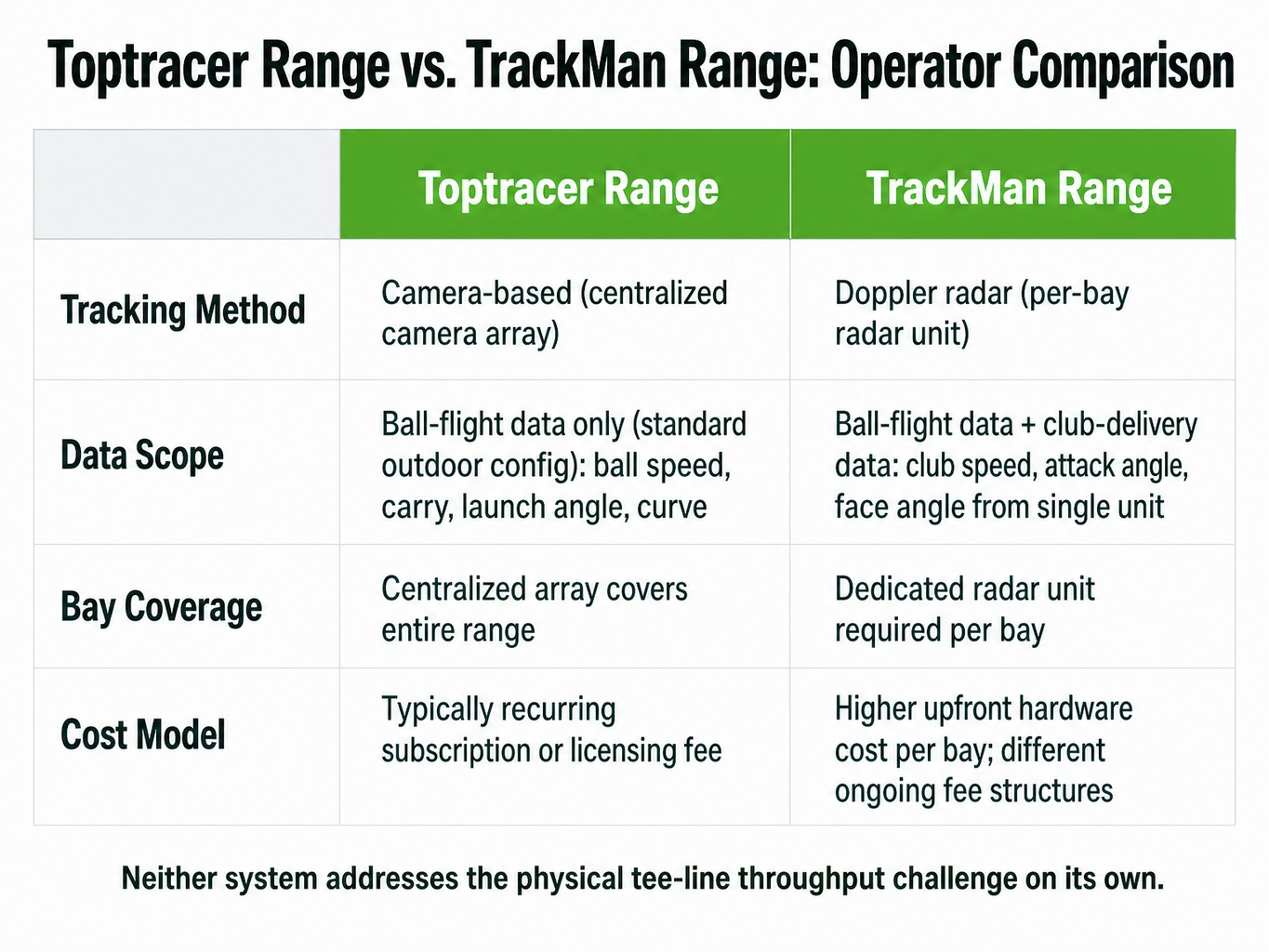
Neither system is inherently superior; the right choice depends on whether an operator wants to prioritize broad-bay entertainment (a common use case for Toptracer) or deep, per-bay analytics for serious practice (a strength of TrackMan).
The tee line calls for its own comparison, and three range systems typically come up alongside Power Tee: Range Automation Systems (RAS), Wittek, and Range Servant. The practical questions for operators are whether a system tees each ball automatically, how it feeds balls to the golfer, and how it holds up under constant daily use. RAS also offers an auto-tee, while Wittek and Range Servant focus on mats, trays, and range tees without automated teeing. Golfers in the industry often question the quality of artificial mats; MyGolfSpy has highlighted Wittek mat complaints about turf bounce, a lack of forgiveness on fat shots, and wear in the foam layer. Power Tee’s Patented Auto-Tee Platform is built for constant daily commercial use and tees each ball at the golfer’s chosen height from a hopper that feeds balls more efficiently than a rubber ball tray. For facilities running Wittek systems, Power Tee is an all-in-one replacement for their mats and trays, combining premium mat surfaces and automated teeing in a single system. Operators comparing systems should weigh those factors against their own bay count, pricing model, and maintenance capacity.
The Complete Picture for Your Tee Line
Toptracer is a camera-based ball-tracking system that adds a layer of engagement, data, and entertainment to a driving range. Understanding how it works using computer vision to reconstruct ball flight is the first step for any operator considering the investment.
However, it is just one layer of a complete range technology stack. As the shot-pace discussion above shows, while it solves the digital engagement problem, it creates a new operational dynamic around shot pace and bay throughput. The physical tee-line experience what happens between shots shapes throughput and ball consumption, so operators get the clearest picture when they evaluate the tracking layer and the teeing layer together.
For operators gauging Power Tee’s track record, its proof of scale reads 8M+ balls, 200+ ranges, 30 years, 18 countries, and 80%+ of UK ranges.
Operators weighing both the tracking and teeing layers for their own tee line can request a virtual demo of Power Tee.
Frequently Asked Questions
What does it cost a driving range to install Toptracer across all bays?
Toptracer Range pricing is facility-specific, depending on bay count, layout, and contract terms. It typically involves hardware installation costs plus an ongoing licensing or revenue-share agreement. Operators should request a custom proposal directly from Toptracer for an accurate quote.
What maintenance and calibration does Toptracer require after installation?
Camera systems require periodic calibration to maintain tracking accuracy, particularly after weather events or with seasonal lighting changes. Operators should factor camera cleaning, hardware inspection, and potential downtime for recalibration into their regular maintenance schedule, with support provided by Toptracer.
Can a facility use Toptracer with bucket-based pricing instead of time-based bay rental?
Yes, many Toptracer facilities sell buckets of balls. Some charge an extra fee for Toptracer access, while others incorporate it into a premium bay rate. The pricing model is a key factor in how Toptracer’s effect on shot pace translates to the facility’s bottom line.
Is Toptracer compatible with an automated teeing system and mat platforms?
Yes. Power Tee’s patented auto-tee platform is fully compatible with ball-tracking systems such as Toptracer and TrackMan and works well with simulator technology. The automated teeing system operates independently of the tracking layer the tee presents the ball, and the cameras track it after it’s hit creating no technical conflict.
How does Toptracer Range generate additional revenue through games and virtual experiences?
Toptracer includes game modes like virtual golf, closest-to-the-pin, and target challenges. These features increase dwell time and attract groups, which can drive ancillary revenue from food and beverage sales and encourage repeat foot traffic and customer visits.


