


Key Takeaways
- Most golf practice routines fail not because of bad drills, but because of the 15-25 seconds of dead time between each manually teed shot, which breaks rhythm and weakens muscle memory.
- Structured, varied practice produces better on-course results, and it depends on a tee line that keeps the next ball ready.
- A 45-Minute Rhythm-Based Practice Session posted in every bay gives customers a reason to stay focused and come back.
- For facility operators, less dead time per shot with automatic teeing means higher ball-per-hour throughput and better bay utilization, which can support revenue per bay.
- Ball tracking technology like Toptracer can slow the pace of play; pairing it with an automated teeing system offsets this by making the next ball available instantly.
A golfer arrives at your range with a solid practice routine: warm up with wedges, move to mid-irons, finish with the driver. Thirty minutes in, the session has lost its rhythm, because re-teeing by hand and resetting their alignment between every shot keeps interrupting it. The plan is sound; the tee line is undermining it.
Most advice on driving range practice routines focuses on what golfers should practice. This article is for range operators, and it focuses on the variable you control: what happens between shots.
That dead time created by manual re-teeing breaks rhythm, reduces the number of useful repetitions, and weakens the very muscle memory you’re there to build. Here, we’ll cover how to build a practice routine that accounts for shot cadence, not just drill selection, and why the tee-line setup at a facility shapes practice quality more than most golfers or operators realize.
You will walk away understanding:
- The real difference between structured and unstructured practice.
- Why shot cadence matters more than total ball count.
- How to give customers a rhythm-based practice plan that keeps them coming back.
Structured Practice vs. Mindless Ball Hitting: The Real Difference
The difference between a structured practice session and mindlessly hitting balls is not whether you have a plan it is whether every shot has a defined target, a specific purpose, and a pre-shot routine before you swing. It’s about intent.
Consider two golfers at the same facility, each with a 60-minute session and a large bucket. Golfer A hits 100 balls with their 7-iron to the same 150-yard flag. Golfer B hits only 70 balls, but they alternate between a wedge to a close target and a 7-iron to a farther one, executing their full pre-shot routine each time. Golfer A gets more swings, but Golfer B has more useful repetitions shots where the brain is encoding a specific motor pattern to solve a new problem, rather than running on autopilot.
This isn’t just opinion. Motor learning research has found that varied practice, where you change targets and clubs, produces better on-course transfer than blocked practice (hitting the same shot repeatedly) once a golfer has achieved basic competency. But varied, structured practice also requires more mental and physical resets between shots. This means the friction of the tee-line environment specifically the time lost to manual re-teeing matters more, not less, when you practice with purpose.
Why Shot Cadence Between Hits Matters More Than Total Balls Hit
Most driving range practice tips tell you which clubs to use, but they ignore the 15- to 25-second gap of dead time between each shot when a golfer manually re-tees. Over a 60-minute session hitting 80 balls, that dead time can add up to 20-30 minutes. That’s nearly half the session spent not practicing. This gap is easy to overlook in a golf practice routine, and it helps explain why range sessions often fail to translate to the course.
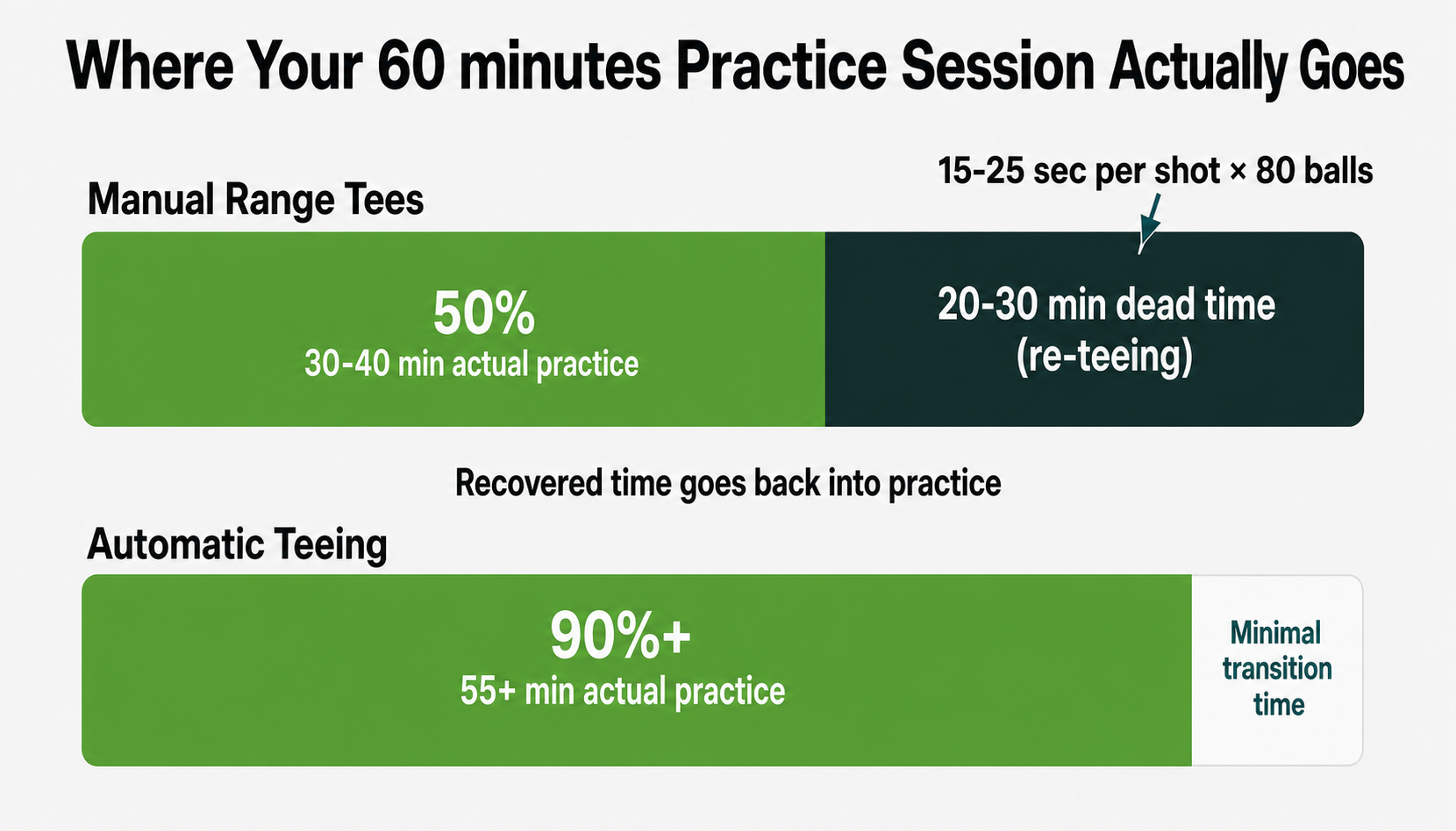
Dead time from manual re-teeing quietly eats into every practice session.
How Dead Time Breaks Rhythm and Weakens Muscle Memory
Muscle memory requires consistent tempo and rhythm between repetitions, not just during the swing itself. When a golfer has to stop, re-tee by hand, and reset between every shot, the neural pathway that was building from the previous swing starts to decay. One important distinction most golfers miss is between shot tempo, the pace of the swing itself, and shot cadence, the interval between one swing and the next. Facility infrastructure only affects cadence, but that cadence is what governs rhythm.
Think of a musician practicing scales. If they stopped for 20 seconds between each note to reset, the practice would be useless for building fluidity. The same principle applies to golf. When the next ball is delivered automatically, the golfer can maintain their focus, keeping the motor-pattern loop tight and reinforcing the feeling of the last good swing. That continuity lets a session build momentum instead of restarting with every ball. Dead time works the other way: it isn’t just neutral; it actively degrades the quality of every repetition that follows.
What Facilities Can Do About Dead Time on the Tee Line
For a facility operator, this dead time is a throughput and revenue problem. Every second a bay is occupied but a ball is not being hit is a second that bay is generating less revenue. Facilities investing in ball-tracking technology like Toptracer or TrackMan often discover that screen-watching behavior slows shot cadence, reducing the number of balls hit per session. The tee-line experience, the layer where Power Tee operates, needs to be fast enough to recover the time lost to data review.
For a facility that hits 800,000 or more balls a year, even a small improvement in shot cadence per bay translates to measurably higher ball-per-hour throughput and faster bucket turnover. The choice between an automated system and manual range tees is less an amenity choice than an operational design decision with direct P&L implications. It determines the practice quality and revenue potential for every bay.
A Driving Range Practice Plan Built Around Rhythm, Not Just Drills
One practical way to put shot cadence to work is to post a rhythm-based practice plan in every bay. Here is a plan you can adapt for your customers. The core principle is that every transition between clubs, targets, and practice phases should preserve your tempo. This framework assumes a tee-line environment where the ball is ready when you are, so the session flows from one swing to the next.
The 45-Minute Rhythm-Based Practice Session
This plan is built on smooth transitions, not rigid stops and starts.
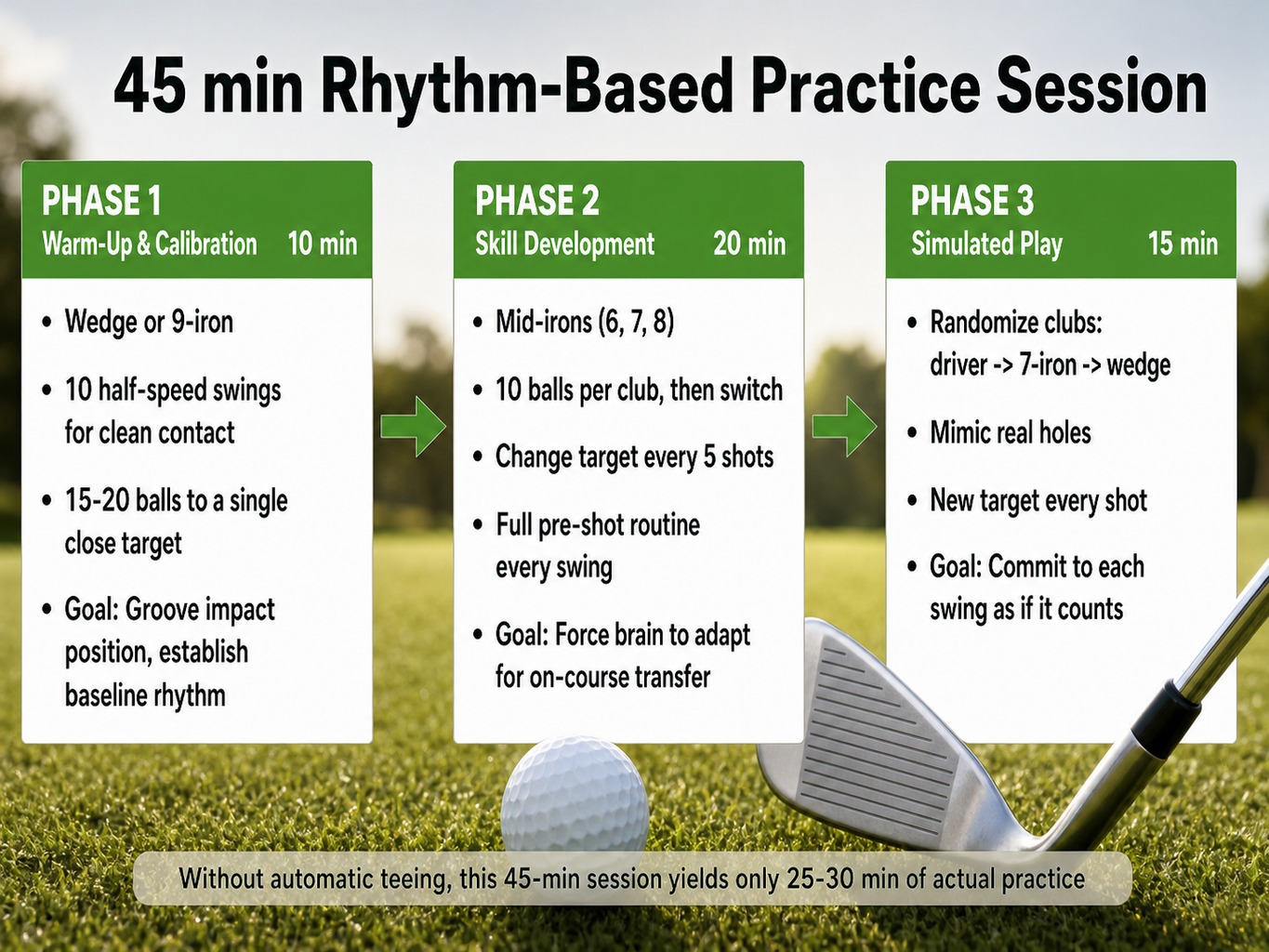
- Phase 1: Warm-Up & Calibration (10 minutes). Start with a wedge or 9-iron. Make ten half-speed swings focused only on clean contact. Then, hit 15-20 balls to a single, close target, gradually increasing to three-quarter speed. The goal is to groove your impact position and establish a baseline rhythm for the day.
- Phase 2: Skill Development (20 minutes). Move to your mid-irons (6, 7, 8). Hit 10 balls with one club, then switch. Change your target every five shots. Execute your full pre-shot routine before every swing. The constant but predictable change forces your brain to adapt, which is key for on-course transfer.
- Phase 3: Simulated Play (15 minutes). This is where you randomize. Hit one shot with your driver. Next, hit a 7-iron. Then hit a wedge. Mimic a real hole: driver, then approach, then pitch. Pick a new target for every shot. Commit to each swing as if it counts. This phase is the most demanding and where a consistent shot cadence is most valuable.
Adapting the Plan for Beginner Customers
For beginner customers, the same framework works with three modifications that build confidence and make the first visit a positive one.
First, extend the warm-up phase to 15 minutes and use only one club, like a pitching wedge or 9-iron. The singular goal is making consistent contact. Second, reduce the skill-development phase to 15 minutes and limit yourself to two or three clubs (e.g., wedge, 7-iron, and a hybrid). Third, replace the “simulated play” phase with a simple target game: pick one green and see how many of your last 15 balls you can land on it. This provides a measurable goal without the pressure of complex course-management decisions.
For facility operators, this matters. A beginner-friendly practice structure is a customer acquisition funnel. A golfer who has a productive, enjoyable first visit is far more likely to return for more visits than one who leaves frustrated after hitting a bucket of balls with no sense of progress.
How Facility Setup Shapes Whether Practice Routines Actually Work
A golf practice routine is only as good as the environment in which it’s executed. A golfer can arrive with the most structured plan, but if the mat is worn, the range tees are inconsistent, and every shot requires a 20-second reset, the routine is set up to fail.
Consider a facility that invested heavily in a ball tracking system like Toptracer, TrackMan, or InRange to modernize its range, but the tee line itself still uses aging mats and manual range tees. The digital experience is advanced, but the physical experience creates constant friction. Every manual reset stacks on top of the time spent reviewing data, and without a way to shorten the gap between hits, the technology ends up reducing ball throughput.
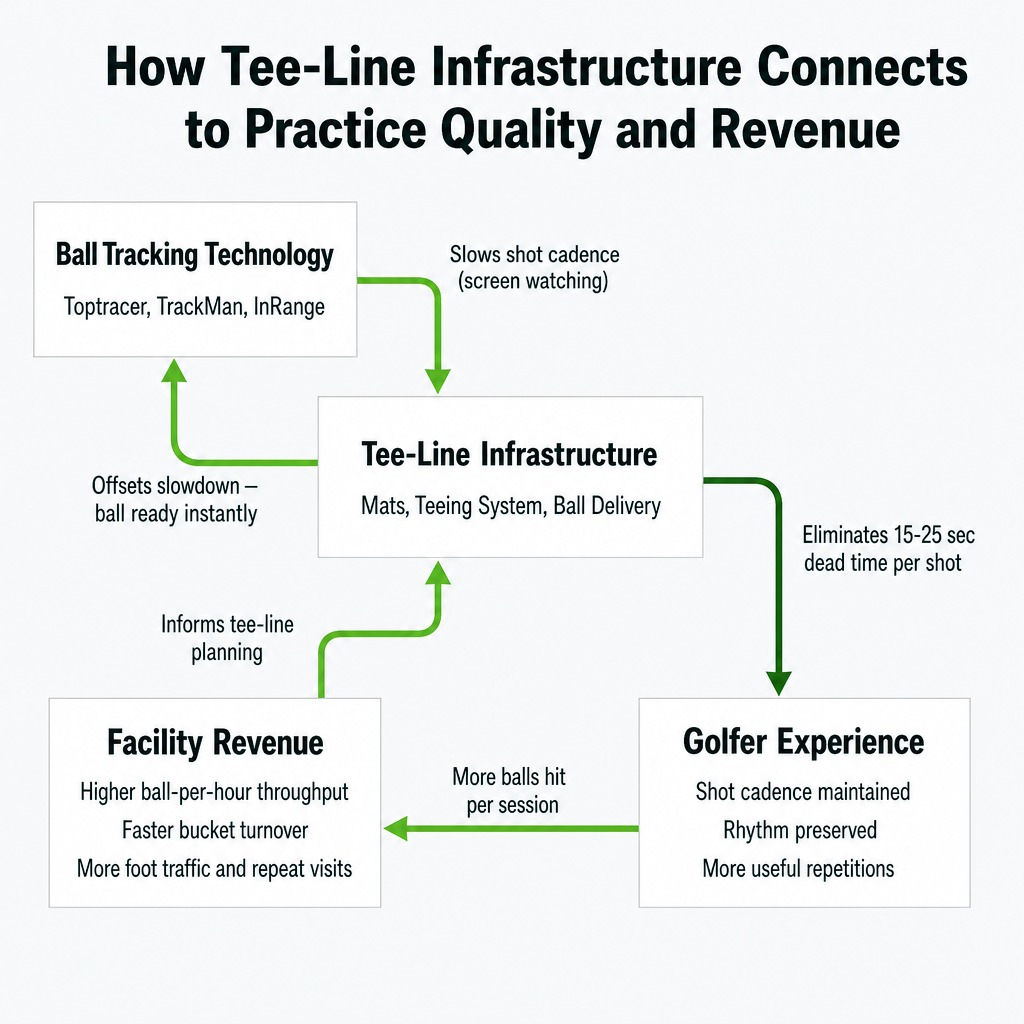
This is where tee-line infrastructure has to keep pace with the digital investment. The next ball needs to be available instantly, so the golfer can review their data, then immediately step in and hit again without a manual reset. Power Tee is fully compatible with these ball tracking technologies, so the teeing layer keeps shot cadence steady in tracked bays.
How Power Tee Eliminates Dead Time and Keeps Golfers in Rhythm
The core problem this article has diagnosed the dead time between shots that breaks rhythm and undermines practice is an infrastructure problem. Power Tee’s Patented Auto-Tee Platform is built to address it at the tee line.
The system delivers the next ball automatically, set to an adjustable height, the moment a golfer is ready. This removes the interruption from manual re-teeing, preserving the shot cadence that makes structured practice work.
Operators comparing systems usually weigh three alternatives: Range Automation Systems (RAS), Wittek, and Range Servant. RAS also offers an auto-tee, while Wittek and Range Servant focus on mats, trays, and range tees without automated teeing. Golfers in the industry often question the quality of artificial mats; MyGolfSpy, for example, has documented common Wittek mat complaints about turf bounce, a lack of forgiveness on fat shots, and wear in the foam layer. Power Tee’s case rests on its own record: a Patented Auto-Tee Platform that sets each ball at a consistent height, a hopper that feeds the next ball to the tee automatically and works more efficiently than a rubber ball tray, and construction built for constant daily use in commercial environments. For facilities running Wittek systems, Power Tee is an all-in-one replacement for their mats and trays, combining premium mat surfaces and automated teeing in a single system.
For facility operators, recovering that dead time translates directly to higher ball-per-hour throughput. Charles Raulerson, one of our customers, put it this way: “Our revenue is up by 25 to 30% since we’ve put in the Power Tee. We have more activity. More repeat customers.” Power Tee customers often see range revenue rise by 30-50%, along with more foot traffic and repeat visits. For context on scale, the record stands at 8M+ balls, 200+ ranges, 30 years, 18 countries, and 80%+ of UK ranges.
Operators who want to see how Power Tee would fit their tee line and practice experience can arrange a demo through the Power Tee contact page.
Conclusion
A quality golf practice routine depends as much on the tee-line environment as it does on drill selection. The central insight is that shot cadence the rhythm between swings is the foundation of productive practice. That foundation weakens when every shot is interrupted by a manual reset that breaks concentration and cuts the number of useful repetitions.
The facilities that create the best practice experiences, and in turn see the most repeat customer visits, are those that treat the tee line as critical infrastructure, not an afterthought. For operators, the question is simple: is your tee line helping or hurting the rhythm that lets your customers’ practice transfer to the course and keeps them coming back?
Frequently Asked Questions
Does an automated teeing system change how golfers practice at the range?
Yes, it changes the quality of practice more than its content. By delivering the ball automatically, it allows golfers to maintain a steady shot cadence. That preserves rhythm and muscle memory, and less of each session goes to resetting. The practice plan doesn’t change, but it becomes more effective overall. Because Power Tee works well with simulator technology, the same cadence holds in tracked bays.
How can driving range operators encourage better practice habits among customers?
Provide printed or posted practice plans in bays, partner with PGA professionals for player development programming, and invest in tee-line infrastructure that supports rhythm-based practice. Facilities that make structured practice easy through automatic teeing, quality mats, and clear targets tend to see higher foot traffic and more repeat visits, which supports revenue most directly for facilities that charge per bucket.
How much does dead time between shots cost a driving range?
It depends on bay count, pricing, and how busy the range is, but every second a bay is occupied without a ball being hit is lost throughput. Power Tee customers report golfers hitting 50% more balls once manual re-teeing is removed, and for facilities that charge per bucket, that added volume shows up directly as revenue.


