


Key Takeaways
- Give the range a fair place in the capital plan. The practice facility is often the highest-revenue-per-square-foot area of a golf facility, yet it’s the last to receive capital in a golf course renovation.
- Automated teeing is a strong candidate for the first phase of a range upgrade. It lifts revenue by increasing ball throughput, and the payback window depends on facility-specific volume and pricing.
- Tracking systems slow down the rate of shots; automated teeing offsets this by having the next ball ready, preserving both engagement and throughput.
- Use a phased renovation approach. You can upgrade a tee line in sections, keeping most bays open and revenue flowing throughout the construction process.
- Reframe your capital request. For private owners, focus on payback period and revenue per bay. For municipal boards, emphasize increased foot traffic, community access, and reduced labor costs.
A facility operator finalizes a $2 million golf course renovation master plan. The documents detail bunker rebuilds, green resurfacing, irrigation upgrades, and clubhouse improvements. The driving range tee line, however, gets a single line item for new mats or nothing at all. It’s a common scenario, from private clubs to municipal courses. The practice facility is often the most revenue-dense square footage on the property, yet it is consistently the last priority in renovation planning.
This approach overlooks a fundamental shift in the golf economy. Practice is no longer just a warm-up; it’s a primary driver of facility revenue. The National Golf Foundation reports that off-course participation and range usage are growing at a significant clip, making the practice facility an increasingly critical profit center. But capital allocation hasn’t kept pace.
Most renovation plans are built on a flawed premise: that the most visible, course-side work delivers the best return. This article makes the case for the opposite. We will cover which range and tee-line improvements generate the fastest measurable return, how to sequence renovation phases to keep bays open and revenue flowing, and how to build a capital case that satisfies ownership or a municipal board. For many facilities, that means rethinking which projects go first.
Why Most Renovation Plans Deprioritize the Practice Facility
The root cause of range neglect is structural. Renovation budgets flow toward visible, course-side improvements because architects, boards, and even many operators think of the range as a utility rather than a revenue engine. This isn’t an accident; it’s a systemic bias in how capital improvement plans are built. The economic case for range upgrades is often stronger than for course-side work, but it rarely gets made because no one in the planning room is equipped to champion it.
The Budget Allocation Bias Toward Course-Side Work
Renovation budgets are shaped by who is in the planning room. Golf course architects (ASGCA members) naturally scope work around holes, greens, and bunkers because that is their domain and fee structure. Superintendents advocate for turf health and drainage. The practice facility is left to compete for whatever remains in the capital improvement planning (CIP) process. Look at a typical CIP breakdown: bunkers, greens, and irrigation consume most of the budget, while the tee line is lumped into a generic FF&E allocation.
When a facility spends six or seven figures on course-side renovation and leaves the tee line untouched, the practice facility’s revenue contribution stays flat while debt service on the new work rises. This creates a margin squeeze that operators often don’t diagnose until the second post-renovation budget cycle.
The ‘Good Enough’ Fallacy at the Tee Line
Many operators tolerate worn mats, manual range tees, and inconsistent tee-line conditions because the range “still works.” Golfers show up and hit balls, so revenue comes in. But this is like saying a restaurant with slow service is fine because people still eat there. The hidden cost is in the sessions that end early, the repeat visits that don’t happen, and a bay utilization rate that sits well below what the tee line could support.
The core issue is that many operators aren’t measuring the right metric. Bay utilization rate alone is misleading; a bay can be occupied all day at low throughput, which looks good on a report but generates far less revenue than a bay turning over faster with higher ball volume per session. The real metric is bay yield how many balls per bay per hour is the facility actually selling versus its theoretical capacity? Most operators have never calculated this number. Until they do, a tee line that seems good enough may be leaving measurable revenue unrealized.
Which Range Improvements Generate the Fastest Return on Investment
Not all range improvements are equal. Some generate measurable revenue lift within months, while others are long-term, aesthetic plays. For operators focused on financial return, the priority should be on upgrades that directly increase throughput and customer spend. The sections below cover the upgrades that typically return capital fastest, starting with the tee line itself.
Tee-Line Automation as the First Renovation Phase
Automated teeing systems are a strong first phase for a range renovation because they begin affecting ball throughput as soon as the upgraded bays reopen. Payback depends on facility-specific volume and pricing, and at busy ranges it can be measured in months rather than years. Power Tee customers report that golfers hit 50% more balls when the next ball is teed up automatically and their rhythm isn’t interrupted. For facilities with a bucket-based revenue model, that increase in volume translates directly to more buckets sold and higher revenue per bay.
Equipment selection matters at this stage. Look for a commercial-grade system built for constant daily use and backed by installation, warranty coverage with most parts covered, and an ongoing support service.
Pairing Ball Tracking Technology with Automated Teeing
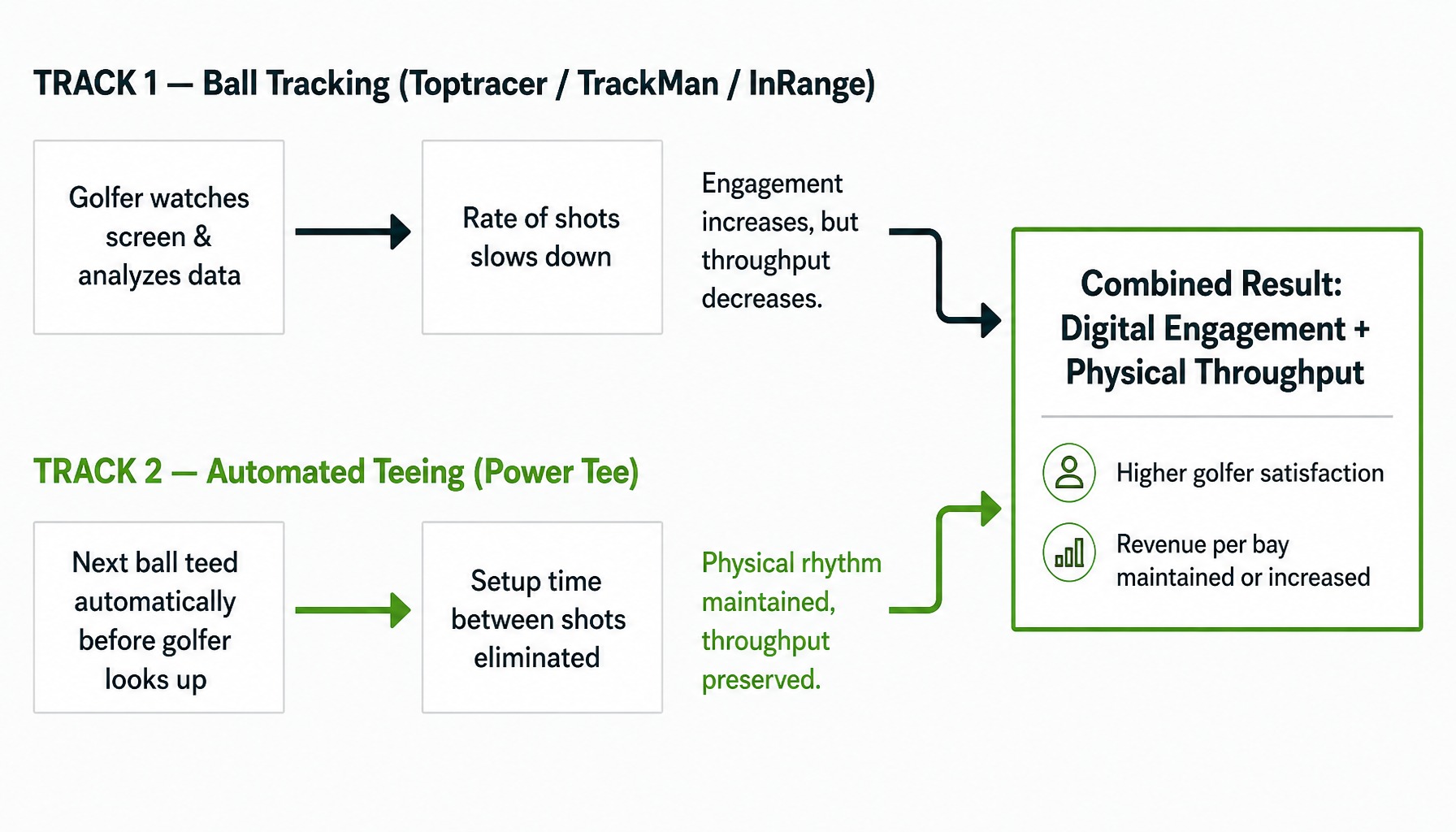
Ball tracking technology like Toptracer, TrackMan, or InRange is a powerful engagement tool. However, it can introduce an operational drag. Because golfers pause to watch each ball flight and analyze data on screen between hits, especially on Toptracer bays, the technology actually slows down the rate of shots. Some facilities install tracking systems only to find their ball throughput per bay declines.
Automated teeing directly offsets this slowdown. On a Toptracer bay, Power Tee speeds up play between hits by teeing the next ball while the golfer is still watching the screen, so golfers keep the data feedback while maintaining the rhythm of consistent practice. Power Tee is fully compatible with ball-tracking technology like Toptracer, TrackMan, and InRange; the two technologies are not either-or choices. Installing tracking without addressing the physical teeing process leaves throughput and revenue on the table.
Why Bucket-Based Pricing Outperforms Memberships After a Range Renovation
The revenue impact of tee-line automation is most visible when a facility charges per bucket of balls. With flat-rate monthly or annual range memberships, increased ball volume from automation doesn’t add per-bucket revenue, and the operator absorbs the cost of more balls being hit and more wear on the equipment, although membership counts can still grow one Power Tee customer saw a 29% increase in range memberships. An upgraded range can still draw more foot traffic and customer visits under any pricing model, but bucket pricing is where added throughput shows up directly as revenue.
Charles Raulerson of Top of the Tree driving range put it this way: “Our revenue is up by 25 to 30% since we’ve put in the Power Tee. We have more activity. More repeat customers.” Across its customer base, Power Tee reports that facilities often see range revenue rise by 30-50% after installation, along with higher food and beverage sales as golfers return more often. As part of your golf course renovation plan, reconsidering your pricing model is just as important as upgrading the physical infrastructure.
How to Phase a Range Renovation Without Shutting Down Revenue
The fear of shutting down the range and losing revenue for months stops many operators from starting a much-needed renovation. This is an understandable but often unfounded concern. Phased renovation is almost always preferable to a full reconstruction for practice facilities. The key is in the sequencing, which determines whether the project pays for itself during construction or creates a revenue hole.
Phased Renovation vs. Full Range Reconstruction
Full reconstruction only makes sense when the entire structure subgrade, drainage, and foundation is compromised beyond repair. In most cases, a tee line can be upgraded in phases by installing automated teeing platforms, replacing mats, and reconfiguring bay partitions without tearing down the entire structure. Look for equipment designed to work within both new construction and existing bay configurations.
The key decision criteria for phased vs. full reconstruction include:
- Drainage and Subgrade Condition: Is there standing water? Is the foundation sound?
- Tee Line Linear Footage: Is there enough space for modern bay dimensions?
- Stall Partition Spec: Are existing partitions compatible with new equipment?
- Bay Configuration: Does the current layout support the footprint of new systems?
For most facilities, the answers to these questions point toward a phased approach, which minimizes disruption and financial risk.
Keeping Bays Open and Revenue Flowing During Construction
A phased renovation is less a construction problem and more a pricing and communication problem. The moment some bays are upgraded and others are not, you’ve created a two-tier product that must be managed.
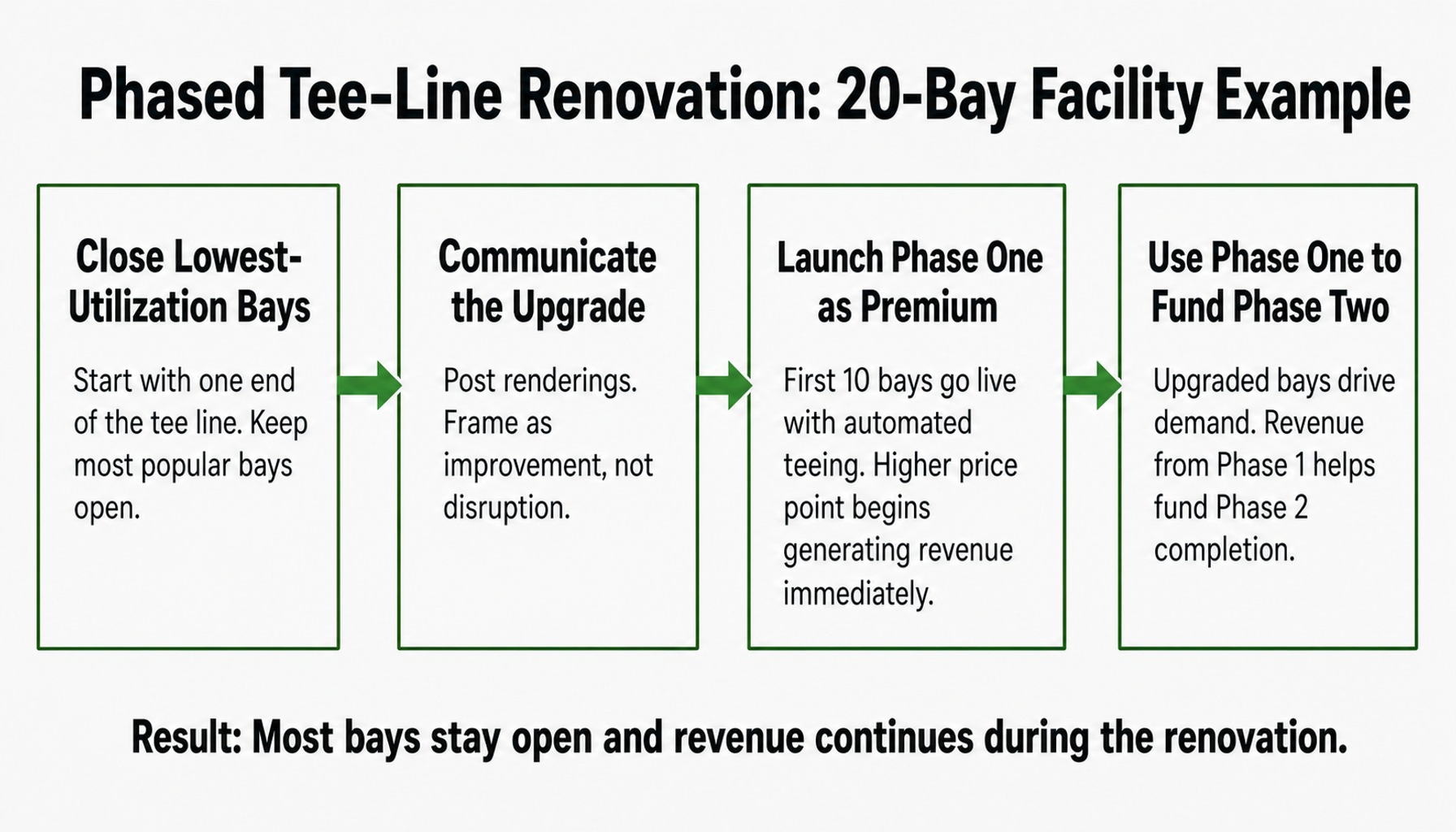
Here is a practical sequence for a 20-bay facility renovating in two 10-bay phases:
- Start with the Lowest-Utilization Bays: Close one end of the tee line first. This keeps your most popular bays open and minimizes revenue impact.
- Communicate the Upgrade: Frame the renovation to customers as an exciting improvement, not a disruption. Post renderings and offer sneak peeks of the new technology.
- Launch the First Phase: Once the first 10 bays are complete with automated teeing, launch them as a premium experience, potentially at a slightly higher price point. This immediately begins generating revenue.
- Use Phase One as a Demo: The new, upgraded bays will drive demand and build anticipation for the second phase. The revenue from the first phase can even help fund the completion of the project.
During this process, operational details like picker schedule optimization are critical. Your ball inventory and collection logistics need to adjust for a smaller active tee line. But with careful planning, many facilities can complete a major tee line renovation while keeping the range open.
Building the Capital Case for Tee-Line Upgrades
Even if you’re convinced a tee-line upgrade is the right move, you still have to sell it to someone else an owner, a board, a municipal parks department, or a corporate parent. The capital case for tee-line automation is often stronger than for other renovation components because its revenue impact can be measured directly against ball volume. But it must be framed in the language the approver understands.
Framing ROI for Private Ownership and Corporate Leadership
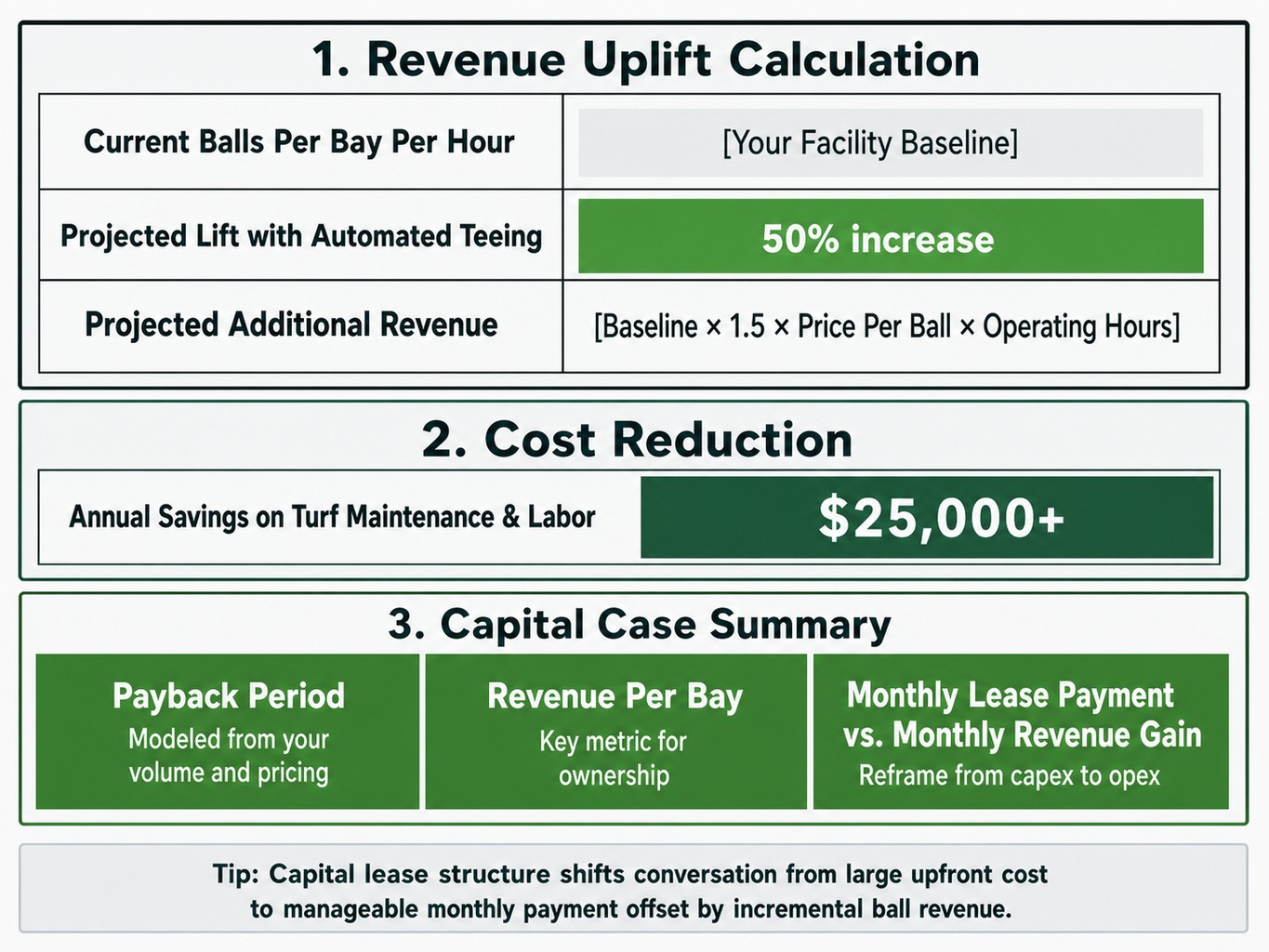
Private owners and corporate leaders respond to three things: payback period, revenue per square foot, and competitive differentiation. Your capital case should be a simple, one-page document built on these pillars.
Start by calculating your current balls per bay per hour. Then, project the increase with automated teeing (Power Tee customers report golfers hitting 50% more balls). Model the projected revenue at that higher volume and subtract the equipment cost. This gives you a clear payback window. Furthermore, framing the investment as a capital lease can shift the conversation from a large upfront cost to a manageable monthly payment that is offset by incremental monthly ball revenue a much easier case to make to a finance committee. Adding potential savings on turf maintenance and labor, which some facilities report after moving practice onto an automated platform, further strengthens the case by showing cost reduction alongside revenue growth.
Navigating Municipal Board and Public-Facility Approval Processes
Municipal facilities face a different approval dynamic. The decision-maker is often a parks and recreation board or city council evaluating your request against competing public priorities like playgrounds or swimming pools. The argument must be framed as a community benefit.
Instead of leading with payback period and revenue per bay, lead with:
- Increased Foot Traffic and Customer Visits: More people using a public asset.
- Broader Community Access: Better facilities for high school teams, junior programs, and player development initiatives.
- Reduced Maintenance Costs: Highlighting how automation reduces the labor burden on municipal maintenance teams.
Funding options like CIP line items, parks bonds, or equipment leases that avoid upfront capital are often more palatable. A vendor’s ongoing support service can also address the common objection from maintenance departments about taking on new, specialized equipment. The language for public-facility approval is about public good, not just profit.
What to Look for in a Tee-Line Partner
The central challenge of a golf course renovation is that the tee line one of the most revenue-dense parts of the facility is often the most neglected. Addressing it usually requires a partner who handles equipment, installation, and ongoing support together. Power Tee’s offering is organized around that need.
For context on commercial reliability, Power Tee reports more than 8 million balls hit across 200+ ranges, 30 years in the industry, operations in 18 countries, and a presence at more than 80% of UK driving ranges relevant mainly as evidence of how the equipment holds up under heavy daily traffic.
The company’s focus is the tee line itself rather than a broad range-equipment catalog.
Power Tee’s approach includes:
- The Power Tee Teeing System: A Patented Auto-Tee Platform with adjustable tee heights.
- Mat Surfaces: Strike Mat and Standing Mat surfaces designed for heavy commercial use.
- Installation & Ongoing Support: Full installation for new or existing bays, warranty coverage with most parts covered, replacement parts, and an ongoing support service to keep your bays running.
How the alternatives compare: Range Automation Systems (RAS) also offers an auto-tee system, while Wittek and Range Servant focus on mats, trays, and range tees without automated teeing. Golfers in the industry often question the quality of artificial mats; MyGolfSpy, for example, has documented Wittek mat complaints about turf bounce, a lack of forgiveness on fat shots, and wear in the foam layer. For facilities already running Wittek systems, the mats and trays can be replaced by Power Tee’s combined auto-tee and mat system. When comparing options, look for a proven record under commercial traffic: Power Tee’s Patented Auto-Tee Platform is built for constant daily use, paired with Strike Mat and Standing Mat surfaces, and backed by installation and an ongoing support service. The practical question is which system keeps the next ball ready with the least downtime across a full day of commercial traffic.
The practical next step is to evaluate these components against your current bay yield and renovation timeline.
A facility-specific consultation can help scope that evaluation.
The Path to a More Profitable Practice Facility
The single most important takeaway is this: the practice facility is not a supporting amenity to renovate last. For many facilities, it is one of the most direct paths to measurable revenue improvement and deserves consideration as the first phase of a golf course renovation plan.
We’ve seen how renovation budgets flow to course-side work by default and why that habit leaves the tee line underfunded. We’ve outlined how phased installation keeps revenue flowing during construction and how to build a capital case that speaks the language of your leadership. The next time you sit down with an architect or a board to review a renovation master plan, make sure the tee line has its own line item and its own champion. Treated as revenue infrastructure, it is often among the strongest capital decisions on the plan.
Frequently Asked Questions
How much does a driving range tee-line renovation typically cost in 2026?
Costs vary widely based on bay count, subgrade condition, and equipment selection. Costs depend on bay count, subgrade condition, equipment selection, and whether the upgrade is leased or purchased, so pricing is quoted per project. Facilities should request a facility-specific consultation for an accurate scope.
How many hitting bays does a facility need to justify an automated teeing system?
Commercial Power Tee installations start at a minimum of 5 bays (a separate Power Tee Home option serves residential setups), and the economics improve as bay count increases. Facilities that hit 800,000 or more balls per year are typically the best fit, as the throughput gains from automation translate to meaningful revenue at that volume.
What should a golf facility RFP include when evaluating tee-line renovation vendors?
The RFP should specify bay count, current tee-line linear footage, subgrade condition, and annual ball volume. Ask vendors to detail warranty coverage, parts availability, ongoing support terms, and mat replacement cycles. Focus on commercial-use reliability ratings and total cost of ownership, not just upfront hardware specs. If your bays also use ball tracking, ask vendors to confirm how their teeing system pairs with it.
How do weather-resistant automated tee platforms perform in extreme U.S. climates?
Commercial automated tee platforms need to be built for constant daily use in demanding outdoor environments. Power Tee systems operate in high-heat, high-humidity, and cold-weather regions across the U.S. and worldwide. Specific performance data for a given climate can be discussed during a facility consultation.
What financing or funding options exist for municipal golf facility renovations?
Municipal facilities commonly fund range upgrades through Capital Improvement Plan (CIP) line items, parks and recreation bonds, or equipment lease structures. Leases are often preferred because they avoid large upfront capital outlays and position the upgrade as an operating expense, which simplifies board approval.


