


Key Takeaways
- Most management agreements incentivize course-centric improvements (tee times, F&B), often leaving the practice range a key profit center underfunded and under-managed.
- Fee structure is critical: an incentive fee tied to total facility revenue aligns operator and owner interests in growing range income, whereas a flat fee provides no such motivation.
- Evaluate range capital improvements using range-specific metrics like revenue per available bay (RevPAB) and ball throughput, not just rounds played.
- Before signing, ask potential management companies how they report range revenue separately, what their process is for range CapEx, and how they benchmark range performance.
- An automated teeing system is best evaluated as a range capital improvement rather than a maintenance cost, with returns measured in bucket sales, foot traffic, and ancillary spend.
You hire one of the well-regarded golf course management companies, expecting operational excellence across the board. Six months in, the reports look good rounds played are up, and F&B margins are steady. But the 24-bay practice range, which accounts for a third of your gross revenue, is running on the same worn mats and manual range tees it had five years ago. Bay utilization is flat, and the range contribution margin is quietly eroding.
This scenario is common. Most management agreements are structured to optimize for tee times and clubhouse operations, treating the practice range as a maintenance line item rather than a distinct profit center. The incentive is pegged to course metrics, leaving the range to stagnate.
This guide is for facility owners, operators, and general managers who need to evaluate third party golf course management through the lens of range economics. We will cover what management companies handle versus what you retain, how fee structures create or destroy incentives, how range-specific capital improvements get evaluated, and the critical questions to ask before you sign an agreement.
What a Golf Course Management Company Actually Handles vs. What the Owner Retains
A common misunderstanding is that a management company takes over everything. In reality, the management agreement defines a specific division of responsibilities. For a facility owner, understanding this division is critical, as your retained authority over capital purchases, brand positioning, and pricing strategy directly affects whether the practice range improves or declines.
Consider a municipal facility where the management company handles staffing and marketing, but the city council retains approval authority over any capital expenditure above $25,000. In this structure, a range equipment upgrade requires a separate approval process that the management company cannot initiate alone. The owner in this case, the city remains a key player in any modernization effort.
Operator Responsibilities Under a Typical Management Agreement
Under most agreements, a third party golf course management company assumes control of daily operations. This scope typically includes:
- Daily Staffing and Scheduling: Managing all facility personnel, from the director of golf to the maintenance crew.
- Agronomics and Course Maintenance: Overseeing all aspects of turf care, irrigation, and course conditioning.
- Food & Beverage Operations: Managing the clubhouse restaurant, bar, and on-course concessions to optimize GOP margin.
- Marketing and Customer Acquisition: Executing campaigns to drive tee times and events.
- Tee-Sheet and POS Management: Administering the point-of-sale and booking systems.
- Merchandising: Handling pro shop inventory, purchasing, and sales.
- Financial Reporting: Providing regular P&L statements, often governed by a P&L transparency clause in the agreement.
Range operations ball picking, cleaning, and monitoring the condition of mats and range tees usually fall within the operator’s maintenance scope. However, a decision to invest in capital equipment, such as installing an automated teeing system, almost always requires owner approval.
What the Owner or Board Retains Control Of
While the operator handles day-to-day functions, the owner or governing board typically retains authority over strategic and financial decisions. These retained powers are your primary levers for driving range improvements. Key areas include:
- Capital Expenditures: Approving any spending above a pre-defined threshold.
- Brand Identity: Controlling the facility’s market positioning and name.
- Pricing Strategy: Setting top-level pricing for green fees, memberships, and bucket sales.
- FF&E Reserve Allocation: Directing how funds for furniture, fixtures, and equipment are spent.
In the municipal example above, that city council threshold means a tee-line upgrade moves on the city’s timeline, not the operator’s. If you want range modernization under third party management, you must know where approval authority sits and ensure the management agreement facilitates, rather than obstructs, that process.
How Third Party Golf Course Management Companies Structure Their Fees
Fee structure directly shapes whether a management company is incentivized to grow range revenue or simply maintain the status quo. The difference between a management agreement that treats the driving range as a cost center and one that treats it as a distinct revenue line can determine whether a capital improvement like a Power Tee installation gets approved or deferred indefinitely. Understanding these models is not just a cost question it’s about aligning incentives.
Three dominant models exist:
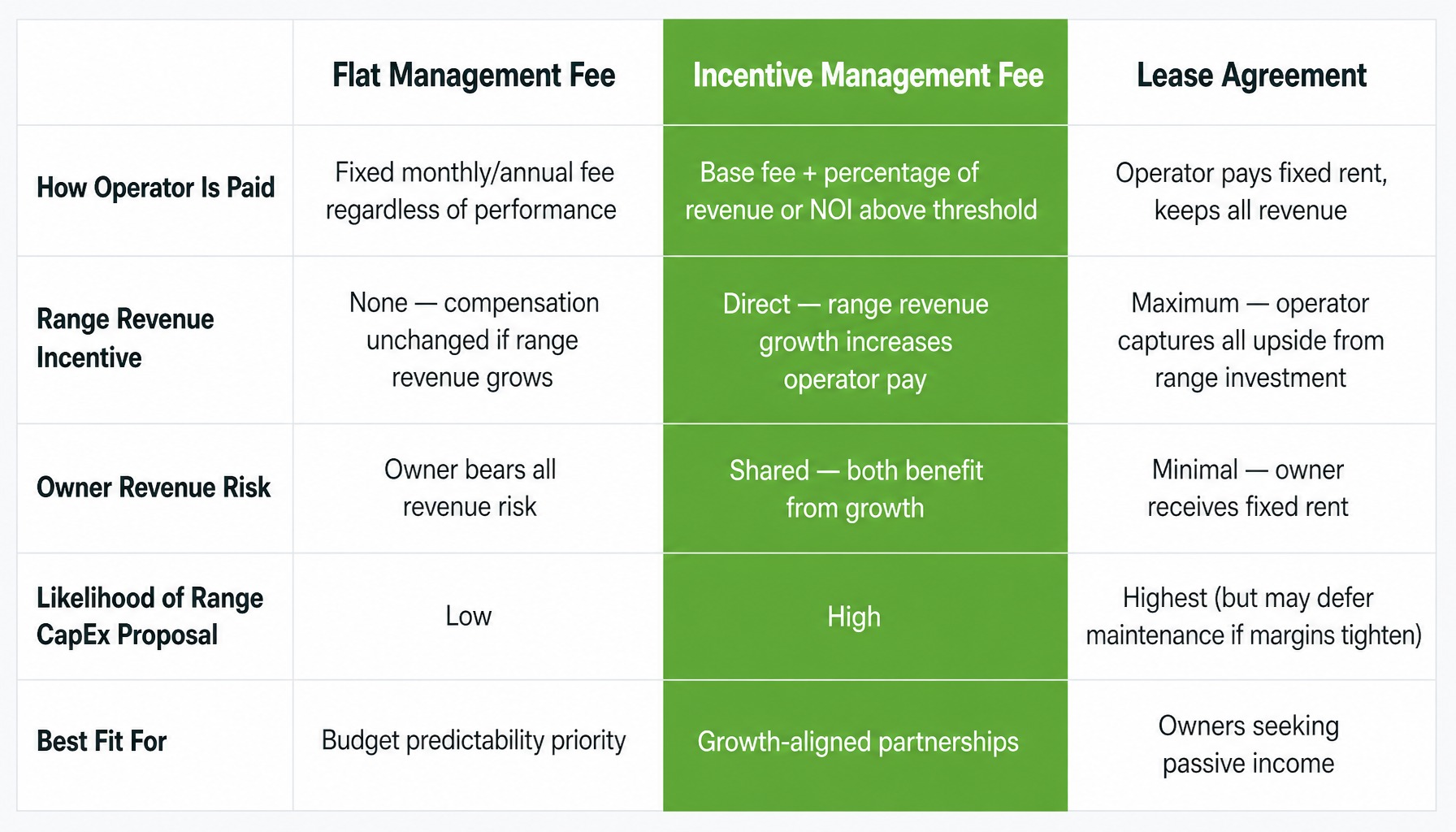
- Flat Management Fee: The operator receives a fixed monthly or annual fee regardless of performance. This model offers budget predictability for the owner but gives the operator no direct financial incentive to grow range revenue.
- Incentive Management Fee: The operator receives a base fee plus a percentage of revenue or net operating income (NOI) above a negotiated threshold. This model, often with an incentive management fee kicker, directly aligns the operator’s compensation with facility performance, including growth in range revenue.
- Lease Agreement: The operator leases the entire facility from the owner for a fixed rent, assuming all revenue risk and operational control. This gives the operator maximum incentive to invest in throughput, but can lead to deferred maintenance if margins tighten.
Consider the impact on a range upgrade. Under a flat-fee model, an operator has little financial reason to propose a $60,000 tee-line modernization project, as their compensation does not change even if range revenue increases by 30%. Under an incentive-fee model, that same project directly contributes to the operator’s bottom line, giving them a direct financial reason to support the investment.
How Management Companies Evaluate Capital Improvements for the Practice Range
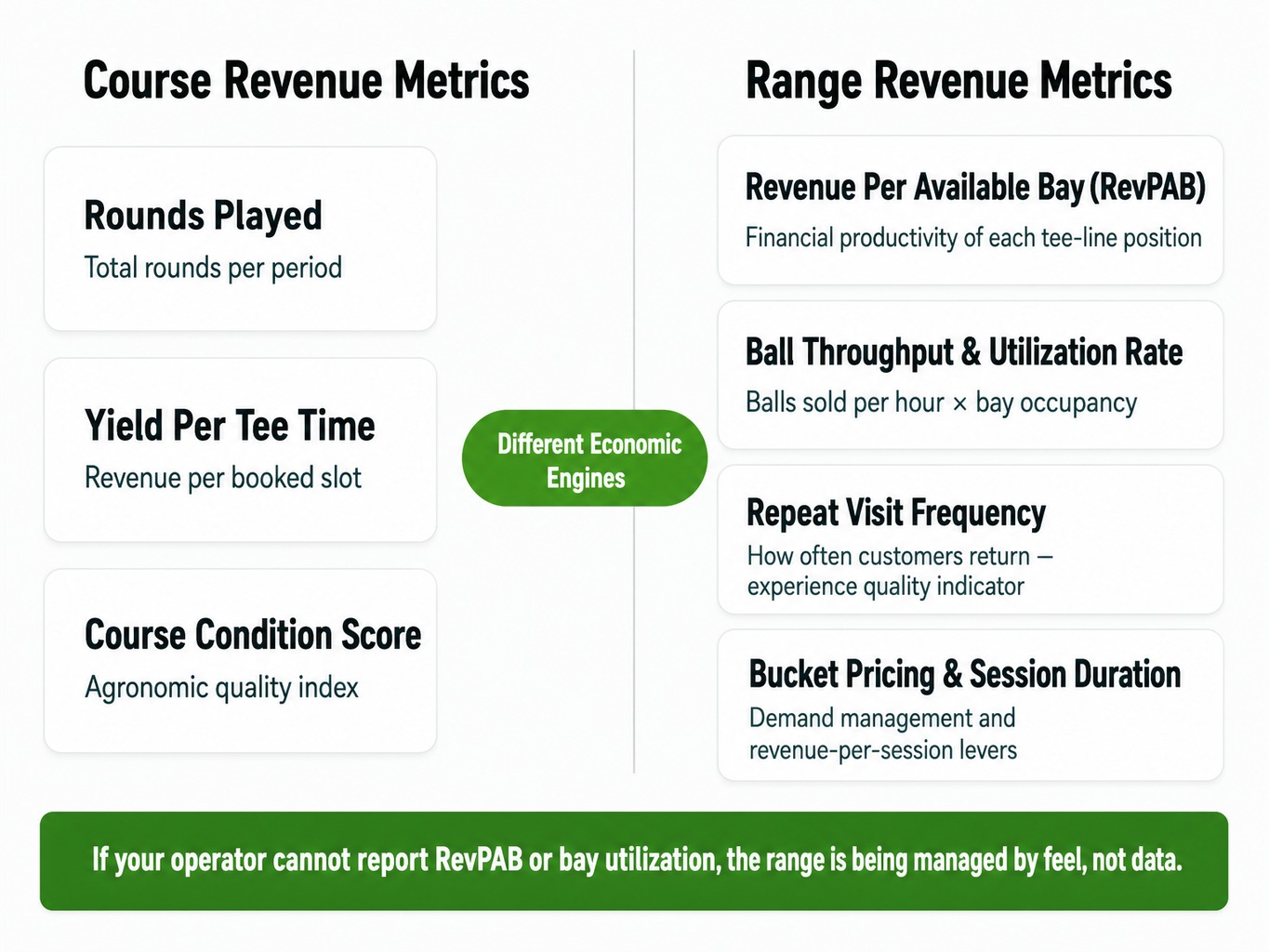
Most golf course management companies evaluate capital improvements through the lens of rounds played, tee-time yield, and course condition. This framework is effective for justifying a bunker renovation or irrigation upgrade, but it systematically undervalues investments in the practice range.
The range has its own economic engine, driven by metrics like revenue per available bay (RevPAB), bay throughput rate, and repeat visit frequency. When management companies apply course-centric ROI models to range decisions, they miss the true value drivers. The return on a tee-line upgrade shows up in increased bucket sales, higher foot traffic, and ancillary F&B spend factors that don’t appear in a rounds-played report. A management company’s monthly reporting template reveals its operational priorities: if the practice range appears only as a single revenue line without per-bay or per-session breakdowns, the operator is almost certainly not managing it as a standalone profit center.
Why Range Revenue Metrics Differ from Course Revenue Metrics
Course revenue is measured in rounds played and yield per tee time. Practice range revenue is a function of volume, utilization, and experience. For facilities that sell buckets of balls and where customers hit over 800,000 balls a year, the key performance indicators are fundamentally different:
- Revenue Per Available Bay (RevPAB): The primary metric for measuring the financial productivity of the tee line.
- Ball Throughput and Utilization Rate: How many balls are sold per hour and how consistently each bay is occupied, often visualized with a range utilization heat map.
- Repeat Visit Frequency: How often customers return, a direct indicator of their practice experience.
- Bucket Pricing and Session Duration: The levers used to manage demand and grow revenue during peak hours.
These four metrics are the minimum reporting standard for a range. If your operator cannot report on RevPAB or bay utilization, they are managing a significant portion of your business by feel rather than by data. This is especially true for facilities that meet the ball count threshold for high-volume operations, where small improvements in throughput can lead to substantial revenue gains.
The Hidden Cost of Deferred Range Upgrades Under Management Agreements
Deferred range maintenance worn mats, inconsistent tee-line conditions, broken range tees is not just a cosmetic issue. It is a compounding revenue problem. While a worn-out hitting surface doesn’t show up on a monthly P&L, it directly erodes the customer experience, reduces session times, and weakens loyalty.
Imagine a facility where mat replacement has been deferred for two years because the FF&E reserve was allocated to clubhouse furniture. The range looks tired. Regulars start visiting less frequently, opting for a competitor with a better practice setup. The drop in foot traffic is slow at first, but it accelerates. This deferred maintenance backlog quietly costs the facility thousands in lost bucket sales and ancillary revenue.
This problem often traces back to the management agreement. If the owner does not specify range condition standards or allocate a portion of the FF&E reserve specifically to range equipment, the management company has no obligation to prioritize it. Writing range condition standards and a dedicated reserve line into the agreement is the owner’s most direct safeguard.
What to Ask a Golf Course Management Company Before Signing
Now that you understand the interplay of scope, fees, and range-specific capital evaluation, you can approach your next conversation with a third party management company with greater clarity. Use these questions in your RFP process or initial meetings to gauge whether a potential partner sees your range as a profit center or a cost center.
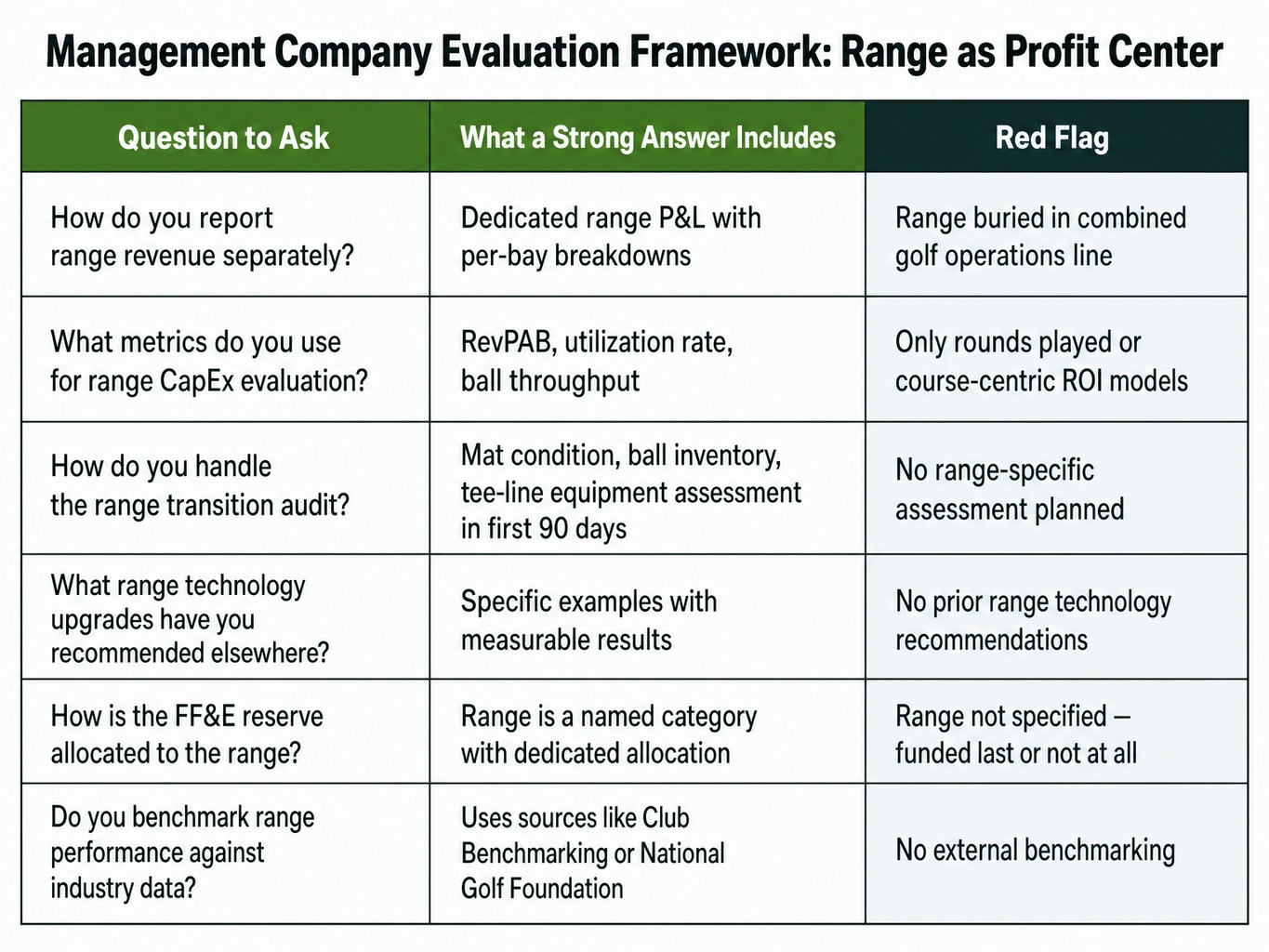
- How do you report range revenue separately from course and F&B revenue?
- Rationale: If range revenue is buried in a combined “golf operations” line item, you cannot evaluate its performance or the ROI of range-specific investments.
- What is your process for evaluating range capital improvements, and what metrics do you use?
- Rationale: If the answer focuses exclusively on rounds played, the company is not equipped to evaluate the range on its own economic terms. Look for answers that include RevPAB, utilization, and ball throughput.
- How do you handle the transition period for range operations?
- Rationale: A proper transition audit should include a detailed assessment of mat conditions, ball inventory, and tee-line equipment. The first 90 days set the baseline for all future performance.
- What technology upgrades have you recommended for practice ranges at other facilities, and what were the results?
- Rationale: A management company that has never recommended range technology is unlikely to start with your facility. Ask for specific examples.
- How is the FF&E reserve allocated between the course, clubhouse, and range?
- Rationale: If the practice range is not a named category in the reserve allocation plan, it will almost certainly be funded last, if at all.
- Do you benchmark range performance against industry averages, and if so, what sources do you use?
- Rationale: Reputable data sources like Club Benchmarking and the National Golf Foundation exist. A management company that doesn’t use them is not managing by data.
How Resort and Municipal Facilities Differ Under Third Party Management
The type of facility you own creates fundamentally different incentive structures for a management company. Resort golf course management and municipal golf facility management are not just different customer segments; they operate under distinct governance and revenue models that directly impact the practice range.
For resort facilities, the range is a critical guest amenity. Its purpose extends beyond serving serious golfers to include engaging hotel guests, families, and corporate groups who may never play 18 holes. A resort management company typically evaluates range investments based on their ability to drive non-golf guest engagement, increase on-property F&B spend, and boost overall guest satisfaction scores. The range is part of the resort’s amenity programming, and an engaging experience can become a meaningful profit center.
For municipal facilities, the practice range is often the highest-margin revenue line. However, capital decisions are subject to municipal golf facility governance, requiring city council or parks department approval, public procurement processes, and long-term accountability. A management company operating a municipal facility may want to propose a tee-line upgrade but cannot execute it without navigating layers of bureaucracy that don’t exist at private or resort properties.
The same management company will behave differently depending on the contract, and your evaluation criteria must reflect that reality.
Where Automated Teeing Fits in a Managed Facility’s Capital Plan
The central tension for owners is clear: management companies often undervalue range capital improvements, leading to deferred upgrades that quietly erode revenue, foot traffic, and customer loyalty. The practical answer is to treat the tee line as range infrastructure that shapes revenue, not as a maintenance item. Automated teeing is a capital improvement whose returns can be measured in bucket sales, bay utilization, and ancillary spend.
According to Power Tee, customers often see range revenue rise by 30-50% after installation. Power Tee attributes those results to increased foot traffic and more frequent customer visits, with food and beverage sales rising as golfers return for consistent practice. Power Tee also reports that some facilities using its practice platform have saved $25,000 or more on turf maintenance and labor, though results are facility-specific.
Power Tee’s Patented Auto-Tee Platform is designed for constant daily use at high-volume commercial facilities. It is fully compatible with ball tracking technology like Toptracer, TrackMan, and InRange, so a consistent physical tee line supports the digital experience golfers see on screen. For a management company operating on an incentive fee, a tee-line upgrade of this kind is worth evaluating, because any revenue increase flows through to both owner and operator.
For context on scale, Power Tee cites 8M+ balls, 200+ ranges, 30 years, 18 countries, and 80%+ of UK ranges.
How Power Tee compares: Range Automation Systems (RAS) also offers an auto-tee system, so owners should compare reliability records and mat quality directly. Power Tee’s strengths lie in its integrated mat surfaces and automated teeing built for constant daily use, which removes the need to re-tee by hand. On the mat side, golfers in the industry often question the quality of artificial mats; MyGolfSpy has reported complaints about Wittek mats, including turf bounce, a lack of forgiveness on fat shots, and wear in the foam layer. For facilities running Wittek systems, Power Tee is an all-in-one replacement for their mats and trays, combining premium mat surfaces and automated teeing in a single system. Power Tee also offers a residential option, Power Tee Home, though this guide focuses on commercial ranges.
Owners and operators who want to see how Power Tee would fit their range can arrange a virtual demo through the Power Tee contact page.
For any facility owner working with a third party, the practice range is not a cost center but a distinct revenue line, often with strong margins, that deserves its own metrics, its own capital allocation, and its own evaluation criteria when selecting a golf course management company.
By understanding what an operator controls versus what you retain, how fee structures create or destroy incentives, and why range-specific questions belong in every RFP, you can ensure your range is managed as a profit center for growth, not just maintenance. The next time a management company presents a capital plan, ask where the range appears and whether the tee line has its own line item.
Frequently Asked Questions
What is the difference between a management agreement and a lease agreement for a golf facility?
Under a management agreement, the owner retains ownership and revenue risk while paying an operator a fee to run the facility. Under a lease, the operator pays the owner fixed rent and assumes full revenue risk and operational control. This distinction affects who decides on capital improvements lease operators can act independently, while management-agreement operators typically need owner approval for significant purchases.
Do management companies prefer bucket-based pricing or range memberships for revenue growth?
In Power Tee’s experience, facilities generate more profit, and see the revenue impact of upgrades more clearly, when they charge per bucket rather than offering flat-rate range memberships. Memberships can increase visit frequency but often reduce per-visit spend, making it harder to attribute revenue gains from capital improvements. Facilities that charge per bucket can more directly connect equipment investment to top-line growth.
How do golf course management companies handle the transition period when taking over operations?
A responsible transition includes a full operational audit of staffing, inventory, and contracts, plus a physical condition assessment of the course and range. The first 90 days establish the baseline for performance reporting. Owners should require a range-specific assessment during this period, including mat condition, tee-line equipment, ball inventory, and any available utilization data.
How can a management company help justify capital expenditure on automated teeing systems?
An engaged management company can use facility-level data bay utilization rates, balls hit per session, and current bucket revenue to build a business case. They can project the impact of faster, more consistent practice on revenue per available bay. The strongest justifications pair a facility’s baseline data with published results from comparable facilities that have already installed automated teeing.
What role does ball tracking technology like Toptracer or TrackMan play in a managed facility’s strategy?
Ball tracking adds a digital engagement layer that can increase session times and attract new customers, but it can also slow the rate of shots as golfers watch the screen. Management companies that pair tracking technology with automated teeing help offset this slowdown. Automated teeing is fully compatible with ball-tracking technology like Toptracer, TrackMan, and InRange, and because each ball is teed automatically, it helps keep the pace between shots steady so bay throughput holds as golfers engage with on-screen data.
What questions should a municipal golf facility ask before hiring a management company?
Municipalities should ask how the company navigates public procurement for capital equipment, how range revenue is reported separately, what governance reporting is provided to the city, and if they have experience with public-sector approval timelines. Governance gaps in the management agreement often let range revenue stagnate because neither party has clear authority to approve and execute improvements.


