


TL;DR
- Golf course valuation is primarily driven by Net Operating Income (NOI), not just land or assets. Any capital improvement that increases recurring NOI directly increases facility value.
- Most appraisals treat the driving range as a static amenity, creating a valuation blind spot. The gap between current range revenue and its optimized potential is where investors find latent value.
- Use the “yield on cost” metric to evaluate capital projects. If a tee-line upgrade’s yield (incremental NOI ÷ cost) exceeds the facility’s cap rate, it creates more value than it costs.
- Improving throughput per bay the number of balls hit per hour is the most direct way to increase range NOI. Automation is the mechanism that unlocks this throughput.
- The valuation impact of range investment is highest at daily-fee and public courses where range revenue is transactional, but it also drives value at private clubs by improving member retention.
When a golf course changes hands, the due diligence is predictable. Appraisers scrutinize the irrigation system, the condition of the greens, and the age of the clubhouse roof. The driving range, however, often gets a single line item, not a deep analysis. This is a critical oversight.
For any facility that sells buckets of balls, treating the tee line as a fixed amenity rather than a capital-improvable revenue engine means the valuation understates what the property could earn. For daily-fee facilities where range revenue can represent a quarter or more of total non-dues income, the difference between a tee line running at baseline throughput and one optimized through commercial-grade automation is not a marginal amenity upgrade. It is a structural shift in the Net Operating Income (NOI) that drives the facility’s entire valuation.
This guide is for owners, operators, and investors evaluating a golf course investment. We will walk through how courses are valued, why the range is systematically undervalued, and how the financial math changes with targeted capital improvements. You will learn what due diligence most appraisals miss and see a clear framework for turning your range from an amenity into a core valuation driver.
How Golf Course Valuation Actually Works: Revenue Composition and NOI
A golf course valuation is not primarily about land value or the replacement cost of its buildings; for an operating facility, it is about the business’s ability to generate sustainable income. The most common and defensible method used in any Uniform Standards of Professional Appraisal Practice (USPAP) compliant appraisal is the income capitalization approach.
The formula is straightforward: Facility Value = Net Operating Income (NOI) / Capitalization Rate (Cap Rate)
.
Consider a facility generating $1.2 million in gross revenue with $800,000 in operating expenses. This produces an NOI of $400,000. Applying a market-appropriate 8% cap rate, the implied value of the golf course is $5 million. If that same facility could increase its NOI to $450,000, its value at the same cap rate jumps to over $5.6 million. This is why small, sustainable improvements to income have an outsized impact on a golf course investment.
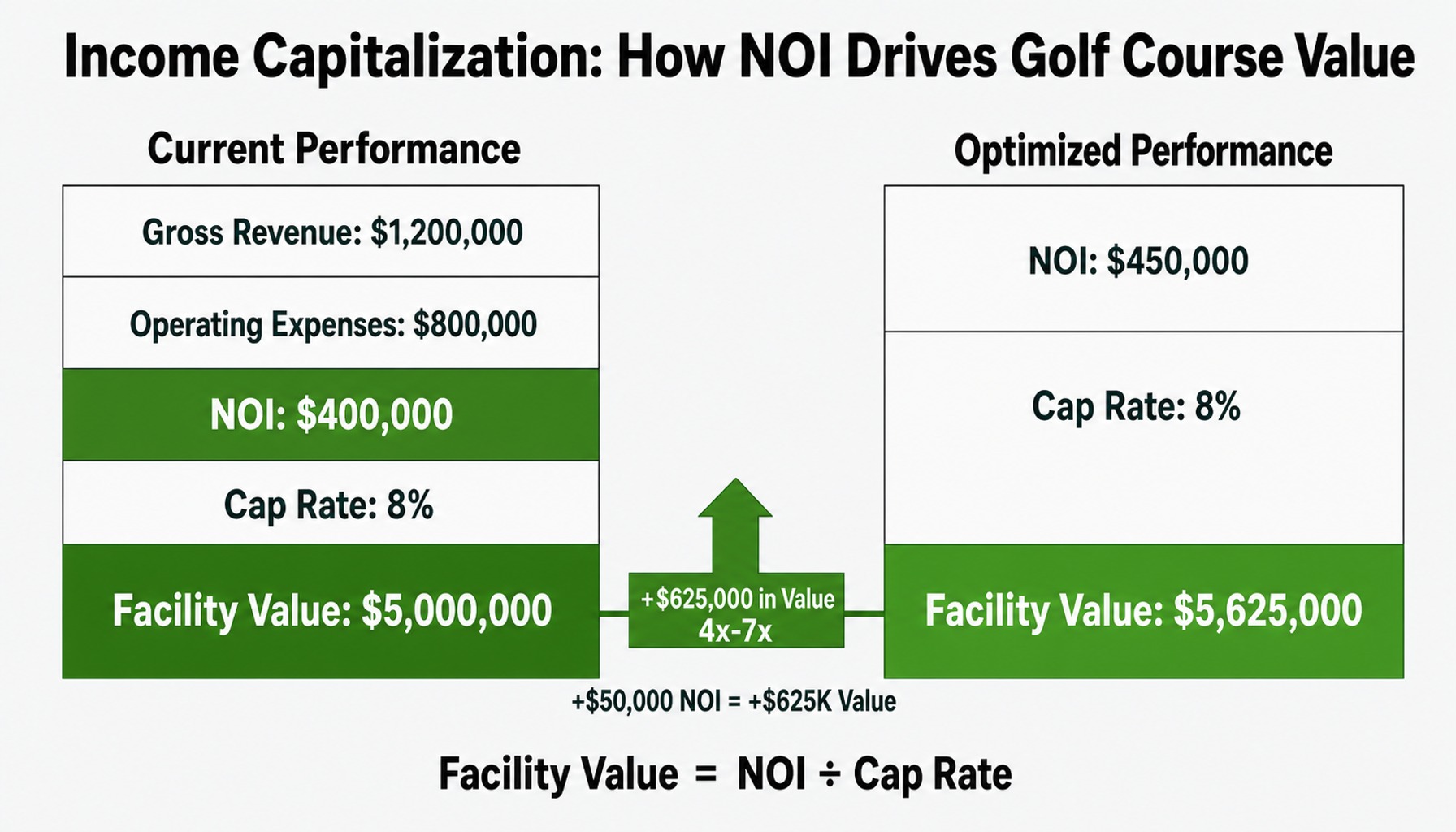
Appraisers “normalize” NOI by smoothing out one-time windfalls or expenses and adjusting for factors like market-rate management fees. This process means the composition of your revenue matters immensely. A dollar of high-margin range revenue, for instance, is worth more to the final valuation than a dollar of low-margin food and beverage revenue. While appraisers use other methods like comparable sales analysis and EBITDA multiples (typically in the 4x-7x range for golf courses, according to industry benchmarks) as a cross-check, the income approach remains central. The key takeaway is simple: valuation is a direct function of sustainable income, and any capital improvement that measurably increases recurring NOI directly increases the facility’s appraised value.
The Driving Range as a Valuation Blind Spot
In most golf course appraisals, the driving range is treated as a fixed-output amenity a line item that produces whatever it produces, with no upside modeled. I’ve sat in on an appraisal where the analyst lumped $180,000 in annual range revenue into an “other income” category with cart storage fees and vending machines, then applied a single blended cap rate to the entire facility. The valuation treated a 30-bay range as if it had the same growth ceiling as a row of soda machines.
This happens because appraisers, by necessity, focus on the variables with the most historical data and obvious levers: rounds played, green fee pricing, membership attrition, and clubhouse performance. The range gets bucketed with ancillary revenue streams. An appraiser reviewing a 20-bay facility generating $180,000 in range revenue will typically project that number forward with a modest inflation adjustment. They will not model what happens if throughput per bay increases by 40% because they have no operational basis to assume the tee-line experience will fundamentally change.
This is the valuation blind spot. For an operator evaluating a golf course investment whether buying, selling, or recapitalizing the range represents latent value that the standard appraisal process does not capture. The gap between current output and potential output is where a strategic capital improvement plan creates real equity. It’s not just about what the range is
making; it’s about what it could
be making with the right infrastructure.
How Tee-Line Capital Improvements Change the Valuation Math
The question is not whether capital improvements matter, but how to quantify their impact on your golf course investment. The bridge between a capital expenditure and its effect on valuation is a framework called yield on cost. This is the metric that separates necessary maintenance from true value-creating investment.
Yield on Cost: The Capital Improvement Litmus Test
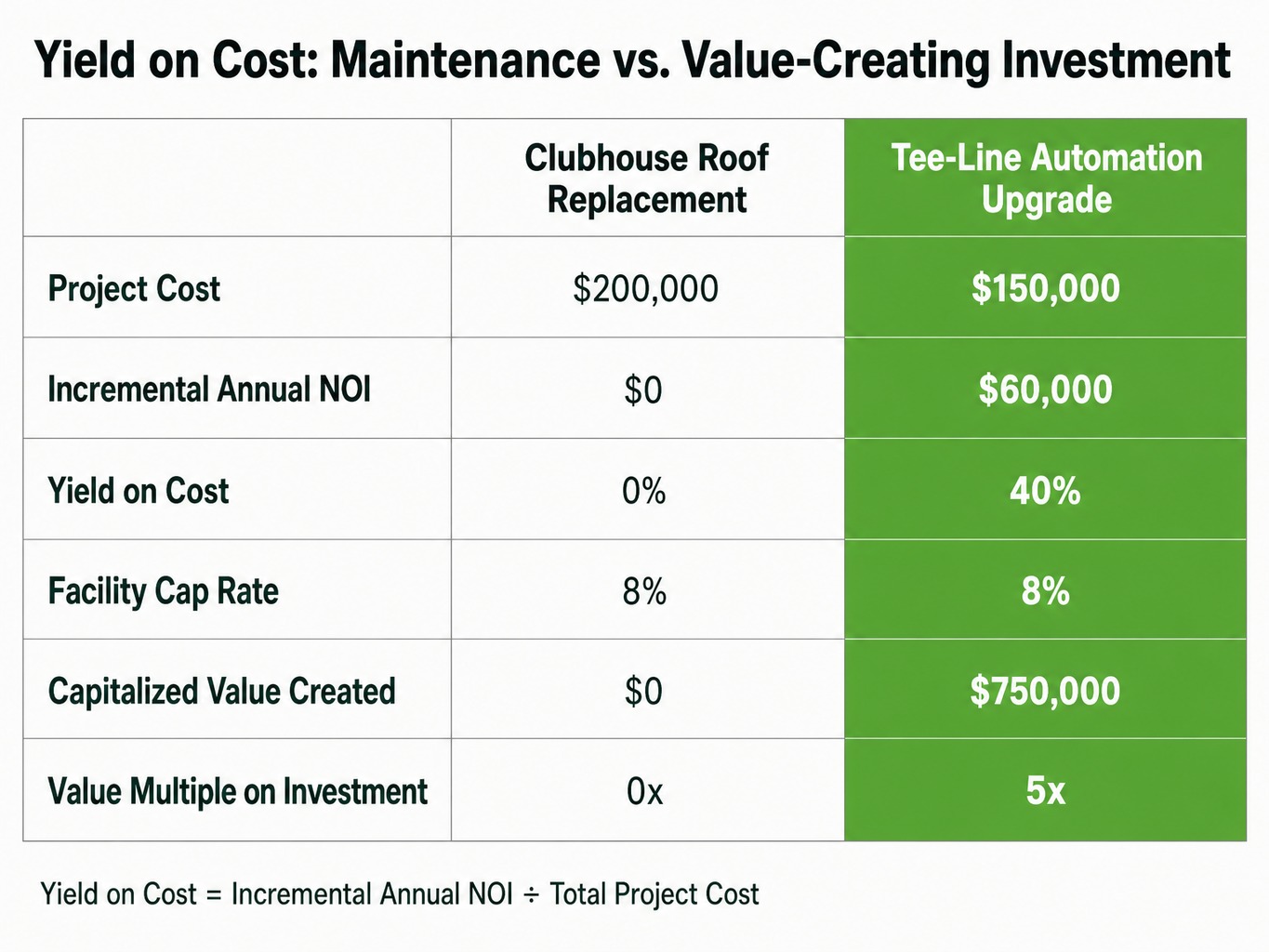
Yield on cost measures the return generated by a capital project. The formula is simple: Incremental Annual NOI / Total Project Cost
. If the resulting percentage exceeds your facility’s market cap rate, the project creates more value than it costs.
Let’s compare two projects. Replacing a clubhouse roof for $200,000 is necessary maintenance, but it generates zero incremental revenue, so its yield on cost is 0%. Now, consider a $150,000 investment to upgrade 20 tee-line stations with commercial-grade automatic teeing. If that project generates $60,000 in new annual NOI (from increased ball sales and higher session value), the yield on cost is a powerful 40% ($60,000 / $150,000).
At an 8% facility cap rate, that $60,000 in new, sustainable NOI translates to $750,000 in incremental facility value
. The investment didn’t just pay for itself; it created a 5x return in capitalized value. This is the core of the investment thesis. Most operators think about range upgrades in terms of a simple payback period, but lenders and investors think in terms of capitalized value creation.
Throughput Per Bay: The Operational Lever That Moves NOI
The financial framework is only half the story; the other half is the operational mechanism. Range NOI is a direct function of balls sold per bay, per hour. The single biggest constraint on that metric is the friction in a golfer’s session.
When a golfer must break their stance, bend down, and manually re-tee a ball after every shot, their rhythm is broken, and they hit fewer balls in the same time window. This means fewer buckets sold, lower bay utilization during peak hours, and less ancillary spend because sessions are shorter and less engaging.
This is where automatic teeing systems directly change the operational and financial equation. By delivering a consistent practice experience and eliminating the manual re-teeing process, these systems increase the number of balls a golfer can hit. In fact, many Power Tee customers report revenue increases of 30% to 50% after installation, alongside higher food and beverage sales, because golfers enjoy the experience and stay longer. These are facility-specific results, but they demonstrate the mechanism.
Let’s connect this back to valuation. Imagine your range generates $200,000 annually. A 40% increase in throughput pushes that to $280,000. Assuming minimal incremental operating costs, that $80,000 increase flows almost entirely to the bottom line. At a 7.5% cap rate, that $80,000 in new NOI implies over $1 million in incremental facility value
. The chain is direct: a better tee-line experience leads to more balls hit, which drives higher NOI and, ultimately, a more valuable asset.
Due Diligence Beyond the Appraisal: What Investors and Operators Miss
Standard golf course due diligence is rigorous but often misses the nuances of the practice facility. An agronomic audit of the course should be paired with a tee-line condition assessment, yet the condition of mats and teeing equipment is almost never inventoried with the same discipline as irrigation heads or HVAC units. This is a risk for both buyers and sellers.
Here are three areas to examine that go beyond the typical appraisal scope:
-
Deferred Maintenance at the Range:
Worn hitting surfaces, inconsistent rubber tees, and aging ball-dispensing equipment directly degrade the golfer experience. This suppresses repeat visits and per-session spend in ways that are invisible in a single-quarter P &L review. A buyer may inherit a range that systematically underperforms its potential, while a seller leaves value on the table by not demonstrating what the range could produce with modern equipment. -
Water Rights and Allocation:
Especially in the western U.S., adjudicated water rights can represent a significant portion of a facility’s value. Range irrigation is part of that equation. Water availability and cost affect not only course maintenance budgets but also the long-term viability of maintaining natural grass tee areas versus converting to high-performance, all-weather mat systems that reduce water and labor costs. -
Environmental Compliance:
Regulations governing wetlands, water runoff, and chemical use can affect operating costs and limit future expansion. A buyer must understand how these constraints apply to the range footprint specifically. An inability to expand netting or add lighting due to environmental restrictions can cap the revenue potential of the practice facility, directly impacting its contribution to the overall valuation.
Daily-Fee vs. Private Club: Where Range Investment Moves the Needle Most
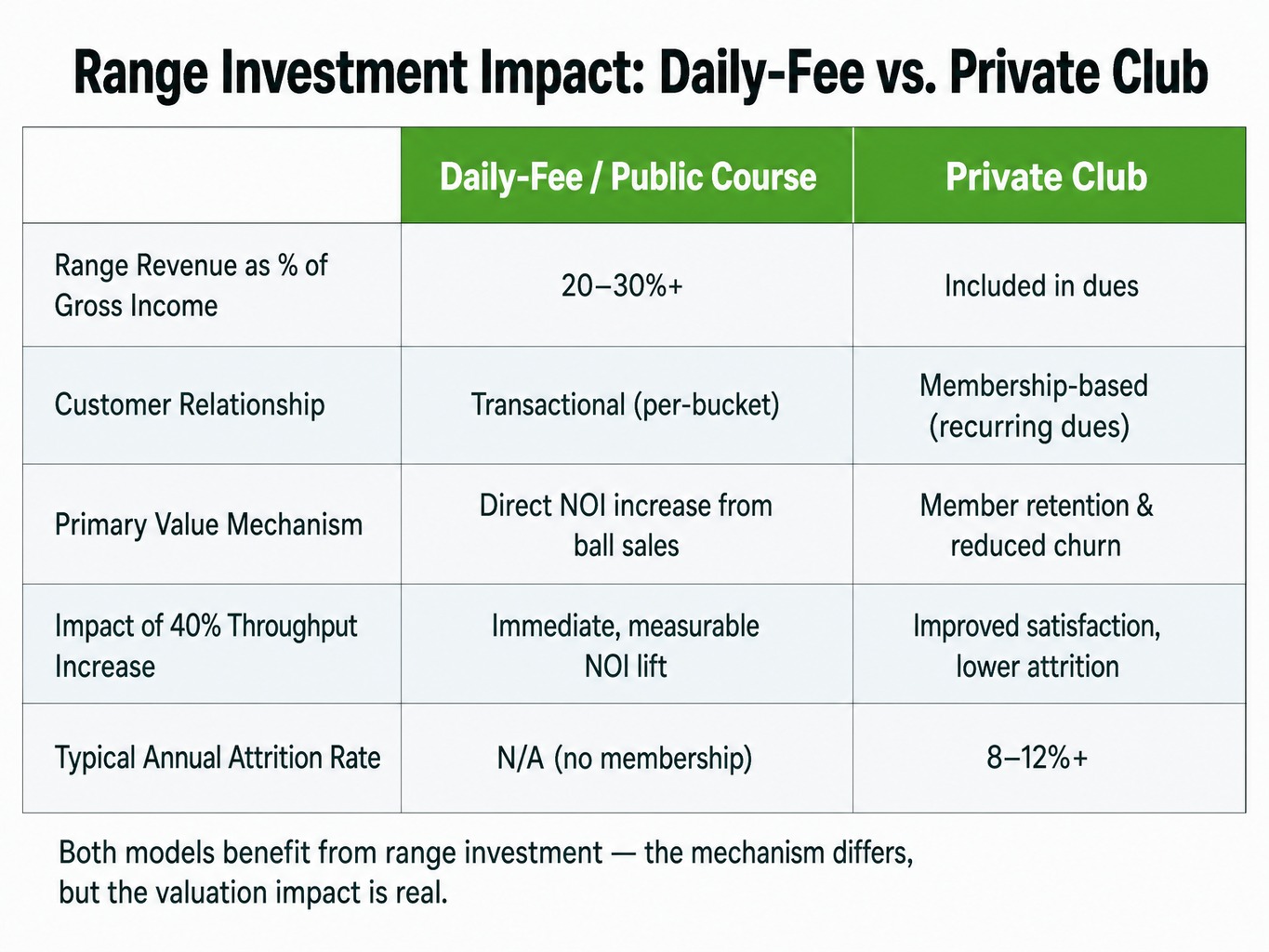
The valuation impact of a range capital improvement is not uniform across all facility types; it depends on the business model.
For daily-fee and public courses
, the connection is most direct. Range revenue is typically a higher percentage of gross income (often 20-30% or more), and the customer base is transactional. Every extra bucket sold contributes directly to the bottom line. For these facilities, a throughput-focused investment that increases ball volume by 40% can have a dramatic and immediate impact on NOI and, therefore, the facility’s appraised value.
For private clubs
, the calculus is different but still powerful. While range use is often included in membership dues, the practice experience is a critical driver of member satisfaction and retention. As most club managers know, annual membership attrition rates can run from 8% to 12% or higher. A modernized practice facility that offers a better training environment can be a key factor in reducing that churn. Lowering attrition directly improves the present value of the club’s future dues stream a core component of how private clubs are valued. An improvement that reduces churn by even a few percentage points can justify the capital investment many times over.
Where Automatic Teeing Fits in the Capital Improvement Case
The entire argument of this article builds to a specific tension: range throughput is the underleveraged variable in golf course valuation, and the physical tee-line experience is the bottleneck. The resolution is not an abstract concept; it is a specific type of capital improvement engineered to solve this exact problem.
Power Tee is a patented automatic teeing system delivered as a complete operating solution: commercial-grade hardware, premium mat surfaces, expert installation, comprehensive warranty, and ongoing support. It is built for facilities that need to increase balls hit per session and turn their range into a more significant revenue driver.
With a 30-year track record and installations at globally recognized venues like St Andrews, The Belfry, and Dromoland Castle, the system is proven to withstand heavy commercial use and deliver a better practice experience. While results are always facility-specific, many Power Tee customers have reported revenue increases of 30% to 50% by enabling golfers to find their rhythm and hit more balls. Because the valuation impact depends on your bay count, current ball volume, and revenue model, the next step isn’t a generic quote. It’s a professional conversation about your facility.
The Final Word on Range Investment and Valuation
If there is one belief to challenge, it is that a golf course’s value is a fixed number determined by its land and historical rounds played. The reality is that valuation is a dynamic function of NOI, and for many facilities, the driving range is the most underleveraged asset on the P&L.
Standard appraisals often treat the range as a static amenity, overlooking its potential to drive significant income growth. However, operators and investors who understand the mechanics of throughput can make targeted capital improvements to the tee line that measurably shift NOI and, through the power of capitalization, create outsized returns in facility value.
Whether you are buying, selling, or recapitalizing a golf course investment, the question is no longer if the range matters to valuation. The real question is whether your current tee-line experience reflects the facility’s true earning potential or actively suppresses it.
Frequently Asked Questions
What cap rate should I expect when evaluating a golf course in 2026?
As a general benchmark, golf course cap rates typically range from 7% to 10%. Upscale private clubs in strong markets may trade at the lower end of that range (6.5%-8%), while municipal or lower-margin daily-fee courses often fall into the higher end (8.5%-10%). These rates are higher than many other commercial real estate classes, reflecting the operational complexity and seasonal volatility inherent in the golf business.
What is the difference between a golf course appraisal and a broker opinion of value?
A USPAP-compliant appraisal is a formal, legally defensible valuation performed by a certified appraiser using standardized methodologies, and it is required for financing, tax disputes, or litigation. In contrast, a broker opinion of value (BOV) is an informal market estimate based on a broker’s experience and recent comparable sales. A BOV is useful for preliminary pricing discussions but carries no legal standing and may be influenced by a broker’s incentive to secure a listing.
How much does deferred maintenance typically reduce a golf course sale price?
The discount for deferred maintenance varies widely but can easily range from 5% to 20% of the facility’s otherwise-indicated value. A critical item like an irrigation system replacement can cost $1 million to $3 million for an 18-hole course, and a savvy buyer will deduct that full cost from their offer. Tee-line infrastructure worn mats, outdated equipment is often a smaller but still significant component, representing $50,000 to $200,000 or more in deferred investment that actively suppresses revenue.
How do you value a golf course with adjacent developable land?
The standard method is to disaggregate the appraisal into two parts. First, value the operating golf course as a going concern using the income capitalization approach. Second, value the developable land separately based on comparable raw land sales and a highest-and-best-use analysis. It is critical to apply a discount to the land value to account for entitlement risk, as unentitled land trades at a significant discount to parcels that are already zoned and approved for development.
What financial documents do I need to appraise a golf course?
An appraiser will require, at a minimum, three to five years of detailed profit-and-loss statements, balance sheets, and business tax returns. You should also prepare a current membership roster or rent roll, a history of capital expenditures, and a schedule of all furniture, fixtures, and equipment (FF &E). For the most accurate valuation, provide a granular breakdown of revenue by source (green fees, carts, range, F &B, events) and a detailed payroll schedule. The more specific your range data is, the better.


