


Key Takeaways
- Your facility’s food and beverage (F &B) revenue is limited by foot traffic and dwell time, not the quality of your menu. Extending the time golfers spend on site is the most effective way to increase secondary spend.
- Focus on high-margin, low-labor menu items. For facilities without a kitchen, this means grab-and-go items and vendor partnerships. For those with kitchens, it means a short, targeted menu that matches traffic patterns.
- The standard four-person scramble with a boxed lunch caps your F &B potential. Shift to non-tournament events and tiered catering packages with minimum spends to drive higher per-capita revenue.
- A better practice experience tends to increase F &B sales. When golfers are more engaged, they hit more balls, stay longer, and are more likely to make impulse food and beverage purchases.
- Improving the tee line, for example with automated teeing, is one way to build the larger, more engaged audience your F &B program needs to become a consistent revenue driver.
Most golf facility operators treat an underperforming food and beverage program as a menu problem. They redesign the snack bar, add craft beer, or hire a better cook, only to see the numbers stay flat. The real constraint on your golf course food and beverage revenue is not how creative the menu is; it is how many people are on site and, more important, how long they stay.
A facility with strong foot traffic and long dwell times will typically outperform one with a better menu but thinner crowds. At most golf facilities, food and beverage operates at a structural disadvantage because the range session is too short and the capture window too narrow to convert foot traffic into secondary spend. This means that extending dwell time, by whatever method fits your facility, widens the revenue window an F &B program needs to become profitable.
This article provides a practical F &B strategy for golf course and driving range operators. We will cover high-margin menu ideas, event formats that generate catering revenue, and the overlooked connection between the range experience and your facility’s bottom line.
Why Food and Beverage Underperforms at Most Golf Facilities
The underperformance of most golf facility F &B programs is rarely a food-quality issue it is a traffic and capture-rate problem. There are three structural reasons why operators consistently leave F &B revenue on the table.
First, golfers finish their round or bucket and leave immediately because there is no compelling reason to linger. Second, the F &B service point is often physically disconnected from where golfers spend their time, requiring a deliberate detour that breaks their flow. Finally, many operators treat F &B as a cost center to be minimized rather than a revenue stream to be designed around traffic patterns.
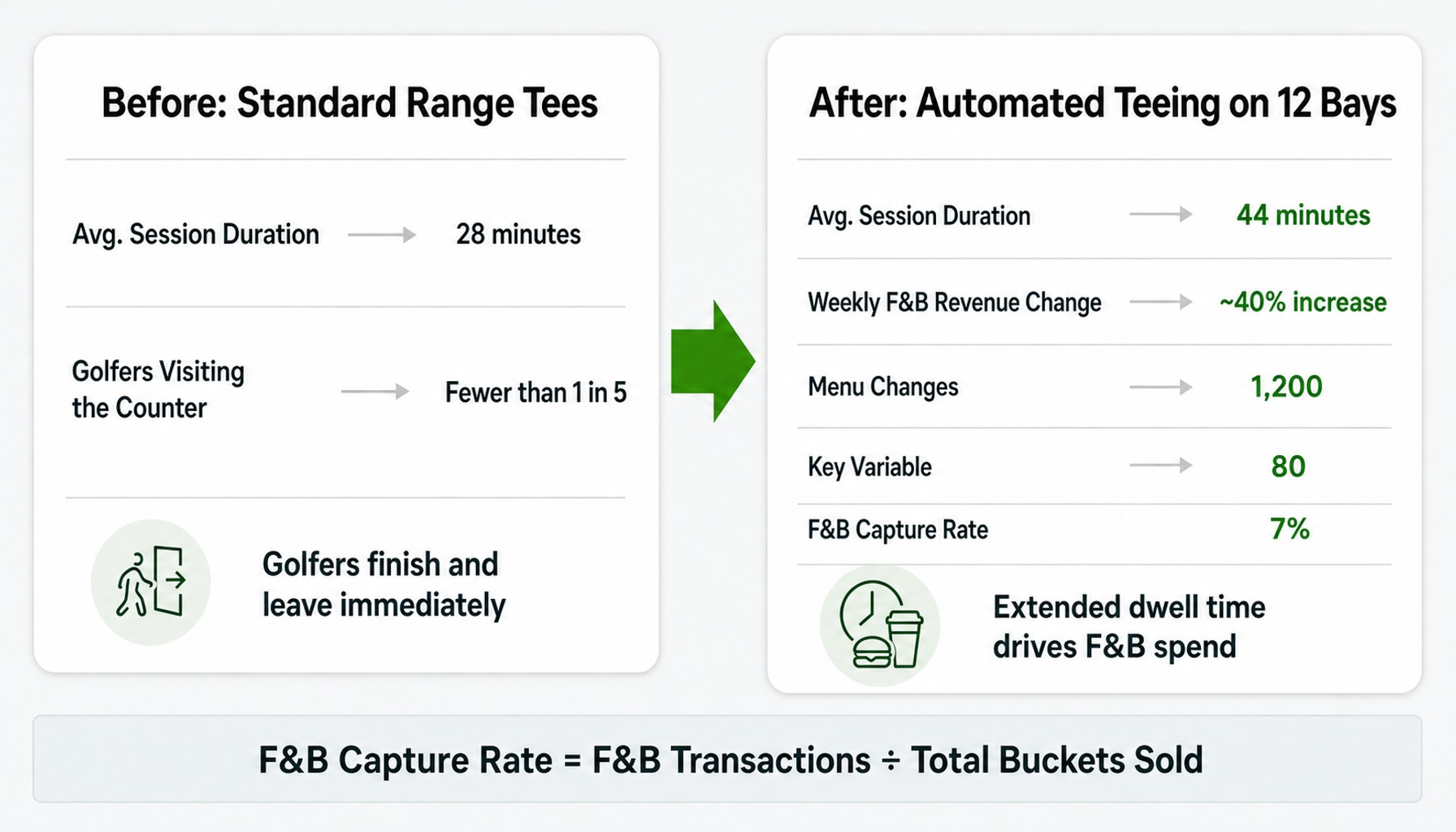
Consider a 40-bay public range in the Southeast that ran a respectable snack bar. The problem was that average range sessions lasted just 28 minutes, and fewer than one in five golfers walked to the counter before leaving. When the facility extended average range sessions to 44 minutes by adding automated teeing on twelve bays, the snack bar’s weekly revenue climbed roughly 40 percent without a single menu change. The variable that moved was time on site, not food quality. Weekly revenue alone does not show where the gap sits, though; the F &B capture rate is the metric operators should actually be tracking. A facility that sells 1,200 buckets on a Saturday but captures fewer than 80 food or beverage transactions has a capture rate under 7%. It is feeding traffic to the parking lot, not the snack bar.
High-Margin Snack Bar and Concession Ideas for Golf Facilities
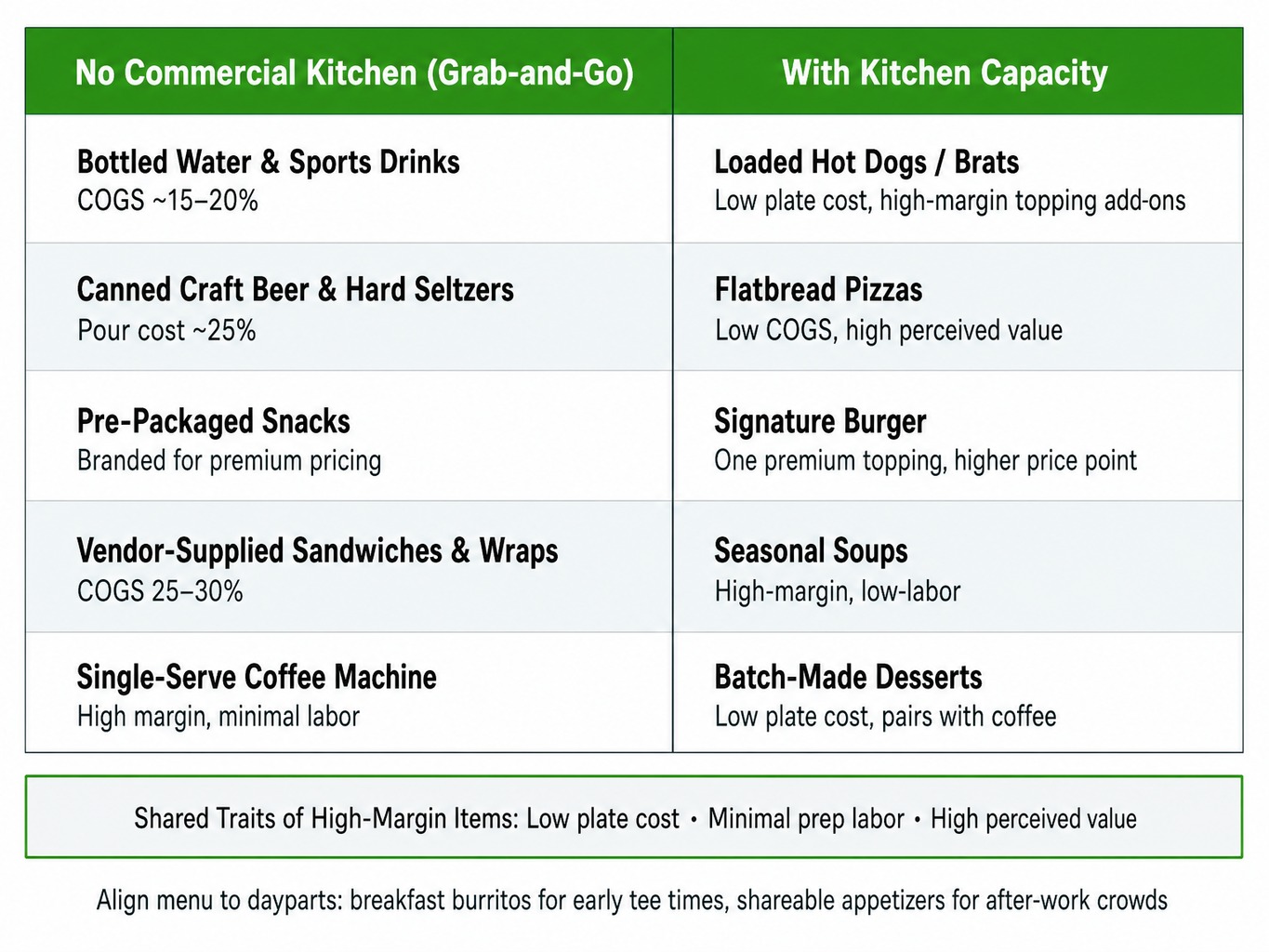
Menu engineering for a golf facility is not about culinary ambition. It is about speed of service, margin per item, and compatibility with how golfers consume food: standing, between shots, or on the move. The highest-margin items share three traits: low plate cost, minimal prep labor, and high perceived value.
The best approach depends on your facility’s kitchen capacity.
Grab-and-Go Items for Facilities Without a Commercial Kitchen
Many driving ranges and smaller facilities lack a commercial kitchen, but this can be an advantage for margins by eliminating significant labor cost and food waste. A well-positioned grab-and-go cooler captures impulse purchases that a distant clubhouse snack bar misses.
Focus on these high-margin items that require no on-site cooking:
- Bottled Water and Sports Drinks: Often the highest-margin items, with a cost of goods sold (COGS) percentage around 15-20%.
- Canned Craft Beer and Hard Seltzers: Higher price point and perceived value than domestic beers, with a pour cost that can be kept around 25%.
- Pre-Packaged Snacks: Chips, protein bars, and candy with your facility’s branding can command a premium.
- Vendor-Supplied Sandwiches and Wraps: Partner with a local deli to provide fresh items daily. This transfers inventory risk and can maintain a COGS of 25-30%.
- Commercial Single-Serve Coffee: A quality machine provides a high-margin beverage with minimal labor.
Another practical option is to invite a local food truck from the community to set up at the facility on peak days or during events. It is an excellent, low-overhead way to offer hot food without needing a commercial kitchen, and it gives you a way to test demand before committing to a larger food service investment.
Menu Items That Work for Facilities With Kitchen Capacity
For facilities with a kitchen country clubs, resorts, and larger municipal courses the key is to build a short, high-margin menu around traffic patterns, not a full restaurant menu. Over-engineering the menu increases waste, slows service, and inflates labor costs.
Consider these items that balance margin with golfer expectations:
- Loaded Hot Dogs or Brats: A low plate cost with high-margin topping add-ons. They are fast to prepare and easy to eat.
- Flatbread Pizzas: High perceived value, easily customizable, and a low COGS. They can be prepared quickly in a convection or pizza oven.
- A Signature Burger: A simple, high-quality burger with one premium topping allows for a higher price point while keeping prep manageable.
- Seasonal Soups: During cooler months, a soup of the day is a high-margin, low-labor option that can be held for service.
- Batch-Made Desserts: Items like cookies or brownies are easy to prepare in volume, pair well with coffee, and have a low plate cost.
Use daypart mix analysis to align offerings with traffic think breakfast burritos for early tee times and shareable appetizers for the after-work crowd.
How Dwell Time at the Range Drives Food and Beverage Spend
The single most controllable variable in your F &B revenue is not the menu, the pricing, or the service model it is how long golfers stay on site. Every additional 15 minutes of dwell time increases the probability of a food or beverage purchase.
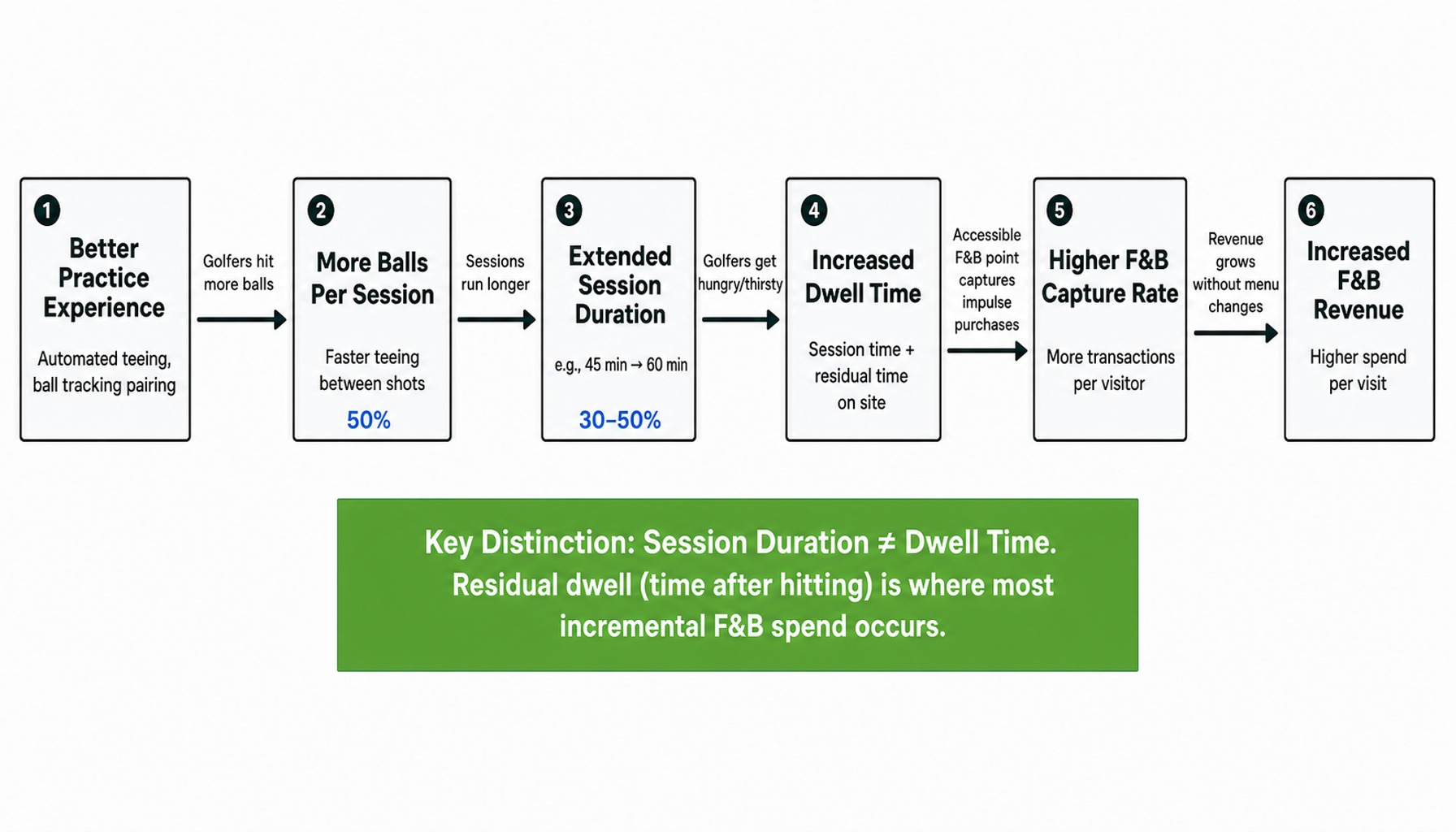
The causal chain is simple: when golfers have a better practice experience, they hit more balls and stay longer. When they stay longer, they get hungry or thirsty. When the F &B purchase point is accessible and quick to use, the conversion happens naturally. Consider a facility where the average range session is 45 minutes. If that session were extended to 60 minutes by making the practice experience more engaging, the F &B capture rate would increase without changing a single menu item.
Tee-line technology such as automated teeing is one way to extend that session. It is important to distinguish session duration from dwell time; a golfer might finish hitting in 45 minutes but remain on site for another 20 if the environment encourages them to stay. That residual dwell is where most incremental F &B spend occurs. Investments in the practice experience are therefore also investments in F &B revenue, because they lengthen the window in which your snack bar or grill can make a sale.
Event Formats That Generate the Most Food and Beverage Revenue
Events are a cornerstone of golf facility F &B programs, but most operators default to the same four-person scramble with a bundled boxed lunch, leaving significant per-cap spending on the table. The highest F &B revenue comes from formats with built-in minimum-spend requirements, longer on-site duration, and continuous beverage service.
Tournament Catering Packages That Protect Margins
Most facilities underprice tournament catering by quoting per-head food cost without accounting for labor, setup, and the opportunity cost of closing the course. Instead of a la carte pricing, structure catering as tiered packages (e.g., Bronze, Silver, Gold) with minimum-spend thresholds.
- Bronze Tier: Grab-and-go lunch (wrap or sandwich) and soft drinks.
- Silver Tier: Hot buffet lunch with two sides, plus beer and wine service.
- Gold Tier: Plated meal or premium buffet, full hosted bar, and an appetizer station.
Finalize the Banquet Event Order (BEO) at least 10 days out to lock in par-level inventory and staffing. And remember that while bundled pricing simplifies invoicing, F &B margins are often highest when alcohol is sold based on consumption rather than included in a flat fee, as it removes the cap on your upside.
Non-Tournament Events That Drive Higher Per-Cap F &B Spend
The highest per-capita F &B spend often comes from non-tournament events where food and beverage is the experience, not an afterthought.
Consider these formats:
- Range Nights with Food Trucks and Live Music: This format attracts non-golfers and families who spend primarily on F &B. The facility takes a percentage of food truck sales, adding revenue with low operational lift.
- Wine or Craft Beer Tastings: Pair a beverage-forward tasting event with a nine-hole twilight round or a range competition. Pour margins on tasting events are typically very high.
- Corporate Networking on the Range: Host corporate clients for an evening of practice with bay-side appetizer and beverage service. The range becomes the venue, and F &B is continuous, driving higher ticket averages than a single post-round meal.
- Holiday and Seasonal Parties: Rent out the clubhouse or patio for private events with an F &B minimum. This creates a double revenue stream from the rental fee and the minimum catering spend.
F &B Staffing, Technology, and Operational Efficiency
A great menu and strong foot traffic will still underperform if your operational infrastructure cannot keep up. The speed of service window at a golf facility is narrow. A golfer will buy a drink if it’s quick, but they will walk away if the process is slow. Efficient operations are not about cutting costs; they are about capturing revenue that is lost to friction.
POS Systems and Mobile Ordering for Golf F &B
The specific POS system matters less than its ability to integrate with your tee sheet and track revenue by daypart, event, and customer segment. Systems commonly used at golf facilities include Toast POS, Square for Restaurants, and integrated platforms like ForeUP and Lightspeed Golf. For private clubs, Jonas Club Software and Club Prophet Systems are frequent choices.
The real value of an integrated POS is data. It allows you to see which days generate the most F &B revenue and which menu items have the highest ticket average. Furthermore, implementing mobile ordering via QR codes at each bay lets golfers order without leaving their hitting station. This captures impulse purchases and reduces the labor needed to take orders, directly improving your F &B capture rate.
Seasonal Staffing Models for Range and Course F &B
Golf F &B demand is highly seasonal and concentrated in specific dayparts, making staffing a unique challenge. Overstaffing erodes margins, while understaffing leaves revenue uncaptured. The goal is a labor-to-revenue ratio that remains between 25-35% during peak months.
A flexible model works best: one full-time F &B lead who manages inventory, vendors, and ServSafe compliance, supplemented by part-time staff scaled to seasonal traffic and event schedules. For facilities without the volume to justify dedicated staff, third-party vendor partnerships are a strong alternative. A revenue-share agreement with a quality local food truck provides a consistent F &B offering without any direct labor cost or inventory risk.
How the Tee-Line Experience Creates a Bigger F &B Audience
The central challenge for any golf course food and beverage program is converting foot traffic into sales. This requires keeping golfers on site long enough for them to make a purchase, and much of that time is determined at the tee line.
An automated tee line is one practical way to do that. When practice is more enjoyable and effective, golfers return more often, which increases foot traffic. Faster teeing also means golfers hit more balls per session, and a more enjoyable practice experience gives them a reason to buy another bucket and stay longer. Where the environment encourages golfers to linger, that extends the residual dwell time in which F &B sales happen. Power Tee customers often see range revenue rise by 30-50%, and that added range traffic is the audience your F &B program draws from.
Ranges typically charge for practice in one of two ways: per bucket or through monthly or annual memberships. Facilities that charge per bucket see the revenue impact most directly, because every additional ball hit is billable. Facilities that run memberships benefit differently, through more frequent visits and higher foot traffic, which is the audience the snack bar depends on.
By making the core practice experience better, you create the larger, more engaged audience your F &B program needs to convert. Part of that engagement comes from pace: compared with standard range tees, automated teeing like Power Tee keeps golfers in rhythm between shots. Ball tracking such as Toptracer, TrackMan, and InRange adds engagement of its own, but it also slows the rate of shots, because golfers stop to watch the screen after each one. Power Tee is fully compatible with these systems and speeds up play between hits, since the next ball is teed automatically, which offsets the time spent watching the screen. The tee line and the snack bar are not separate line items; they are a connected revenue system.
If you are comparing tee-line systems, the three names that usually come up are Range Automation Systems (RAS), Wittek, and Range Servant. The practical questions for an owner are how the system holds up under daily commercial use, how quickly golfers can reload between shots, and how the mat and teeing components work together. Power Tee’s answers to those questions are a patented auto-tee platform designed for constant daily use, a hopper that keeps balls feeding between shots, and an ongoing support service after installation. On mats, MyGolfSpy has noted golfer complaints about Wittek mats, including turf bounce, little forgiveness on fat shots, and wear in the foam layer. For facilities running Wittek systems, Power Tee is an all-in-one replacement for their mats and trays, combining premium fiberbuilt mat surfaces and automated teeing in a single system.
Power Tee’s own reported figures (8M+ balls, 200+ ranges, 30 years, 18 countries, and 80%+ of UK ranges) describe its operating history, but results still vary by facility, so it is worth modeling traffic, pricing, and F &B capture for your own site before committing to a capital purchase.
The most critical shift in thinking for any operator is this: golf course food and beverage revenue is not primarily a menu problem. It is a foot traffic and dwell time problem. High-margin menu items and well-structured events matter, but they only work when golfers are on site long enough to buy.
The facilities that consistently capture more secondary revenue plan the practice experience and the F &B program together. Before redesigning the snack bar menu, it is worth checking whether your tee line gives golfers a reason to stay. The most effective F &B investment you can make may not be in the kitchen at all. If you are evaluating a tee-line upgrade, take the next step and contact Power Tee here to start a consultation and model facility-specific results.
Frequently Asked Questions
Do you need a full commercial kitchen to offer food service at a driving range?
No. Many high-performing driving range F &B programs operate with only grab-and-go coolers, coffee machines, and partnerships with local food trucks. A commercial kitchen adds menu flexibility but also introduces significant labor, equipment, and compliance costs. Facilities without a kitchen can achieve strong F &B margins by focusing on pre-packaged items and vendor arrangements.
How do golf course operators calculate food and beverage profit margins?
Start with COGS percentage: divide the cost of ingredients by F &B revenue. Most facilities target 25-35% COGS on food and 18-25% pour cost on beverages. Then, factor in your labor-to-revenue ratio, which should be 25-35% in peak season. After accounting for fixed overhead, a well-run F &B program can achieve a net margin of 10-20%.
How do food trucks compare to a permanent snack bar at a golf facility?
Food trucks eliminate facility labor costs, kitchen maintenance, and inventory risk. The tradeoff is a lower margin per sale (typically a 15-25% revenue share for the facility) and less control over menu and availability. Food trucks are an excellent option for facilities without kitchen infrastructure or those wanting to test F &B demand before investing in a permanent setup.
What liquor license type does a golf course or driving range need for beverage service?
Requirements vary by state and municipality, but most facilities need either a full on-premises liquor license or a more limited beer-and-wine license. The application process can take several months, so plan ahead. Always consult your state’s alcohol beverage control board and a local attorney specializing in hospitality licensing before launching a beverage program.
How does mobile ordering technology improve food and beverage throughput at a golf course?
Mobile ordering via QR codes at each bay or on the course allows golfers to place orders without walking to the counter. This reduces the labor needed for taking orders, shortens wait times, and captures impulse purchases that would otherwise be lost. The primary operational benefit is a higher F &B capture rate with fewer front-of-house staff.
Does an automated teeing system hold up on a busy range?
It can, provided the system is designed for commercial use rather than light-duty practice. Look for teeing hardware built for constant daily use and a supplier that provides ongoing support. Power Tee is fully compatible with ball-tracking technology like Toptracer, TrackMan, and InRange systems already installed on the range. Its residential option, Power Tee Home, is a separate product line, so a busy commercial range should specify the commercial system.


