


Key Takeaways
- Focus on recurring revenue models like range memberships and lesson packages, which provide predictable cash flow and are more valuable than one-time bucket sales.
- For facility-based businesses like driving ranges, success hinges on throughput and bay utilization, not just location. The quality of your tee-line experience directly impacts revenue per bay.
- Don’t overlook revenue layers inside your existing facility. Player development programs, range memberships, and F&B capture can lift revenue per visitor without adding land or bays.
- Before adding new bays, audit your existing tee line. Upgrading the practice experience on the bays you already have is often a higher-return capital decision than expanding capacity.
- Use the four-part evaluation framework Capital, Revenue Model, Market Fit, and Operator Skills to determine which revenue model genuinely fits your facility.
A search for golf business ideas returns endless lists of concepts aimed at first-time entrepreneurs, each described in a sentence or two. If you already run a driving range or golf facility, most of that advice doesn’t apply. Your question isn’t which golf business to start; it’s which revenue models will grow the facility you already have. The golf industry is a massive market, with post-pandemic participation growth holding strong into 2026, but the facilities that grow aren’t necessarily the ones that add the most capacity. They’re the ones that match capital to the revenue model with the highest return.
The real problem isn’t a lack of ideas; it’s a lack of economic context.
This guide provides that context. Instead of a padded list, you’ll get a focused set of golf business ideas for range operators, organized by model type, grounded in real revenue potential, and followed by a decision framework you can apply to your own facility. We’ll cover three areas:
- Facility Models: How driving ranges and entertainment-format venues make money, and where the ceiling is.
- Revenue Layers: Programs you can add inside an existing facility, like player development.
- Recurring Revenue Models: The income structures that compound over time.
Facility-Based Golf Businesses: Highest Capital, Highest Ceiling
Facility-based golf businesses represent the most significant capital investment but also offer the highest revenue ceiling and the most defensible local market position. These are brick-and-mortar operations that anchor a local golf economy. However, they also carry the most operational complexity, including staffing, maintenance, weather exposure, and capital equipment cycles. A common scenario plays out in facility budget meetings: a GM earmarks six figures to add two new bays while the existing 24-bay tee line still runs on range tees and mismatched mats. Model the per-bay revenue difference, and the higher-return capital deployment is often upgrading the 24 existing bays, not adding two new ones.
Driving Ranges and Practice Facilities
A standalone driving range is one of the most underrated golf business ideas because it avoids the massive land and maintenance costs of a full 18-hole course while capturing the highest-frequency golfer behavior: practice. A range is a throughput business.
Consider the math for a 20-bay facility in a mid-size metro area. Hitting 1.2 million balls per year at an average of $0.06 per ball generates $72,000 in ball revenue alone. Add in lesson fees, club regripping, and a small F&B operation, and the revenue picture becomes compelling. But total revenue is the wrong metric to focus on; revenue-per-bay is a more diagnostic metric because it exposes whether growth is coming from utilization improvement or simply adding capacity.
The ceiling depends entirely on bay utilization and throughput. Operators who invest in the tee-line experience with quality mats and automatic teeing systems that enable a smoother practice rhythm consistently find that golfers hit more balls and stay longer. This directly lifts revenue per bay. Startup costs for a basic outdoor range can range from $200,000 to $500,000, but a technology-equipped facility can easily exceed $1M.
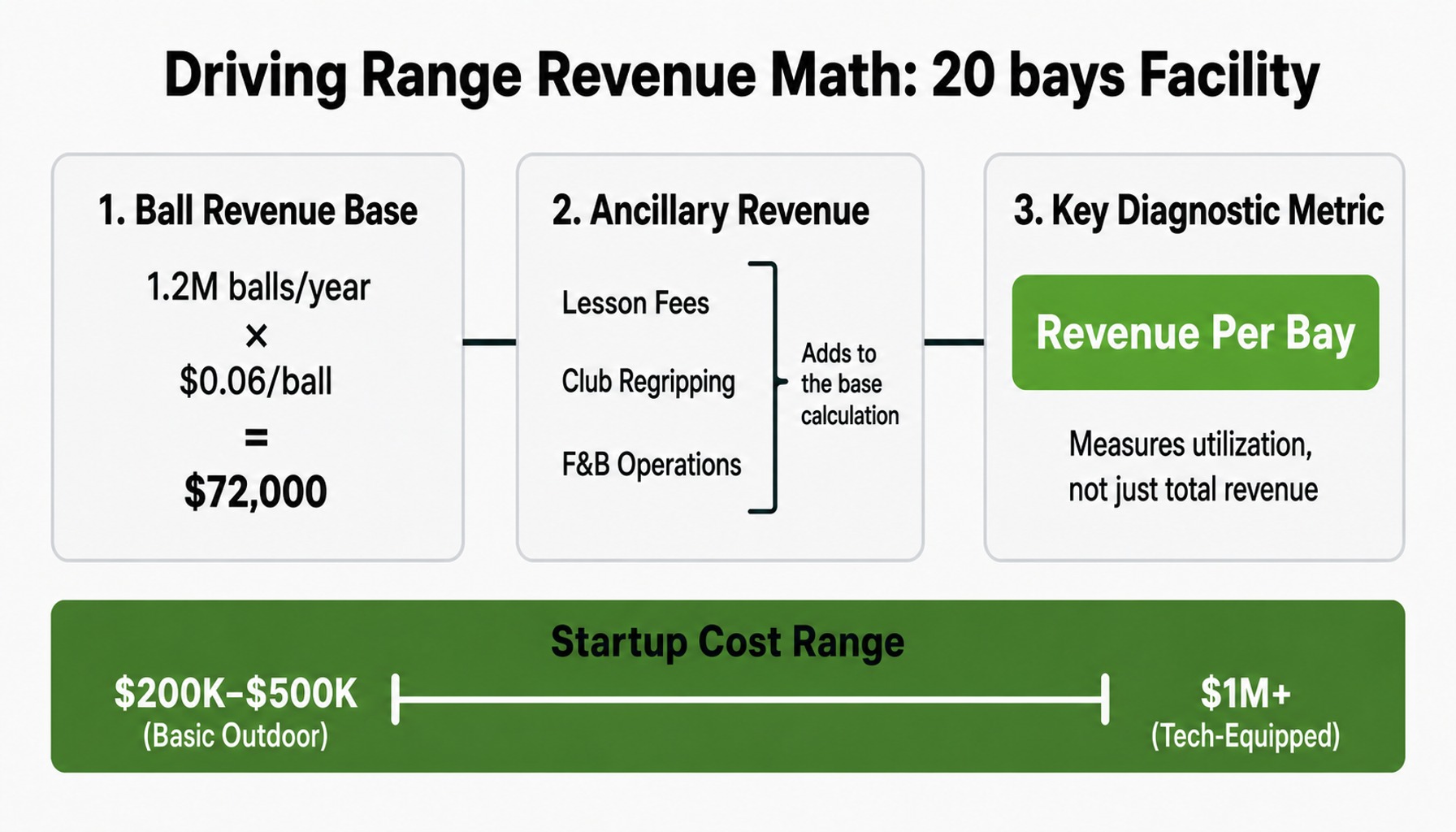
Revenue-per-bay, not total revenue, is the metric that matters for range operators.
Entertainment-Format Golf Venues
Entertainment-format venues are a different beast. While they have hitting bays, they are fundamentally hospitality businesses where golf is the anchor activity, not the primary profit center. For these models, food and beverage often accounts for 40-60% of total revenue.
The independent model looks like this: 10-30 bays equipped with ball-tracking technology, a full kitchen and bar, dedicated space for corporate events, and programmed activities like leagues and trivia nights. The key financial metric is ancillary revenue per visitor. The business succeeds when a group of four stays for two hours and spends $150 on food and drinks, not just when they hit a large bucket of balls.
This model requires deep hospitality and event management expertise. New builds often run from $2 million to over $10 million, depending on build-out and location. For an existing range, the more practical path is borrowing elements of the format upgraded bays, league programming, and a stronger F&B offer without a full conversion.
Revenue Layers You Can Add to an Existing Facility
Instruction, Club Fitting, and Player Development
Instruction and club fitting are well-known concepts, but most facilities underuse them as revenue layers. A single instructor renting bay time for $100-an-hour private lessons adds modest revenue and hits a ceiling quickly. To build a scalable program, you need leverage.
A more robust model is a player-development center that combines multiple revenue streams. This includes one-on-one instruction, but also group clinics, junior camps, and corporate programs. It incorporates technology-driven services like custom club fitting using launch monitors like Trackman or Foresight Sports GCQuad, which commands premium pricing. While PGA certification isn’t legally required to teach golf, it provides immense credibility and is often necessary for securing partnerships with top facilities. A successful instruction business is built on recurring student relationships and group formats, not just hourly appointments.
How to Evaluate Which Golf Business Idea Fits Your Situation
A list of golf business ideas is useless without a framework for choosing between them. Before committing capital or time, run any idea through these four evaluation criteria.
- Capital Requirement vs. Available Funding: Be honest about your financial reality. A new player-development program might require a modest investment in launch monitors and staff, while a tee-line upgrade or bay expansion can run well into six figures. Don’t just look at the sticker price; consider how financing structures can change the math. Equipment-heavy models, for instance, can often be funded through leases that turn a large capital expenditure into a predictable operating expense.
- Revenue Model Type: Is the business built on one-time transactions (e.g., selling a driver) or recurring revenue (e.g., a range membership)? Recurring models are almost always more valuable, more stable, and more attractive to lenders because they create predictable cash flow.
- Local Market Fit: An upgrade that differentiates your range works best when you know what nearby facilities offer. In a metro with no modern tee-line experience, a premium practice upgrade can become your competitive edge. In a market where competitors have already upgraded, it may be what it takes to keep your regulars. Use data from state golf associations and local Google Trends to gauge demand before you invest.
- Operator Skill Match: The best revenue layer is one your team can actually run. A facility with a strong F&B manager should lean into hospitality programming. A facility with PGA professionals on staff is a natural fit for a player-development academy. A lean team focused on throughput should prioritize upgrades that lift revenue per bay without adding labor.
Revenue Models That Compound: Why Recurring Income Separates Winners from Hobbyists
The golf businesses that survive and grow are the ones built on recurring revenue. One-time transactions force you to re-acquire your customer every single time, whereas recurring models create predictable cash flow, support financing, and dramatically increase customer lifetime value. A facility owner who picks a golf business model built on single-visit bucket sales often discovers that customer acquisition costs eat the margin on every new visitor.
Here are recurring models that work for range and facility operators:
- Bucket and Ball Programs: Instead of selling individual buckets, facilities that offer monthly or annual range memberships see visit frequency skyrocket. A customer paying $99/month for unlimited range balls is locked in, providing stable revenue and turning them into a regular at your facility.
- Lesson Packages & Subscriptions: Instructors who sell 10-session packages or monthly coaching subscriptions instead of single lessons transform their income from transactional to recurring, dramatically increasing the lifetime value of each student.
- F&B Capture as a Multiplier: Facilities that pair a strong practice experience with appealing food and beverage options see ancillary spend that compounds with visit frequency. While food-and-beverage revenue attribution at ranges is notoriously loose because most POS systems don’t tie F&B spend to specific bay sessions, the directional impact is clear. For example, some Power Tee customers have reported not only direct revenue increases of 30% to 50% from higher ball volume but also a noticeable lift in F&B sales because golfers enjoy the experience and stay longer.
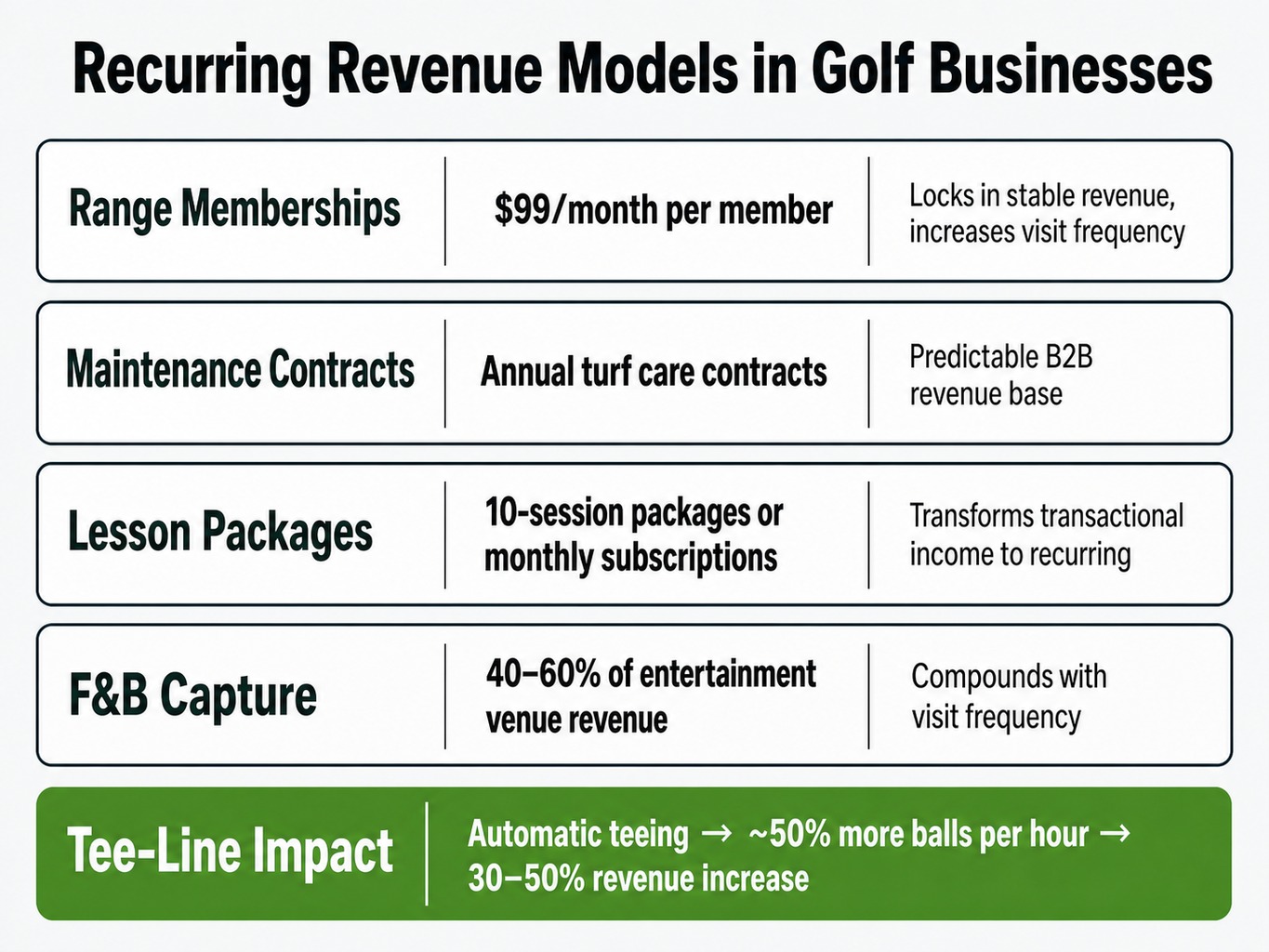
Recurring revenue models separate sustainable golf businesses from expensive hobbies.
What a Tee-Line Upgrade Looks Like in Practice
The argument for recurring revenue and facility throughput leads to a practical question for range operators: how do you actually increase visit frequency and per-bay spend without adding more land or extending hours? The answer lies in upgrading the core practice experience on the tee line.
Consider Power Tee’s automatic teeing system. It’s an example of the tee-line-as-a-revenue-engine thesis in action. The system automatically places a new ball on the tee after every shot, which allows golfers to stay in their stance, maintain rhythm, and hit more balls with less downtime. Facilities report that golfers using Power Tee hit roughly 50% more balls per hour, which can directly increase ball revenue and bay turnover.
Crucially for an operator evaluating a capital investment, this isn’t just hardware. It’s delivered as a complete operating solution: the patented teeing units, commercial-grade mat surfaces, professional installation, warranty, and ongoing support. This approach addresses the total cost of ownership and operational reliability. Facilities from local driving ranges to world-renowned venues like St Andrews, The Belfry, and Celtic Manor use the system. Many have reported significant revenue gains and stronger ancillary sales, though results are always facility-specific.
For operators serious about turning their range into a higher-revenue facility, the first step is understanding the specific economics of their own tee line.
Request a facility-specific consultation to see how automatic teeing fits your range economics.
Conclusion
The golf industry offers a wealth of genuine business opportunities, but the ideas that generate lasting income are not found on a simple list. They are built on a foundation of recurring revenue, operational leverage, and a clear-eyed match between an operator’s capital, skills, and local market. The most successful ventures are rarely the most glamorous; they are the ones that solve a specific problem so efficiently that customers return again and again.
You now have a set of revenue models built for facility operators and a framework for evaluating them. The next step is to run your top two or three options through the four-criteria model and see which ones hold up for your facility.
Frequently Asked Questions
Do I need a PGA certification to start a golf instruction business?
No, there is no legal requirement to hold PGA certification to teach golf in the United States. However, PGA or LPGA certification significantly improves credibility, access to facility partnerships, and the ability to charge premium rates. Most serious golf academies and clubs require or strongly prefer certified instructors for their programs.
What licenses and permits are required to open a driving range?
Requirements vary by municipality but typically include a business license, zoning approval, and environmental permits for water runoff. You will also need comprehensive liability insurance. If you plan to serve food and alcohol, you will need additional health department permits and a liquor license. Always start by consulting your local zoning office.
How has the post-pandemic golf boom affected business viability in 2026?
The participation surge from 2020-2021 has largely held, with sustained growth in off-course and practice-facility visits. For new businesses, this means demand is real, but so is competition. More operators have entered the market, so differentiating your business through a superior customer experience is more critical than ever to capture and retain customers.
What insurance do I need to operate a golf-related business?
At a minimum, you’ll need general liability insurance, commercial property insurance if you own or lease a facility, and workers’ compensation if you have employees. Entertainment venues with bar service will also require liquor liability coverage. It is highly recommended to work with an insurance broker who specializes in recreation or hospitality businesses to ensure you have adequate coverage.
How much does it cost to upgrade a driving range tee line?
Costs depend on the number of bays, facility layout, and site requirements, so pricing is quoted per project. Many operators fund tee-line upgrades through equipment leases, which spread the cost over several years and turn a large capital expense into a predictable operating expense. Installation typically takes one to three days depending on project complexity, which limits disruption to daily operations.


