


TL;DR
- A driving range business plan is a financial blueprint; its biggest risk isn’t underestimating startup costs ($425K–$2M+), but overestimating bay utilization by 30-40%.
- Stress-test your pro forma with downside scenarios: model what happens if utilization is 30% below projection, ball loss exceeds 8%, or a competitor opens nearby.
- Treat the tee line as a revenue multiplier, not a cost. The physical setup directly impacts throughput per bay per hour a key variable most plans ignore.
- Implement daypart yield management. Charging different prices for a bucket on a Tuesday morning versus a Saturday afternoon can increase per-bay revenue by 20–30%.
- Ancillary revenue from food & beverage (F&B) and memberships is critical. F&B can be your highest-margin stream, while memberships create predictable recurring revenue to smooth seasonal dips.
A driving range business plan is a financial and operational blueprint that maps startup capital, facility design, revenue streams, and break-even timing for a commercial golf practice facility. But let’s be direct: most aspiring range owners spend weeks refining their startup cost estimates and almost no time stress-testing their utilization assumptions. This is a critical mistake, because utilization error is what actually kills profitability.
Consider a common scenario: an operator budgets $1.2 million for land, netting, and equipment. Their pro forma financial statements project 70% bay utilization, assuming a steady stream of customers. Within six months of their soft opening, they discover the reality: peak-hour utilization on a Saturday is a respectable 55%, but off-peak utilization on a Tuesday morning is below 20%. The blended rate is nowhere near 70%, and the cash flow projections are already off track.
This guide covers the real cost breakdown for opening a range. But more importantly, it provides a framework for modeling revenue honestly. We will examine the operational economics that separate a profitable range from a cash-burning one, focusing on the variables that investors and lenders scrutinize most: utilization, throughput, and ancillary revenue streams.
What It Actually Costs to Open a Driving Range in 2026
Opening a driving range in 2026 typically requires $425,000 to $2 million or more in total startup capital. The range is wide because the single biggest variable is land a decision to lease versus purchase changes the entire capital stack. A smaller, 12-bay uncovered range on leased land might fall at the lower end of that spectrum, while a 30-bay covered facility with integrated technology on purchased land can easily exceed $1.8 million.
A credible business plan must break down these costs with realistic figures. Below is a typical breakdown, though figures will vary significantly by market.
| Line Item | Estimated Cost Range | Notes |
|---|---|---|
| Land Acquisition / Lease Deposit | $5,000 – $1,500,000+ | Lease deposit vs. full purchase of 8-15 acres. |
| Site Work (Grading & Drainage) | $40,000 – $150,000 | Critical for all-weather operation; often underestimated. |
| Netting & Poles (Containment) | $80,000 – $250,000+ | Depends on height (50-150 ft) and linear feet. |
| Tee-Line Construction | $75,000 – $400,000+ | Includes foundation, mats, dividers, and structure. |
| Clubhouse / Service Structure | $50,000 – $500,000+ | From a simple pro shop to a full F&B facility. |
| Range Balls & Picker Equipment | $30,000 – $80,000 | Includes initial inventory (20,000-50,000 balls) and machinery. |
| Lighting for Night Operations | $40,000 – $120,000 | Essential for maximizing peak evening hours. |
| Technology (e.g., Toptracer) | $60,000 – $180,000 | Often leased; cost per bay installation. |
| Permits, Insurance, Legal | $15,000 – $50,000 | Zoning, conditional use permit, liability insurance. |
| Initial Working Capital | $50,000 – $150,000 | 6-12 months of operating expenses, as required by most lenders. |
The tee-line buildout is where operators are often tempted to cut costs, yet it is the primary revenue-generating surface of the entire facility. Under-investing here relative to its impact on revenue is a common but avoidable error.
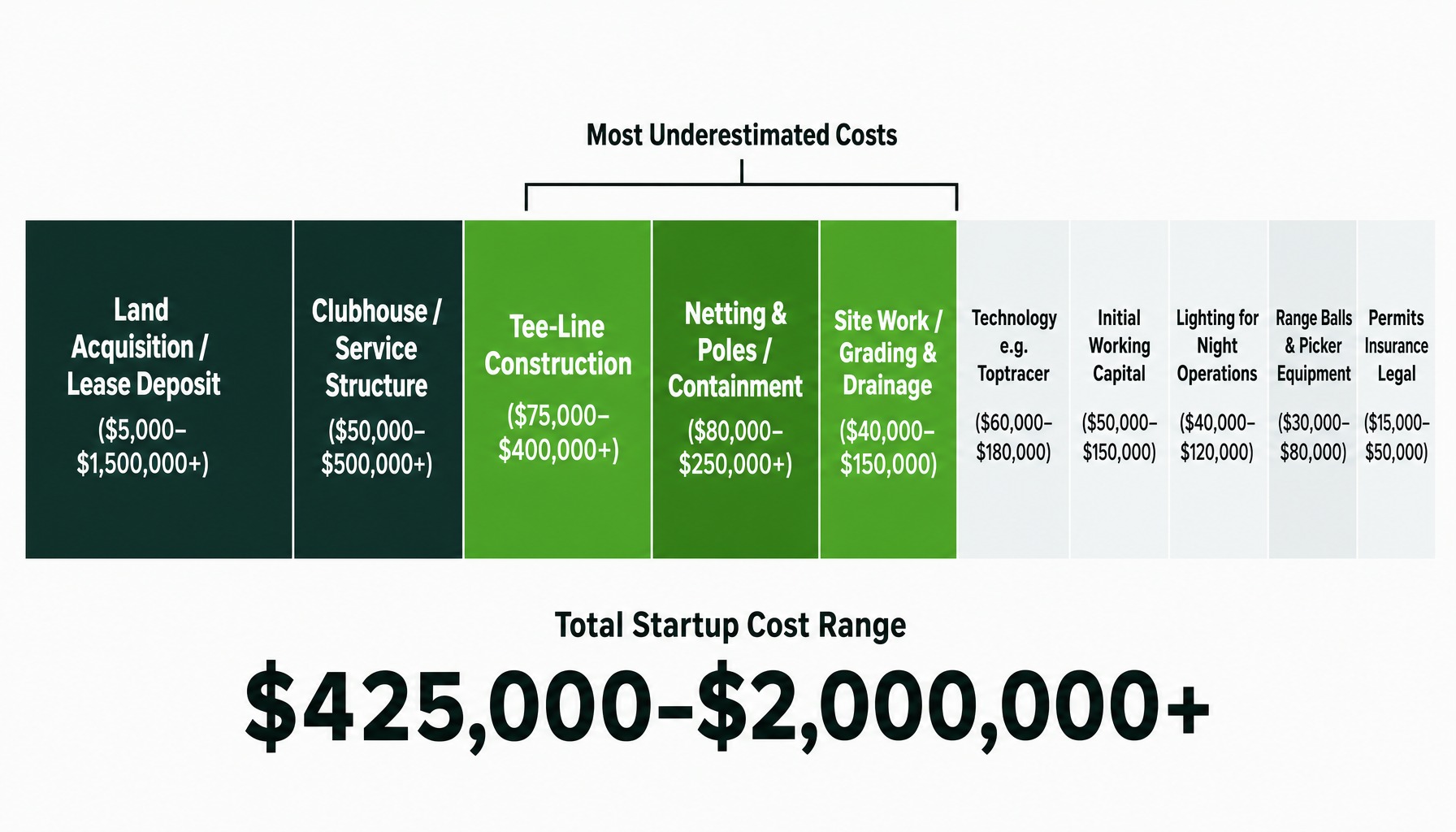
How much does it cost to open a driving range? Three categories are consistently underestimated.
Land: Lease vs. Purchase and Why It Changes Everything
The lease-versus-purchase decision is the single most consequential financial choice in your business plan. A land purchase, which can run from $500,000 to over $1.5 million for 8 to 15 acres in a desirable market, requires a completely different capital stack and financing structure than a long-term ground lease at $3,000 to $12,000 per month.
This choice cascades through your entire pro forma. A land purchase may require a larger down payment but builds equity and can be a significant asset upon exit. A lease preserves startup capital for equipment and operations but introduces long-term fixed costs and potential landlord complications. This decision heavily influences SBA loan eligibility, your facility’s cap rate valuation, and your ultimate exit strategy, as acquirers and golf-focused REITs evaluate owned-land and leased-land assets very differently. This isn’t a real estate preference; it’s a financial architecture decision.
The Costs Most Plans Underestimate: Netting, Drainage, and Tee-Line Buildout
First-time operators consistently get surprised by three cost categories. First is the ball flight containment envelope; netting and poles can easily run from $80,000 to over $200,000, depending on the required height and total perimeter. Second is site drainage. It’s not a glamorous expense, but poor drainage can shut down a grass tee or a muddy landing area for days after a storm, killing revenue potential faster than any equipment failure.
The third, and most strategically important, is the tee-line buildout itself. This includes the concrete pad, bay dividers, covered structures, and the hitting surfaces. The tee line is the factory floor of your business. Skimping on commercial-grade mats or forgoing automated teeing systems to save upfront capital can directly suppress the per-bay revenue your plan is projecting. A durable, high-throughput tee line isn’t a cost center; it’s the engine of your entire operation.
Why Your Utilization Projections Are Probably Wrong
The most common reason driving range business plans fail financial scrutiny is not that they underestimate costs it is that they overestimate utilization by 30–40%. Most pro formas apply a single, blended utilization rate (e.g., 65% of bays occupied during all operating hours) without modeling the dramatic difference between peak and off-peak demand. This is a fatal flaw.
A 20-bay range at 80% utilization from 4 PM to 7 PM on a Saturday and 15% utilization at 10 AM on a Tuesday produces a very different annual revenue number than a flat 65% assumption. Let’s do the math: a 20-bay range open 12 hours a day, 360 days a year has 86,400 available bay-hours. At an optimistic 65% utilization, that’s 56,160 occupied hours. At a more realistic 45% blended rate, it’s 38,880 hours. With an average bucket price of $15, that’s a revenue difference of over $250,000 per year. Your business plan must model utilization rate by daypart.
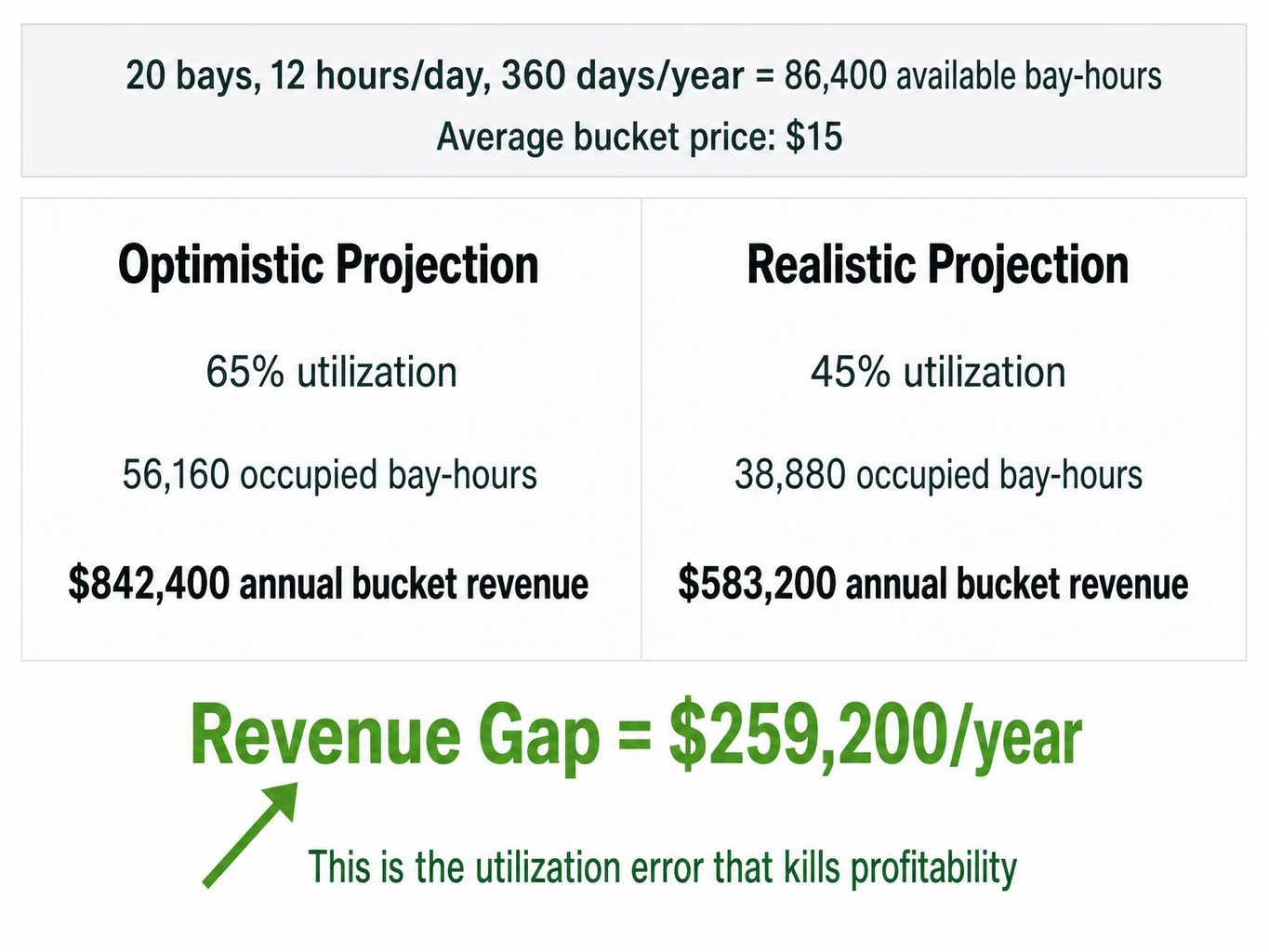
A 20-point utilization miss costs over $259K annually the core risk in any driving range business plan.
But even utilization is only half the equation. The other half is throughput: when a bay is occupied, how many balls does a golfer actually hit per hour? This is where the tee-line experience directly impacts your bottom line.
Daypart Yield Management: Pricing Tuesday Morning vs. Saturday Afternoon
Most ranges use a flat bucket pricing model, charging the same amount whether it’s a slow weekday morning or a packed weekend evening. This is a classic operational mistake that leaves significant revenue on the table. The solution is daypart yield management, a strategy borrowed from the airline and hotel industries. It involves using dynamic bucket pricing charging a premium during peak demand windows and offering discounts or loyalty incentives during slow periods.
This isn’t just about squeezing more from peak times; it’s about creating an incentive to fill empty bays during off-peak hours. For example, a facility that charges a flat $12 per bucket could instead charge $15 during peak hours (e.g., 4-8 PM weekdays, all day Saturday) and $9 during off-peak hours. This dual approach can increase average revenue per available bay and smooth demand curves. A well-designed pricing strategy can increase overall per-bay revenue by 20-30% without adding a single bay.
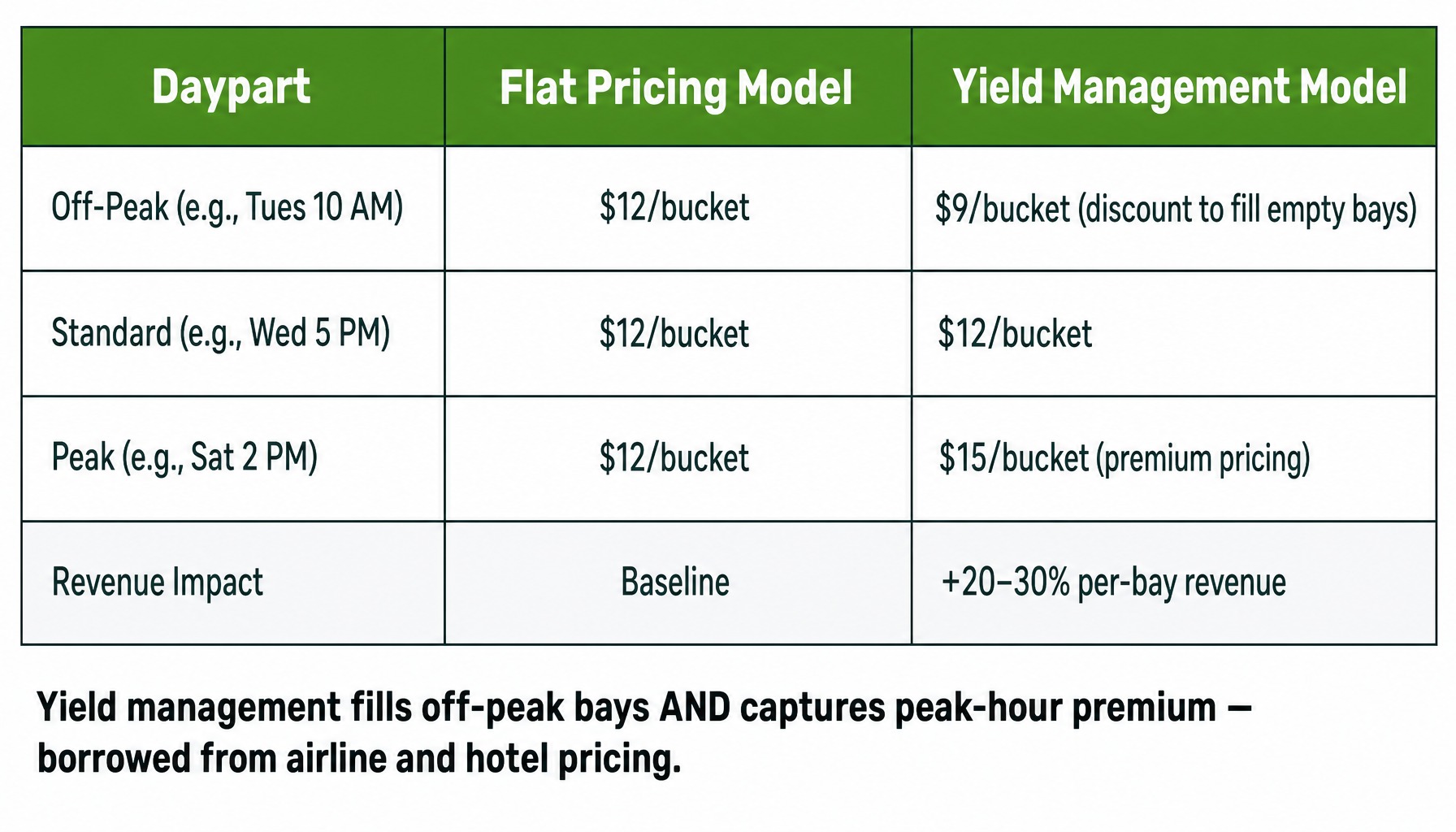
Daypart pricing can boost per-bay revenue 20–30% a must-model variable in your business plan.
Throughput Per Bay: How the Tee-Line Experience Affects Your Revenue Math
Throughput per bay per hour is a critical revenue variable that most business plans ignore entirely. The logic is simple: the more balls a customer hits in their session, the more revenue that bay generates. A golfer who must repeatedly break their stance, bend down, and manually tee each ball will hit roughly 60–80 balls in an hour. In contrast, a golfer using an automatic teeing system that presents the next ball instantly can hit 50% more shots in the same amount of time.
This difference in ball throughput compounds across every bay, every hour, every day. When building your financial model, your assumption for buckets sold per bay-hour is directly tied to the tee-line configuration you choose. A plan that projects high revenue but specifies a low-throughput, manual-teeing setup has a fundamental contradiction. The tee line is not a passive cost center; it is an active throughput multiplier that directly influences bucket pricing elasticity and revenue per occupied bay-hour.
Revenue Streams Beyond Bucket Sales
Bucket sales are the core revenue engine of a driving range, but the facilities with the strongest EBITDA margins treat the range as a platform for higher-margin ancillary revenue. A credible business plan must model these streams separately because their financial profiles are completely different. The three primary ancillary streams are food and beverage (F&B), instruction and player development, and memberships or loyalty programs. A plan that just lists these as “other income” is incomplete; a strong plan models the margin contribution of each and shows how they interact with core range utilization. Facilities often find that a premium practice experience encourages golfers to stay longer, which directly boosts ancillary spend.
Food and Beverage: The Margin Driver Most Plans Undermodel
For many modern ranges, F&B is not a “nice to have” it is the highest-margin revenue stream in the entire operation. While range ball margins are respectable, a well-run F&B program can achieve gross margins of 60–70%. Your business plan must account for the specific costs, including a liquor license (which can add $2,000–$15,000+ depending on state and municipality) and operational needs like staffing, kitchen equipment, and health department compliance. The business case for F&B is strongest when the core practice experience is compelling enough to keep customers on-site. A golfer who hits a bucket for 45 minutes and then stays for a beer and a sandwich generates two to three times the per-visit revenue of one who simply hits and leaves.
Memberships and Loyalty: Flattening Seasonal Revenue Dips
Membership and loyalty programs are financial engineering tools that create predictable, recurring revenue, smoothing the seasonal fluctuations inherent in the golf business. A pay-per-bucket model is volatile and weather-dependent. A membership model, where 200 members paying $79/month generate $15,800 in revenue regardless of rain or snow, provides a stable cash flow base to cover fixed costs like rent and debt service. The key risk is calibrating the pricing correctly. Membership tiers must be designed to reward frequency without allowing heavy users to erode per-ball margins or cannibalize revenue from walk-in customers during peak hours. When modeled correctly, memberships transform a transactional business into a relational one with a more defensible financial foundation.
How to Stress-Test Your Pro Forma Before Lenders See It
A pro forma financial statement is only as useful as the assumptions it stress-tests and most driving range business plans present a single base-case scenario that assumes everything goes right. Lenders and investors, especially those familiar with the SBA 7(a) loan program, want to see that you’ve prepared for adversity. Your plan must include a base case, a downside case, and a severe downside case.
Run these three stress tests on your model:
- The Utilization Miss: What happens to your cash flow if actual utilization is 30% below your projection for the first 18 months? Calculate the monthly cash burn under this scenario. This will determine the minimum working capital reserve you need to survive the soft opening ramp curve. If your base case shows break-even at month 14, but this downside case shows you run out of cash at month 10, your plan has a funding gap.
- The Ball Loss Problem: What happens if your annual ball loss rate is 8% instead of the 4% you projected? For a range with 30,000 balls, that’s an extra 1,200 balls to replace. Model the compounding cost of ball inventory replacement; it’s a small but persistent drain on cash.
- The New Competitor: What happens if a new range opens within your 10-mile competitive radius in year two? Model a 15-20% customer attrition rate and the impact on your revenue. How would you respond with pricing or loyalty programs?
The plan that survives this kind of scrutiny is the plan that gets funded. Your base case isn’t your worst case. Lenders know this. Your plan should show that you know it too.
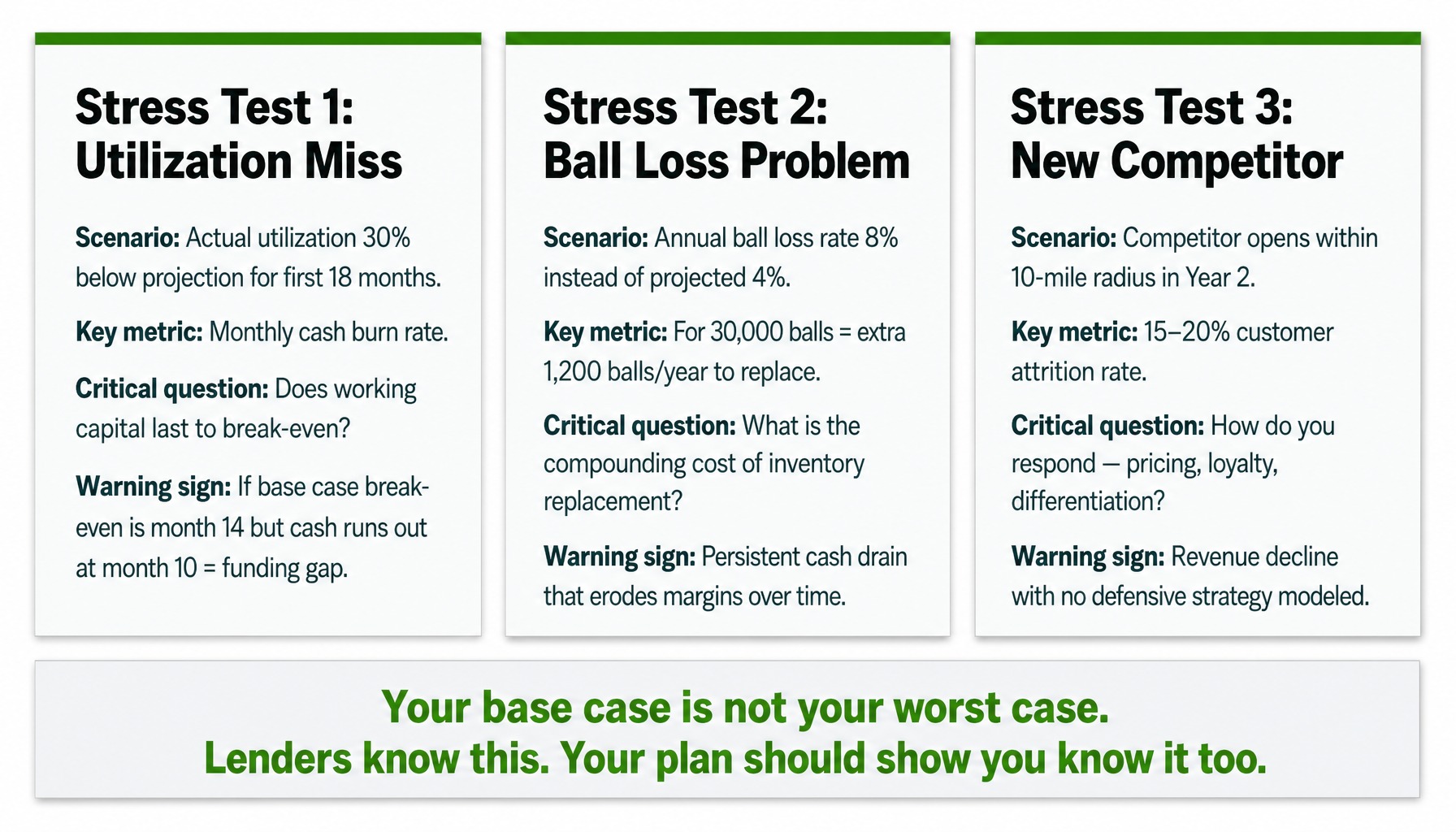
Stress-test these three scenarios before any lender sees your driving range business plan.
What a Failing Driving Range Business Plan Looks Like
The most instructive driving range business plans are often the ones that failed. Consider this composite scenario, based on common patterns seen across the industry:
An enthusiastic operator secures a loan based on a business plan with three critical flaws. First, they projected 65% utilization by copying the reported numbers from a successful tech-enabled range in another state, without adjusting for their own location’s demographics or traffic patterns. Second, they allocated 70% of their startup capital to land acquisition and the clubhouse, treating the tee-line buildout as a commodity and opting for basic mats and manual teeing to save money. Third, they set a single, flat price for a bucket of balls, with no daypart differentiation or loyalty program.
The result was predictable. Actual blended utilization hovered around 40%. The uninspired tee-line experience failed to build repeat business, and throughput per bay was low. The break-even point, projected for month 14, was pushed past month 22. The working capital reserve was exhausted by month 16, forcing the operator to seek additional, high-interest debt to stay afloat.
The transferable warning signs are clear: utilization assumptions based on someone else’s facility, tee-line investment treated as a line item instead of a revenue engine, and a rigid pricing model with no flexibility.
Building the Tee Line Into Your Business Plan as a Revenue Variable
This article has built a sustained argument that per-bay throughput is the most under-modeled variable in a driving range business plan. The physical experience on the tee line directly determines how many balls a golfer hits, which in turn dictates how many buckets are sold per bay-hour. The failure case above shows what happens when the tee line is treated as an afterthought.
This is where you can build a strategic advantage into your financial model. Power Tee’s automatic teeing system is engineered specifically to increase throughput. By eliminating the need for a golfer to break their stance and re-tee the ball, it creates a rhythm that allows them to hit more shots in the same amount of time.
When building your pro forma, the tee-line configuration you choose is a direct input to your revenue projection. A manual teeing setup supports a lower throughput assumption; an automated one supports a higher one. Some Power Tee customers have reported revenue increases of 30–50% after installation, along with corresponding growth in food and beverage sales because golfers enjoy the experience and return more frequently. These are facility-specific results, of course, and depend on many factors. The right first step is to model the potential impact for your unique facility.
Request a facility consultation to model how automatic teeing changes your per-bay revenue projections.
Conclusion
A driving range business plan that only models startup costs is half a plan. The other, more important half is the per-bay revenue model that determines whether those costs are ever recovered. The operators who build defensible, fundable plans are the ones who move beyond static cost estimates and engage with the dynamic variables of their operation.
They are the ones who stress-test utilization, model throughput per bay as a function of the tee-line experience, and build out ancillary revenue streams with a clear-eyed analysis of their margin contributions. They invest in the tee line as a revenue multiplier, not a commodity expense. Before submitting your plan to a lender, an investor, or even yourself, run the three stress tests outlined in this guide. Ask whether your tee-line configuration truly supports the throughput assumptions your revenue projections require. If it doesn’t, your plan has a gap that no amount of cost optimization can close.
Frequently Asked Questions
How much land do you need to open a driving range?
A standard outdoor driving range requires 8–15 acres minimum, including the hitting area (at least 300 yards of ball flight), tee line, parking, and any clubhouse structure. Zoning classification varies by municipality most ranges require a commercial or recreational conditional use permit, and environmental review may be triggered if the site is near wetlands or residential zones.
What insurance policies does a driving range need?
At minimum, a facility needs general liability ($1M–$2M per occurrence), property insurance covering structures and equipment, and workers’ compensation. If you have vehicles like ball pickers, you’ll need commercial auto insurance. Many operators also carry umbrella liability and business interruption coverage, with total annual premiums typically running from $8,000 to $25,000 for a mid-sized facility.
Can you run a driving range as a seasonal business and still profit?
Yes, but the business plan must account for 4–6 months of reduced or zero revenue in northern climates. Successful seasonal ranges typically have lower fixed costs (e.g., leased land) and must generate enough margin during the operating season to cover annual debt service. Installing covered and heated bays or building a strong membership base can help extend the season and provide more predictable income.
How many bays should a new driving range start with?
Most operators find that 15–25 bays is the minimum for a standalone range to achieve viable economics, though 30+ bays is common for facilities with integrated technology and significant F&B operations. Starting with fewer than 10 bays makes it very difficult to cover fixed costs unless the range is a small amenity attached to a larger golf facility or club.
What zoning classification is required for a driving range?
Driving ranges typically fall under “commercial recreation” or “outdoor amusement” zoning. Many jurisdictions require a conditional use permit rather than allowing it by-right, which involves a public hearing and detailed site plan review. It’s critical to consult the local planning department early, as zoning approval can take 3–12 months and may require traffic, noise, or environmental impact studies.
What technology should I install to compete with entertainment-golf venues in 2026?
Toptracer Range and TrackMan Range are the most adopted ball-tracking systems for commercial ranges, adding a digital experience layer that attracts a broader audience. Automatic teeing systems like Power Tee complement these technologies by increasing the pace of play and practice consistency. Plan for technology from day one building conduit and data infrastructure into the tee line during construction costs significantly less than retrofitting it later.


