


Key Takeaways
- Focus on balls-hit-per-year, not just rounds played, as the key metric for driving range health and revenue potential. A facility hitting over 800,000 balls annually is a strong investment candidate.
- Isolate range-specific operating costs during due diligence. Sellers often blend turf maintenance and labor into general overhead, hiding real expenses that will affect your pro forma.
- Prioritize a bucket-of-balls pricing model. It allows you to directly capture the revenue upside from tee-line improvements, unlike flat-rate membership models that cap earnings per customer.
- Sequence your capital improvements to fund range upgrades first. Tee-line automation can generate new cash flow in weeks, which can then help fund longer-term course renovations.
- Evaluate the tee line for deferred CapEx. The true cost of an acquisition includes the worn-out mats, aging dispensers, and poor drainage the seller hasn’t addressed.
When you’re evaluating a golf course acquisition, the process feels familiar. You walk the fairways, inspect the greens, and scrutinize the financials for rounds played and green fee trajectory. But a common mistake happens on the way back to the clubhouse: the driving range gets a quick glance, noted as an amenity rather than evaluated as a revenue line in its own right.
Imagine closing on a course with a 20-bay range. The numbers look solid. Six months later, you realize the mats are worn to the fiber, the ball dispenser is unreliable, and bay utilization never breaks 40% on a good day. The bucket price hasn’t changed in five years. You’ve inherited an asset with real upside but also a host of deferred problems.
Many buyers treat the range as an afterthought. They focus on the course, but the driving range is often the highest-margin, most improvable asset in the portfolio and the one most likely to have hidden costs buried in the seller’s pro forma.
This guide provides a practical framework for operators and management groups adding a golf facility to their portfolio. We’ll cover how to evaluate driving range revenue potential during due diligence, identify the hidden costs that distort projections, and sequence capital improvements to generate cash flow from the range before you ever break ground on the bunkers.
Why the Driving Range Is the First Line Item to Evaluate
The first step in a smarter acquisition process is to decouple the range from the course in your financial analysis. While rounds-per-year is the standard metric for course health, it tells you almost nothing about range profitability. The real indicators of a strong range operation are ball volume and the pricing model used to capture its value.
Facilities hitting 800,000 or more balls per year represent a throughput volume where tee-line condition directly governs revenue per bay. Buyers who skip a detailed tee-line condition assessment during due diligence are effectively underwriting a revenue ceiling they haven’t measured. A range hitting 1.2 million balls at $12 per bucket is a fundamentally different asset than one hitting 500,000 balls at $8, even if their green fee revenues are identical. That distinction rarely appears clearly in a seller’s prospectus.
Balls-Hit-Per-Year: The Acquisition Metric That Matters More Than Rounds Played
Rounds played captures course utilization but completely masks range performance. A club doing 35,000 rounds annually could have a range that’s thriving or one that’s losing customers daily; the rounds metric won’t tell you which.
The most reliable indicator of range health is balls-hit-per-year. This single metric reveals actual customer demand, engagement, and the facility’s true revenue capacity. During due diligence, you should request this data directly from the seller’s point-of-sale (POS) system, specifically looking at bucket revenue reports. If that’s unavailable, you can estimate it by analyzing ball inventory turnover and range picker cycle times.
Once you have the number, use it to frame the rest of your review. At high volumes, infrastructure investments have a measurable payback, so your next questions should be about the physical condition of the tee line and the pricing model, because that’s where the upside is.
Bucket-of-Balls Pricing vs. Range Memberships: Which Model Maximizes Post-Acquisition Revenue
The range’s pricing model determines how effectively you can capture revenue from increased utilization. A bucket-of-balls model is the most direct way to monetize throughput, as every additional ball hit can generate incremental revenue.
In contrast, flat-rate range memberships provide predictable cash flow but cap your revenue per customer, regardless of how much they practice. A member might hit twice as many balls after you upgrade the tee line, but your revenue from that customer remains fixed.
For a buyer evaluating post-acquisition upside, a bucket pricing structure creates a direct link between tee-line improvements and revenue growth. Consider a simple scenario: if you improve the practice experience and golfers hit 50% more balls, a bucket model captures that value immediately. A membership model captures it less directly, through new sign-ups rather than per-ball revenue. When evaluating a target facility, look for a bucket-of-balls system or be prepared to transition to one so range revenue can grow with utilization.
What Due Diligence Actually Looks Like for a Range Attached to a Golf Course
Most due diligence checklists for buying a golf course focus heavily on course agronomy and infrastructure greens, fairways, and irrigation systems. The range tee line often gets a cursory walkthrough at best. This is a critical oversight. The range is where deferred maintenance is most likely to hide and where the fastest post-acquisition revenue improvements are possible.
A proper evaluation requires two parallel tracks: a physical infrastructure assessment and a thorough market demand analysis. Alongside both, isolate range-specific costs in the seller’s financials, because blended line items are where buried costs tend to hide. One buyer we advised was looking at a 27-hole club with a 20-bay range. The seller’s pro forma lumped all turf maintenance into a single line item. It was only after closing, when we isolated range-specific costs for the first time, that the new owner discovered that mat replacement, ball picker fuel, and tee-line repairs accounted for nearly 40% more annual spend than the blended number suggested. That kind of buried cost changes the entire payback calculation on any post-acquisition capital plan.
Facility Condition Assessment: Tee Line, Mats, Dispensing, and Bay Layout
Your physical assessment of the range should be as rigorous as your inspection of the greens. Start with the basics: what is the total tee line linear footage and the nominal bay count? More importantly, how many of those bays are consistently usable? Balls-hit-per-bay-per-hour is a more diagnostic metric than total volume because it exposes whether low revenue is a demand problem or a throughput constraint caused by tee-line friction.
Walk the line and evaluate these specific elements:
- Mat Condition: Are the hitting surfaces providing a consistent, firm feel, or are they worn, uneven, or so thin that golfers avoid certain bays? Check for wear patterns that indicate a poor mat rotation schedule.
- Teeing System: Does the facility use manual range tees and rubber trays, or does it have an automated system? The setup signals the facility’s current investment level and the quality of the customer experience.
- Ball Dispensing & Retrieval: Observe the ball dispenser. Does it function reliably, or does it require staff intervention? Time the range picker cycle during a busy period. Can the facility retrieve and wash balls fast enough to keep the dispenser full?
- Agronomics & Drainage: For any grass tee areas, an agronomic assessment is essential. Check for drainage issues across the entire tee line, as water pooling can render bays unusable after rain.
Market Demand Analysis: Is There Enough Volume to Justify the Investment?
A physically sound range cannot deliver returns without sufficient market demand. Your due diligence must confirm that the local area can support the ball volume needed for profitability.
Use tools like the National Golf Foundation (NGF) and its GolfMAP system to analyze:
- Population Density: How many people live within a 5, 10, and 15-mile radius?
- Golfer Demographics: What is the concentration of golfers in the area, and what are their spending habits?
- Competition: How many other public-access ranges are competing for the same customers?
- Growth Trends: Is the local population growing or contracting?
This analysis helps you answer a critical strategic question: is the facility’s current ball volume constrained by a lack of demand, or is it constrained by a poor practice experience? A range located in a strong, growing market but suffering from poor infrastructure is often a better acquisition target than a pristine facility in a declining market. The former has correctable problems; the latter has market-level challenges that are much harder to overcome.
Hidden Costs That Change the Pro Forma
The seller’s pro forma is a starting point, not the final word. When buying a golf course, assume that the reported range operating costs are understated. This usually happens in two ways: critical expenses are averaged across the entire facility, or necessary capital expenditures have been deferred for years, leaving the bill for you to pay. A range that appears to generate a healthy profit on paper might be carrying significant hidden costs that will immediately impact your net operating income (NOI).
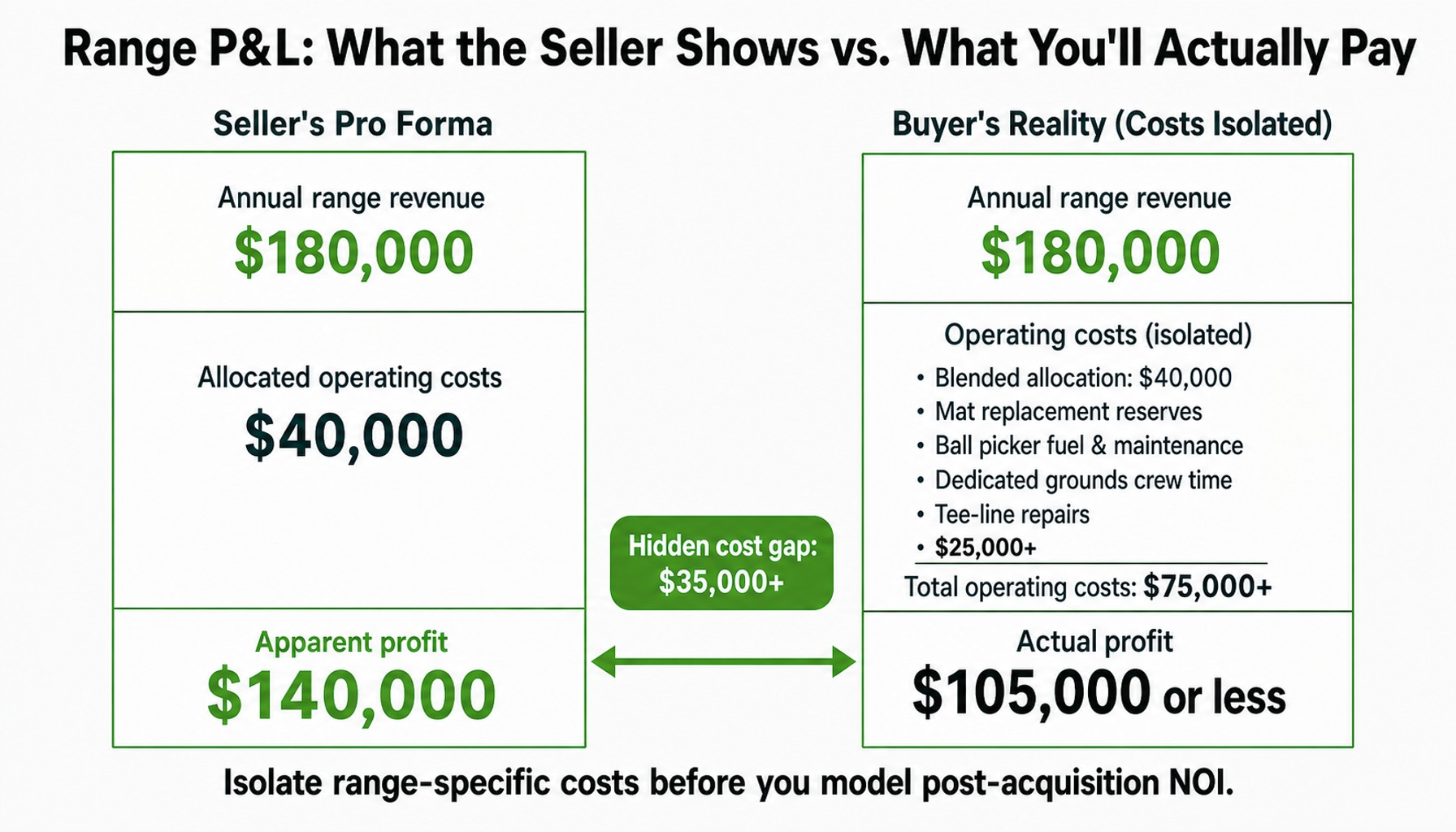
For example, a seller’s pro forma might show $180,000 in annual range revenue against $40,000 in allocated costs, suggesting a $140,000 profit. But after isolating the true costs including a dedicated portion of the grounds crew’s time, mat replacement reserves, and ball-picker maintenance the real operating expense could easily be over $75,000, cutting the actual margin significantly before you even account for future capital needs.
Turf Maintenance and Labor: The Range Cost Buyers Miss
For facilities with natural grass teeing areas, turf maintenance is one of the largest hidden costs. A grass tee line requires a dedicated rotation schedule, constant divot repair, reseeding, fertilization, and irrigation. These activities consume a significant portion of the agronomic budget, but they are rarely broken out from general course maintenance in a seller’s financials.
Labor is the other major hidden expense. Staff time spent rotating mats, repairing grass tees, and keeping the tee line clean adds up quickly. During due diligence, ask the superintendent or range manager specific questions to isolate these costs, because they belong in your pro forma as range-specific expenses rather than buried in general overhead. This is also where the practice platform matters: some Power Tee customers report saving $25,000 or more a year on turf maintenance and labor after moving practice onto the Power Tee platform.
Deferred CapEx: What the Seller Is Not Telling You About the Tee Line
Deferred capital expenditure (CapEx) is the most common and costly surprise for new golf course owners. In the years leading up to a sale, it’s common for operators to postpone major investments to maximize short-term cash flow. The range tee line is often the first place these cuts happen.
During your site visit, look for the tell-tale signs of a deferred CapEx backlog:
- The stated age of the hitting mats is over five years.
- Multiple bays are consistently out of service.
- The ball dispenser or other range equipment looks dated and worn.
- There is no record of significant range investment in the last 3-5 years.
Quantify this backlog by getting quotes for necessary upgrades. A range that needs $75,000 in tee-line improvements within 18 months of closing effectively increases your acquisition cost by that amount. This figure should be factored directly into your offer price or negotiated as a seller concession.
How Range Automation Changes the Revenue Model Post-Acquisition
Identifying the range’s revenue potential is one thing; capturing it is another. Capturing it depends on upgrading the tee-line infrastructure to support higher throughput and a better customer experience. This is where commercial-grade automatic teeing comes into the picture.
The mechanism is straightforward: when golfers practice on an automatic teeing system, the next ball is teed up automatically, so they stay in rhythm. As a result, they tend to hit more balls in the same amount of time. In a bucket-of-balls model, this increased throughput translates directly to more buckets sold and higher revenue per bay. Power Tee customers often see range revenue rise by 30-50%, which is consistent with that throughput effect.
This improved experience also drives foot traffic and customer visits, leading to more ancillary spend on food and beverage. Furthermore, modern range automation is fully compatible with ball tracking technology like Toptracer, TrackMan, and InRange. When facilities layer ball-tracking technology onto a manual tee line, golfers tend to hit fewer balls per session because screen engagement slows the pace between shots. Automatic teeing counteracts that by reducing the dead time between swings, which helps preserve ball volume even as screen time increases. With Toptracer specifically, golfers slow down as they watch each shot on screen, and Power Tee speeds up play between hits by teeing the next ball automatically, which offsets that slowdown.
Sequencing Capital Improvements: Range First, Course Second
After an acquisition, many new owners make the same capital allocation mistake: they pour their entire budget into course renovations like bunker rebuilds or green resurfacing. While aesthetically pleasing, these projects are expensive, take holes out of play, and are slow to generate a return.
A more financially astute strategy is to sequence your capital improvements to focus on the range first. Here’s why:
- Faster ROI: Range upgrades, particularly tee-line automation and new mats, can begin generating incremental revenue within weeks of installation.
- Less Disruption: Unlike a major course renovation that may require closing holes, range bays can be upgraded on a rolling basis, keeping the facility operational.
- Self-Funding Growth: The new cash flow generated from the improved range can be used to help fund the longer-term, more expensive course projects.
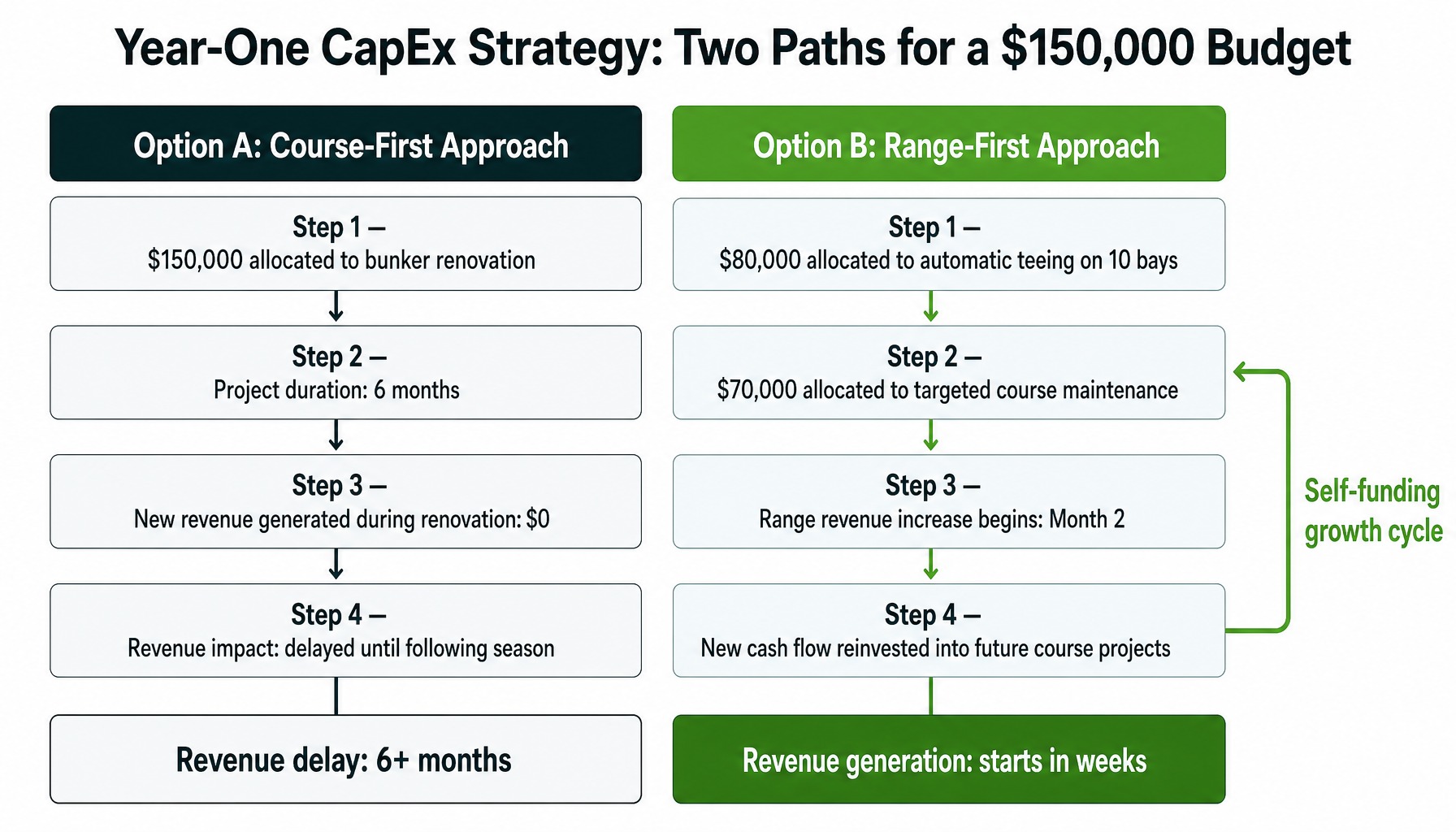
Consider a buyer with a $150,000 CapEx budget in year one. Option A is to spend it all on a bunker renovation project that takes six months and generates no new revenue until the following season. Option B is to allocate $80,000 to installing automatic teeing on 10 bays and use the remaining $70,000 for targeted course maintenance. In this scenario, Option B starts generating higher range revenue by the second month, creating positive cash flow that can be reinvested back into the property.
How Power Tee Fits Into a Post-Acquisition Range Strategy
The analysis points in one direction: the driving range is often undervalued in golf course acquisitions, and the tee line is where revenue improvements tend to come first. The question for a new owner is what specific infrastructure makes that opportunity real.
Power Tee is one system built for that purpose: a patented auto-tee platform designed for constant daily commercial use. Each installation includes the teeing hardware, Strike Mat and Standing Mat surfaces, and professional installation for new or existing bays, with most parts covered under our ongoing support service.
For owners comparing tee-line systems, the main alternatives are Range Automation Systems (RAS), Wittek, and Range Servant. Wittek and Range Servant setups pair hitting mats with ball trays or manual range tees rather than automatic teeing. Mat performance is worth checking during your evaluation: MyGolfSpy has reported golfer complaints about Wittek mats, including turf bounce, limited forgiveness on fat shots, and wear in the foam layer. For facilities running Wittek systems, Power Tee is an all-in-one replacement for their mats and trays, combining premium mat surfaces and automated teeing in a single system.
For a buyer who has just closed on a facility, our process is consultative and facility-specific. We evaluate your bay count, layout, ball volume, and project goals to determine the right fit. The goal is to provide the infrastructure that captures the revenue upside you identified during due diligence. We also offer a residential option, Power Tee Home, though the commercial platform is the relevant system for a range acquisition.
For context on our proof of scale: 8M+ balls, 200+ ranges, 30 years, 18 countries, and 80%+ of UK ranges.
Conclusion
When buying a golf course, the most important shift in thinking is to see the driving range not as a secondary amenity but as one of the highest-margin, most improvable profit centers in the operation. Properly evaluating its potential during due diligence can change your entire acquisition thesis.
Most buyers focus on rounds played and green fees. But the operators who build the strongest post-acquisition returns are the ones who dig deeper. They evaluate balls-hit-per-year, isolate the true range operating costs hidden in blended financials, and sequence their capital to upgrade the tee line first.
The next time you walk a facility you’re considering buying, spend as much time analyzing the tee line as you do on the 18th green. That is where the hidden costs and the most immediate revenue upside are waiting to be found.
Frequently Asked Questions
What is the typical cap rate for golf course acquisitions?
Cap rates for golf courses vary widely based on location, condition, and revenue stability, but typically range from 8% to 14%. Golf assets generally trade at higher cap rates than other commercial real estate due to their operational complexity and seasonal risk. It is critical for buyers to normalize the seller’s Net Operating Income (NOI) before applying a cap rate, as reported income often includes deferred maintenance savings and understated labor costs that inflate apparent profitability.
How does ball tracking technology like Toptracer or TrackMan affect range revenue?
Ball tracking technology enhances customer engagement and can justify premium pricing per bay. However, systems like Toptracer often slow down the rate of play as golfers watch the screen between shots, which can negatively impact ball throughput in a bucket-of-balls model. Automatic teeing systems such as Power Tee work well with simulator technology, including Toptracer, TrackMan, and InRange. Pairing automatic teeing with ball tracking offsets the pace reduction by shortening the time between hits, which helps maintain ball volume alongside the tech-enhanced experience.
Should I buy a golf course with an existing driving range or build one from scratch?
Acquiring a facility with an existing range is almost always more cost-effective. Building a new 15+ bay range with netting, lighting, and retrieval infrastructure can cost anywhere from $500,000 to over $1.5 million. The main exception is if the existing range has fewer than five bays or is sited in a way that makes expansion impossible, in which case building new may be the better choice, and those construction costs must be factored into your acquisition pro forma.
How do I evaluate whether a golf course driving range needs a tee line upgrade?
Look for three key signals during your site visit. First, check for mat surfaces that are visibly worn, inconsistent, or clearly avoided by golfers. Second, assess the teeing setup; if it uses manual range tees or rubber trays, it’s interrupting practice rhythm and limiting throughput. Finally, if bay occupancy is low despite adequate local demand, the tee-line experience is likely a constraint. A facility-specific consultation can help quantify this performance gap and model the revenue impact of an upgrade.


