


Key Takeaways
- As a working estimate, a profitable U.S. driving range with 20-40 bays can generate $400,000 to $1,000,000+ in annual ball sales, with net margins of roughly 15-30% before debt service.
- The most important metric isn’t total revenue; it’s bay-hour yield the revenue generated per bay, per hour of active use. This is a direct measure of throughput.
- Manual range tees create a throughput ceiling, adding dead time to every bucket and suppressing bay-hour yield across the entire facility.
- In Power Tee’s experience, per-bucket pricing generates more revenue than flat-rate memberships, especially when paired with technology that increases balls hit per session.
- Tee-line configuration affects the core drivers of profitability: ball throughput, labor costs, and turf maintenance.
Many driving range operators believe the path to higher profits runs through an expanded food and beverage menu, a new patio, or a complex loyalty program. They make these investments only to find that revenue per bay has barely moved. The question, then, is are driving ranges profitable if these common strategies don’t reliably increase the bottom line?
The answer is yes, but the lever for profitability is rarely found on the menu. It’s found at the tee line.
Driving range profitability is fundamentally a throughput problem. Most publicly available advice focuses on ancillary revenue while ignoring the core operational mechanics that determine whether each bay generates enough ball sales per hour to be profitable. This article provides realistic revenue and margin benchmarks for U.S. facilities, an introduction to the bay-hour yield metric, a breakdown of the five cost categories that compress margins, and a look at the tee-line decisions that directly move the numbers.
How Much Does a Driving Range Actually Make?
As a working estimate, a standalone U.S. driving range with 20-40 bays can generate between $400,000 and $1,000,000+ in annual gross revenue from ball sales alone. At well-run, high-traffic locations, total facility revenue including lessons, retail, and food and beverage can reach $1,000,000 to over $2,000,000.
That’s a wide spread, driven by four key variables: geographic market and population density, bay count, annual ball volume, and pricing strategy. The profit margin is just as variable. Efficiently run standalone ranges often see net margins between 15% and 30% before debt service. However, facilities with high turf maintenance costs, underutilized bays, or a poorly structured pricing model can see those margins compressed to single digits.
The core insight is this: revenue is a function of balls sold, and balls sold is a function of how many golfers hit how many balls per hour. Consider a 30-bay facility selling 1.5 million balls per year at an average of $0.30 per ball (a $12 bucket of 40 balls). This facility generates roughly $450,000 in annual ball revenue. But if that same facility, through operational improvements, sells 3.0 million balls at the same price, it generates $900,000 with nearly identical fixed costs. The difference is not pricing; it’s throughput.
The Metric That Matters More Than Total Revenue: Bay-Hour Yield
Most operators track total monthly revenue but can’t diagnose whether underperformance is a demand problem or a throughput problem. That blind spot can quietly cost a 30-bay facility tens of thousands of dollars a year in unrealized capacity. The metric that closes this gap is bay-hour yield.
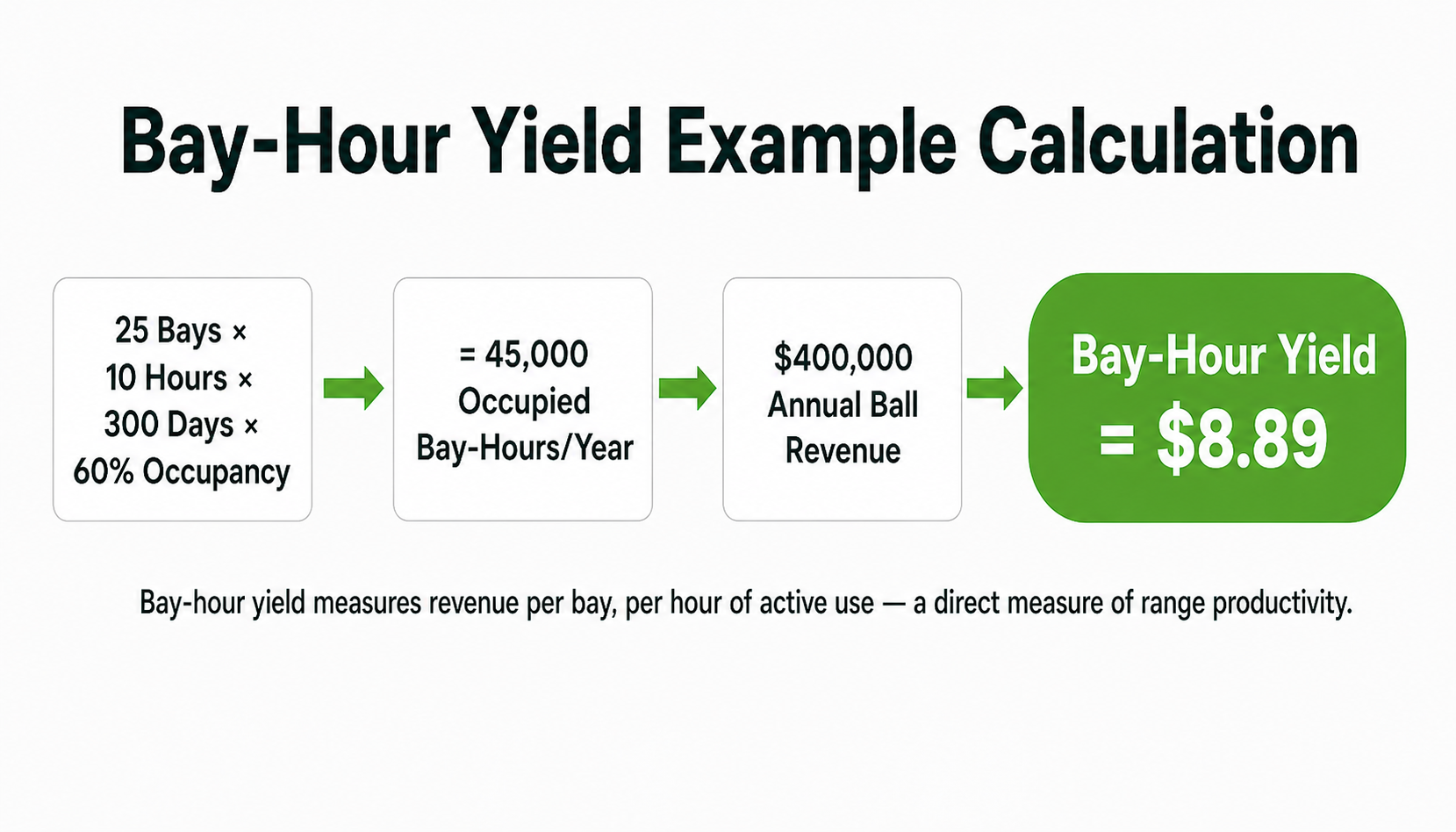
Bay-hour yield is the revenue generated per bay, per hour of active use. It cuts through the noise of total sales to reveal how productive each hitting bay actually is.
Here’s a practical example: A 25-bay range is open 10 hours a day, 300 days a year. At an average occupancy of 60%, the facility has 45,000 occupied bay-hours annually (25 bays x 10 hours x 300 days x 0.6). If annual ball-sale revenue is $400,000, the bay-hour yield is $8.89.
This number shows how productive each occupied bay is in revenue terms. It’s also the metric most directly affected by what happens at the tee line. If golfers hit more balls per session because they spend less time on manual setup, bay-hour yield rises without adding bays, hours, or staff. Bay-hour yield separates a range that just covers its costs from one that generates real operating profit. It’s important to note that bay-hour yield and bay utilization rate measure fundamentally different things; a range can have high utilization with low yield if golfers occupy bays for long sessions but hit relatively few balls.
Why Manual Range Tees Are a Yield Constraint
The configuration of your tee line places a hard ceiling on your facility’s throughput. Manual range tees are the most common constraint. Every time a golfer stops to re-tee by hand, the bay is occupied but generating zero revenue. Across a full bucket, those interruptions add up to minutes of dead time and break the golfer’s rhythm.
Across a busy tee line, this dead time compounds into thousands of dollars in lost potential revenue per year. This isn’t a minor convenience issue; it’s a direct operational drag on bay-hour yield. Reducing this non-hitting portion of the ‘stall dwell time’ the total time a golfer occupies a bay is one of the most direct ways to improve yield without raising prices or extending operating hours.
Five Operating Costs That Compress Driving Range Margins
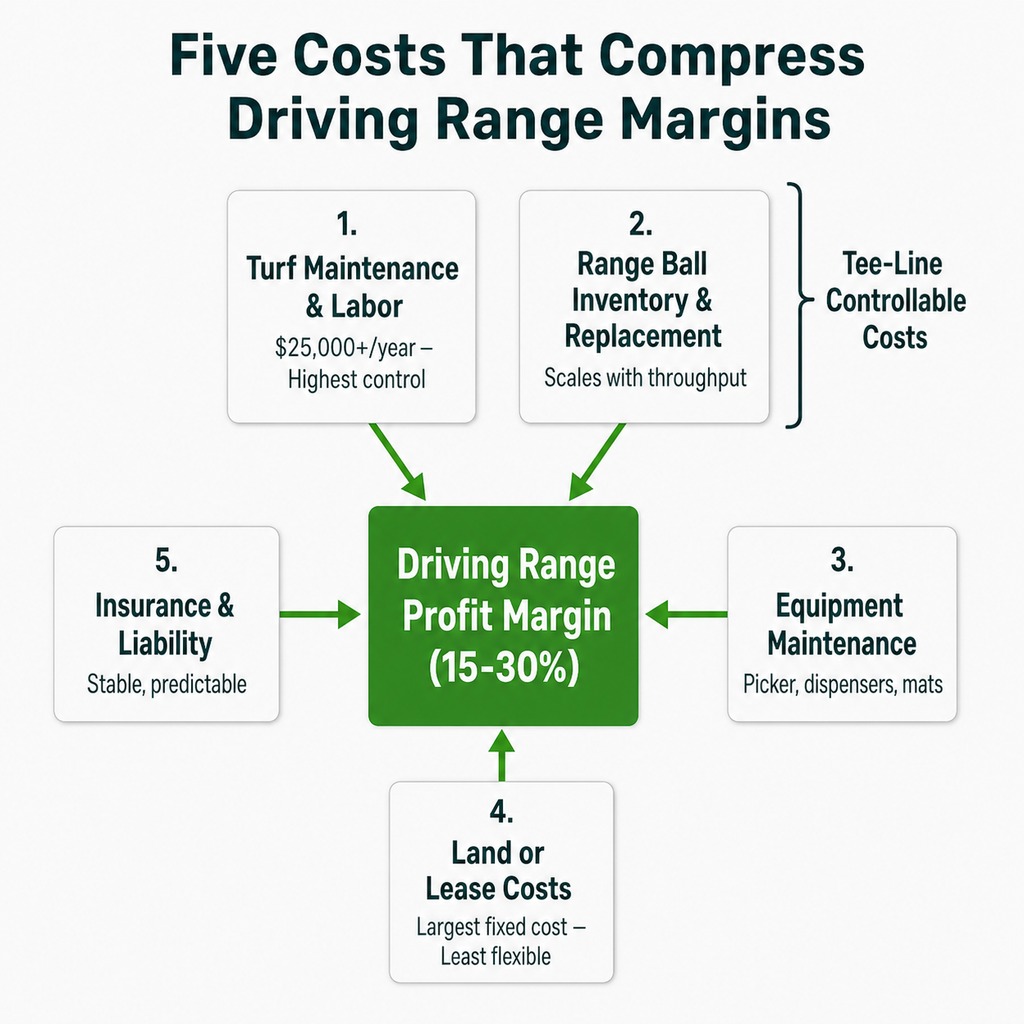
While revenue potential is driven by throughput, profitability is determined by how well you manage costs. Most operators can recite their revenue but underestimate how five specific cost categories erode their driving range profit margin:
- Turf maintenance and labor
- Range ball inventory and replacement
- Equipment maintenance (picker, dispensers, mats)
- Land or lease costs
- Insurance and liability
Land/lease costs are typically the largest fixed expense with the least flexibility, while insurance is a stable and predictable line item. The real opportunity for margin improvement lies in the variable costs you can control specifically, the two most misunderstood categories directly tied to your tee line.
Turf Maintenance and Labor: The Line Item Most Operators Underestimate
Consider a municipal facility with 24 bays and a healthy-looking $380,000 gross that quietly spends $68,000 a year on range attendant labor and turf repair on the tee line alone. The director presents the range as profitable, but once those tee-line costs are isolated from the general grounds-keeping budget, the operating margin on ball sales plummets.
This is the cost category most directly impacted by tee-line configuration. Grass tee lines require constant divot repair, turf rotation, and labor-intensive maintenance. Low-quality mats lead to frequent replacement cycles and deter repeat customer visits.
Some Power Tee customers report saving $25,000 or more a year on turf maintenance and labor after installing Power Tee.
Range Ball Inventory: The Cost That Scales With Success
Higher ball throughput drives revenue, but it also increases ball replacement costs, picker cycle times, and ball washer demands. A facility hitting 1.5 million balls per year will naturally have a higher ball-replacement budget than one hitting 800,000.
However, this is a cost that scales with success, not a problem to be avoided. The marginal revenue from an additional ball sale far outweighs the marginal cost of that ball. The key is to manage this cost through efficient range ball inventory management, not by suppressing the throughput that drives your primary revenue stream. The economics favor tee-line decisions that support higher ball volume.
Revenue Levers Operators Actually Control
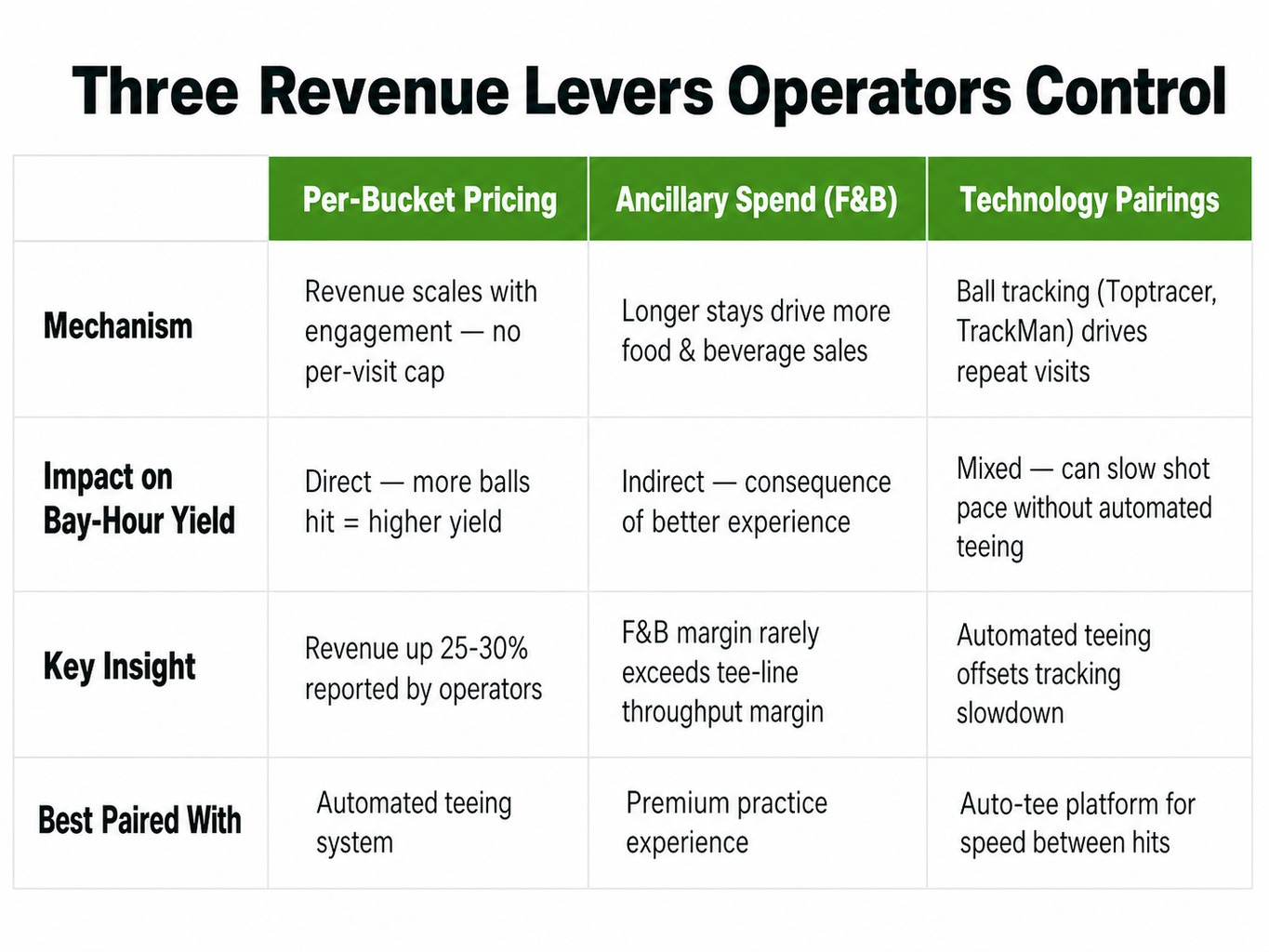
Beyond adding bays, operators have three primary levers to increase how much a driving range makes: pricing structure, ancillary spend, and technology pairings.
First is pricing structure. Power Tee is a driving range technology with a clear commercial upside across different facility models. For facilities that charge per bucket, the revenue impact is easy to see because bucket sales scale with engagement, and golfers who stay in rhythm and hit more balls tend to buy more buckets. It is also highly profitable for facilities that do not sell buckets, including country clubs, resorts, and membership-based facilities, where it supports repeat visits, member retention, and additional food and beverage or retail spend.
Second is ancillary spend. Ancillary revenue from food and beverage is frequently cited as the path to range profitability, but it works best as a result of a strong practice experience, not a substitute for one. Facilities where golfers enjoy the practice experience and stay longer generate more F&B revenue as a natural consequence.
Finally, technology like Toptracer, TrackMan, or InRange can drive repeat visits. However, this technology can also slow the rate of shots as golfers watch the screen. An automated teeing system speeds up play between hits, offsetting this potential throughput loss.
How Seasonality Affects Driving Range Profit Margins
For U.S. driving ranges in northern and midwestern markets, seasonality is a primary factor in annual profitability. These facilities can see steep revenue drops during winter months, compressing margins even when summer is strong. A range that looks highly profitable in July may barely break even on an annualized basis.
The key to managing this is shoulder-month stabilization. The operational decisions you make to keep foot traffic and customer visits consistent during the variable weather of spring and fall are critical. The quality of the tee-line experience is a major factor in this retention. Golfers are far more likely to make a trip on a cool October evening if they know the practice experience will be consistent and engaging, helping to smooth out the revenue valleys that define a seasonal business.
How Automatic Teeing Changes the Profitability Math
The profitability of a driving range depends on bay-hour yield, which is dictated by ball throughput. Manual range tees and inconsistent surfaces put a hard cap on that throughput.
Power Tee’s patented auto-tee platform addresses that constraint on three fronts. First, by automatically teeing a ball at an adjustable height, it eliminates the 3-5 seconds of dead time between shots, directly increasing balls hit per session; Power Tee reports golfers hit 50% more balls when using the system, which raises bay-hour yield. Second, the strike mat and standing mat surfaces are designed for constant daily use, reducing the turf maintenance and labor costs that compress margins. Third, it is fully compatible with Toptracer, TrackMan, and InRange tracking. Installations are backed by Power Tee’s ongoing support service, which matters for a tee line that runs every operating day.
Power Tee customers often report range revenue rising by 30-50%, along with more foot traffic and repeat visits. Power Tee also offers a residential option, Power Tee Home, though the economics in this article apply to commercial tee lines.
Operators comparing tee-line systems will typically weigh Power Tee against three alternatives. Range Automation Systems (RAS) also offers an auto-tee, so operators should compare reliability records and mat quality directly. Wittek and Range Servant do not offer auto-tee technology; golfers on those tee lines work from a ball tray or range tees. Power Tee’s case rests on its own record: a patented auto-tee platform built for constant daily use, premium mat surfaces, and an ongoing support service. For facilities running Wittek systems, Power Tee is an all-in-one replacement for their mats and trays, combining premium mat surfaces and automated teeing in a single system.
Operators who want to see how automatic teeing would affect their own bay-hour yield can visit the Power Tee contact page to book a virtual demo.
The spread between a struggling range and a successful one is rarely a matter of marketing or menu changes; it’s driven by bay-hour yield. The costs that truly matter turf maintenance, labor, and ball inventory are all directly influenced by tee-line configuration.
Operators who manage the tee line as a core operating decision, rather than a commodity purchase, are better positioned to improve their profitability numbers over the next 12 months.
Frequently Asked Questions
How many balls per year does a driving range need to sell to be consistently profitable?
While it depends on pricing and operating costs, 800,000 balls per year is a practical threshold for U.S. driving ranges. Below this volume, many standalone facilities struggle to cover fixed costs and generate meaningful operating profit. If your facility is below this mark, first evaluate whether your tee-line setup is limiting throughput before concluding the market is too small.
How do entertainment-format golf venues compare in profitability to traditional driving ranges?
Entertainment-format venues can generate higher per-visit revenue through premium pricing and integrated F&B. However, they also carry significantly higher capital costs, staffing needs, and technology maintenance overhead. A well-run traditional range that focuses on increasing ball throughput can achieve comparable or even superior net margins with lower operational complexity. It is a business model decision, not a simple profitability contest. Traditional ranges can add some of that entertainment appeal with ball tracking systems such as Toptracer, TrackMan, or InRange, and an auto-tee such as Power Tee is fully compatible with those tracking systems.
What is a realistic payback period for upgrading a driving range tee line?
The payback period depends on the number of units installed, facility traffic, bucket pricing, and the resulting revenue lift. The revenue lift associated with automated teeing, which Power Tee customers often report at 30-50%, can shorten payback, but the timeline varies by facility. Operators should model the return based on their own P&L to arrive at a facility-specific financial projection.


